
How Does Traffic Arbitrage Work and How Can Marketers Run Profitable Campaigns in 2025?

Traffic arbitrage is the practice of buying traffic from one source, redirecting it through strategically crafted funnels, and then earning revenue by sending that traffic to a feed provider or advertiser who pays more for higher-quality or more targeted clicks.
Success in traffic arbitrage depends on accurate tracking, understanding your sources, and efficiently qualifying visitors to maximize profit margins. Dedicated tools offer advanced tracking and automation, enabling marketers to analyze, optimize, and scale arbitrage campaigns with confidence and compliance.
Traffic arbitrage is an additional way of monetizing traffic that comes with its own perks and challenges that will be discussed in the article below.
How Does Traffic Arbitrage Work?
The typical marketing scenario looks like this:
- An ad is displayed to an audience outlined in a traffic source’s setup.
- A click on this ad sends a visitor to a landing page, and later to the offer page – provided that this visitor demonstrates an interest in it.
- A tracker records all these events.
Can you see the flaw in this scenario?
Sure you do, you are a smart marketer. After all, you are reading this article!
But let’s write this clearly for your not-so-wise friend that is reading this text with you.
The flaw is that you can’t really tell what your audience is really interested in. You assume that some general criteria are enough to define their intent:
- People that have Samsung Galaxy phones want cases for their phones, right? That sounds reasonable.
- iPhone users should be interested in crypto offers, right? Why not others? Why them? It is more of a gut feeling.
- Hmm, who should be the target for house security offers? Gaming affiliate programs?
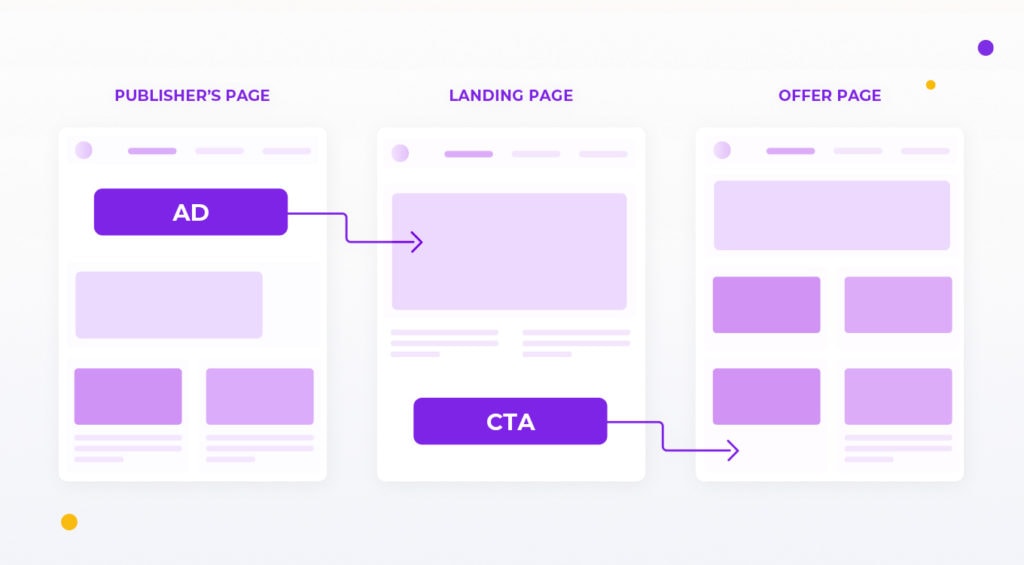
Your own traffic or the traffic you bought in a traffic source is qualified only once: by an ad that determines general intent.
What traffic arbitrage brings you is the option to double qualify visitors by granting you access to the world’s best search feed.
Here’s how it works:
- A visitor clicks a relevant ad. This could be a native ad but also banner or other ad type. Let’s assume that this ad says ‘Time travel!’. This is the first qualification.
- The visitor is then directed to a special landing page that contains search results related to the ad. A visitor sees search queries such as ‘Cheap time travel’, ‘Best time travel gear’, ‘Easy fix to grandfather paradox’. Clicking on one of these queries is the second qualification.
- An ad tracker records all these steps in detail until the conversion occurs, providing you with the data you need to spot optimization opportunities and manage profitability at scale.
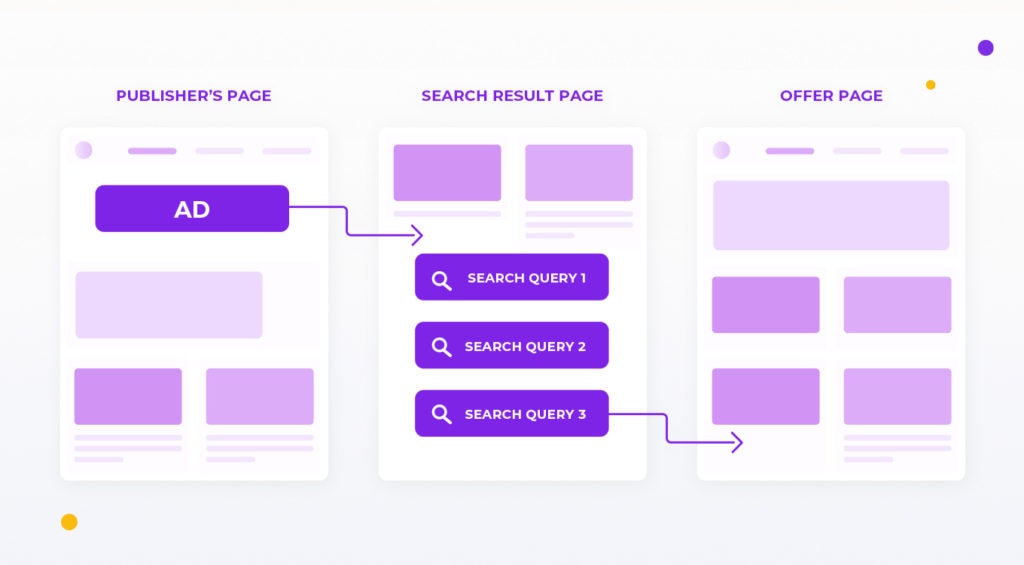
Can you see the brilliance? I know you can but let me explain it clearly for your dumber friend that is overlooking this article.
Because of this double qualification, a final offer is much closer to the visitor’s interest, and therefore, has much higher chances of converting.
Traffic arbitrage is about reselling traffic. You still deal with two sides of the equation: a party that you get traffic from (ad network) and a party where you sell and redirect traffic to (feed providers). Same as in any paid advertising scenario.
The difference is that your traffic doesn’t go immediately to an offer. Instead, it goes to the search engine result page (SERP) that then takes visitors to the final offers.
From the perspective of feed providers – you are the traffic source.
Where’s the money for you?
Your revenue is made from the small differences between the prices of purchased traffic and prices of sold traffic.
Yes, small differences. Traffic arbitrage is a big-numbers game. To be profitable, you need to run some serious traffic volumes to turn these small margins into serious revenue.
Read below to learn more.
Who participates in traffic arbitrage?
The following persobas are a part of a traffic arbitrage funnel.
- Arbitrageour (arbitrage marketer). This is you, connecting all stakeholders with a traffic arbitrage campaign. Your role is to make everyone happy – and earn some money along the way.
- Ad network. This is where you will be getting traffic from. This may be a standard CPA network, social media platform, search engine, or any other place where you can get money from in exchange for money.
- Feed provider. This is where you will be directing traffic to. Feed providers are a bit like affiliate networks in standard affiliate marketing campaigns. But instead of presenting a single offer, they display a SERP-like page with search queries related to the original ad in the ad network. Feed providers are a general term – there are usually run by affiliate programs that act as feed providers.
How to choose the best affiliate program for traffic arbitrage?
Choosing a destination for your arbitrage traffic is an important decision. After all, your earnings depend on that.
There are the following aspects that you should take into consideration when choosing the best affiliate program for your traffic arbitrage campaigns:
- Vertical: make sure that a given program operates in a vertical you want to advertise in.
- Reputation: Since you are working on behalf of the offer owner, you need to make sure that this offer is reputable. Check Affiliate program’s opinions and testimonials before joining.
- Keyword matching. Good affiliate program needs to sport an awesome keyword matching mechanism to ensure that the offers it present are related to the original search term.
- Payout conditions. Affiliate programs usually support monthly payouts but if cashflow is a problem, go with a program with weekly or at least bi-monthly payouts.
What is Search Arbitrage?
Search arbitrage is a specific strategy within the broader field of traffic arbitrage. While general traffic arbitrage might involve buying various types of traffic (like native, social, or display ads) and directing it towards a monetized page, search arbitrage focuses specifically on leveraging search engine traffic itself.
How Does Search Arbitrage Work?
The core idea remains buying traffic low and selling it high, but the mechanics are tied directly to search keywords:
- Buy Cheaper Search Traffic: The arbitrageur identifies and purchases traffic from search engines (like Google Ads or Bing Ads) associated with relatively low-cost keywords. For example, bidding on a broader, less competitive keyword.
- Direct to a Feed Provider: Instead of sending the visitor directly to a final offer page, the click redirects to a SERP-like page generated by a feed provider (such as Google AdSense, Tonic, or System1).
- Monetize Higher-Value Keywords: This feed provider’s page displays search results and ads related to the original keyword, but often includes more specific or slightly higher-value keywords.
- Earn the Margin: When the visitor clicks on one of these links on the feed provider’s page, the arbitrageur earns revenue. The goal is for the revenue earned from this click (based on the higher-value keyword) to be greater than the cost of the initial click purchased from the search engine (based on the lower-value keyword).
The Profit Model
Just like other forms of traffic arbitrage, search arbitrage is fundamentally a low-margin, high-volume game. The profit on any single click might be fractions of a cent or a few cents at most. Success hinges on driving significant amounts of traffic efficiently, ensuring that the cumulative earnings from clicks on the feed provider’s page consistently exceed the total cost of acquiring the initial search traffic.
It requires careful keyword research to find profitable discrepancies between keyword costs and potential earnings, as well as robust tracking for monitoring performance and scaling up only the campaigns that deliver.
You are essentially arbitraging the cost difference between related search keywords across different platforms or contexts (the initial search engine vs. the feed provider’s network).
Examples of Search Arbitrage Scenarios
While the article defines the mechanics, here are hypothetical examples illustrating the “Search to search” arbitrage principle described:
- Finance: Refinancing An arbitrageur buys search traffic on Bing Ads for the relatively broad and cheaper keyword “lower mortgage payments.” Visitors clicking this ad are sent to a feed provider’s page (like System1 or a Google AdSense-powered page). This page displays more specific, higher-value search links/ads like “best mortgage refinance rates today,” “cash-out refinance calculator,” or “compare FHA refinance lenders.” The profit comes if the revenue generated from clicks on these specific refinance links exceeds the cost of the initial, broader keyword click.
- Education: Online Degrees Using Google Ads, an arbitrageur purchases clicks for the general keyword “online degree programs.” This traffic is directed to a feed provider page focused on education. The feed presents targeted results and ads for more valuable terms such as “accredited online nursing degrees,” “top online MBA programs [University Name],” or “best value online psychology bachelor’s degree.” The arbitrageur earns from the difference between the low cost of the general keyword and the higher revenue generated when users click these specific, high-intent degree program links.
- Insurance: Auto Policies An arbitrage marketer buys traffic for a generic term like “cheap car insurance” from a search platform. This traffic lands on a feed provider’s page (perhaps via Tonic) displaying competing links and ads for more lucrative keywords such as “State Farm multi-policy discount,” “Progressive safe driver quote,” or “minimum liability insurance [User’s State].” The goal is to capture clicks on these specific, often branded or location-targeted, insurance terms, earning more revenue per click than the initial cost of the generic keyword traffic.
- E-commerce: Product Niche An arbitrageur bids on a moderately priced keyword like “antivirus software” on Google Ads. The clicks are sent to a feed page that displays results tailored to specific needs or brands, such as “Norton 360 Deluxe deals,” “best antivirus for Mac 2025,” or “compare Bitdefender vs McAfee.” Users clicking these more specific product links demonstrate higher purchase intent. The arbitrageur profits if the earnings from these clicks, managed through the feed provider, surpass the acquisition cost of the original “antivirus software” keyword.
How to find traffic arbitrage sites?
Finding traffic arbitrage sites involves a strategic approach to identifying platforms that serve as intermediaries in the online advertising ecosystem.
- Firstly, scouring popular advertising networks and platforms such as Google AdSense, Taboola, and Outbrain can reveal potential candidates. These platforms often connect publishers with advertisers and offer opportunities for traffic arbitrage.
- Monitoring online forums and communities related to digital marketing, affiliate marketing, and SEO can provide valuable insights and recommendations from experienced practitioners.
- Keep an eye on websites that frequently display ads from various niches, as these could be actively engaged in traffic arbitrage.
- Analyzing website traffic sources, such as using tools like SimilarWeb or Alexa, can further help identify sites that leverage arbitrage to capitalize on the difference between ad revenue and traffic acquisition costs.
It’s essential to stay updated on industry trends and continuously refine search criteria to discover new traffic arbitrage opportunities.
How much can you earn in traffic arbitrage?
It is difficult to precisely estimate how much you can earn with traffic arbitrage. You don’t earn much on a single click, that’s for sure. But when you work on a larger scale, it is only important to surpass the breakeven point and you will start earning some serious money. Even if you earn only ten cents on each click, it will turn into $100 daily with 1,000 clicks.
You need to have cash reserves to buy large volumes of traffic that you can then monetize with traffic arbitrage. It is not profitable to run traffic arbitrage campaigns on a lower scale.
Requirements of running traffic arbitrage
There are two main requirements that you should fulfill before you jump headfirst into arbitrage:
- Ad spend on the ad network side (where you will get traffic from) – You should spend at least 3 – 4 figures a day to be approved by feed providers.
- High quality traffic – Learn the requirements of feed providers regarding the traffic they accept. Sending low quality traffic (non-converting, full of bots) may result in account suspension. Feed providers have tools to check the traffic quality (TQ)
Types of traffic arbitrage
Depending on the traffic type you send, you can distinguish several traffic arbitrage types:
Search to search
In this scenario, you purchase traffic connected with a cheaper keyword and then you send it to a feed provider for the same or very similar keyword that is slightly more expensive.
Display to search
You purchase banner traffic and then send it to related search results. As display traffic is generally considered to be cheaper, this is a great option to start, as it is financially safer.
Native to search
The goal of this type is to buy cheap traffic from a native platform and send it to a search result page.
Social to search
Traffic bought on social platforms is sent to a search result page. Like with display to search type, social traffic is usually a bit cheaper, so making a profit in this case should be a little bit easier.
Best Traffic Sources for Traffic Arbitrage in 2025
To succeed in traffic arbitrage in 2025, effectively leveraging a diverse mix of traffic sources remains essential. The landscape continues to evolve, but several core channels remain vital, alongside newer strategies gaining prominence. Here’s a look at key sources:
Core Traffic Channels:
- Search Engine Traffic (PPC): Paid search advertising (Pay-Per-Click) continues to be highly effective, especially for Search-to-Search arbitrage. Platforms like Google Ads and Microsoft Ads (Bing) allow you to capture users with high intent based on their search queries. While Organic SEO can build a foundation, PPC provides the immediate, scalable traffic often needed for arbitrage.
- Social Media Advertising: Major platforms like Meta (Facebook & Instagram), TikTok, and X (formerly Twitter) offer vast audiences and increasingly sophisticated targeting options based on demographics, interests, behaviors, and lookalike audiences. Engaging ad creatives (including video) are crucial here for driving traffic suitable for Social-to-Search arbitrage.
- Native Advertising: Platforms such as Taboola and Outbrain remain cornerstones of traffic arbitrage, particularly for Native-to-Search strategies. Their ad formats blend into publisher content, often leading to higher engagement than traditional display ads, and they provide access to large volumes of traffic across diverse websites.
- Display Ad Networks: Networks like the Google Display Network (GDN) and various programmatic platforms provide broad reach across countless websites and apps. While potentially having lower intent than search, display ads (banners, video) can be cost-effective sources for arbitrage when combined with smart targeting (contextual, audience-based) and compelling creatives.
- Programmatic Advertising: Beyond specific networks, buying traffic programmatically through Demand-Side Platforms (DSPs) offers access to wide inventory (display, native, video, sometimes audio) with AI-driven bidding and targeting capabilities. This allows for efficient scaling and optimization across multiple exchanges, though it often requires more technical expertise.
Other Important Strategies & Sources for 2025:
- Video Advertising Platforms: With video consumption booming, platforms like YouTube (via Google Ads) and TikTok are powerful traffic sources. Short-form video ads, in particular, can be highly engaging and drive significant volume, suitable for arbitrage models targeting relevant search feeds.
- Push Notifications: This channel allows direct engagement via browser or mobile notifications. While facing challenges like user fatigue and stricter regulations, push ads can still be effective for specific niches or re-engagement campaigns when used judiciously and compliantly.
- Referral Traffic: While potentially less scalable than paid sources for high-volume arbitrage, building partnerships with relevant websites, blogs, or newsletters can provide a stream of targeted referral traffic that may convert well.
- Influencer Collaborations: Partnering with influencers (especially micro-influencers with engaged niche audiences) can drive targeted traffic. While sometimes complex to manage for pure arbitrage margins, it can be effective if the audience alignment and cost structure work.
Key Considerations for 2025: Diversification remains key to mitigate risk. Furthermore, leveraging AI tools for optimization, staying vigilant about traffic quality and compliance, and adapting to privacy changes (like the shift towards contextual targeting) are crucial across all sources.
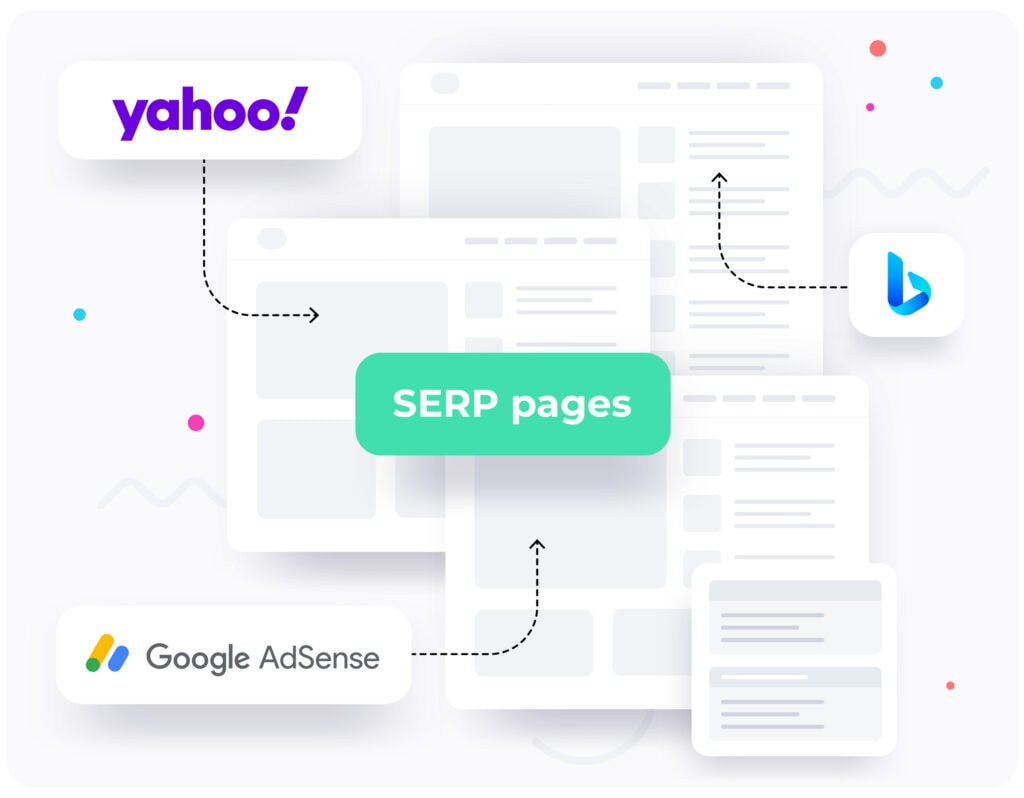
Feed providers
Feed providers are the ones that generate search engine result pages that then link to concrete offers.
These offers are, obviously, related to the originally searched keyword or displayed ad. The search queries are usually more specific versions of the original ad. For example, if the original ad displayed via an ad network advertised ‘space suits’, the search SERP page displays results such as:
- ‘Space suit for women’
- ‘Space suit helmet’
- ‘Oxygen tank’
This double-qualifies visitors and allows them to reach the most fitting offer. It does wonders for conversion rates.
Popular feed providers:
- Google AdSense
- Yahoo
- Bing
- System 1
- CBS Interactive
- Sedo
- Tonic
- Domain Active
Feed providers are very strict when it comes to traffic quality. They also have a set of their own requirements which you must fulfill. Otherwise, you risk getting banned.
Traffic quality
There are several factors that make up good quality traffic:
- Convertibility
- Stability
- Human origin
Make sure that you check all of these boxes before you start sending them traffic.
Funnel types
Let’s talk more about how traffic arbitrage works by showing you the two different funnel types that are typically used with arbitrage:
- 1 Click flow: Ad -> SERP page
- 2 Click flow: Ad -> prelander (so-called parked domain) -> SERP page
The important thing to know at this point is that SERP pages (feeds) cannot be edited. More on that later.
How to Make Traffic Arbitrage Profitable
The quick answer is: know when you struck a balance between cost and revenue. Because that’s what traffic arbitrage is all about. There are no delayed benefits like with lead generation campaigns, no other goals, like with brand awareness marketing.
With the cost of getting a click being so close to the money you get from each click, accurate tracking is everything.
Funnel setup
Voluum supports both direct and redirect tracking methods. While the direct method is highly flexible, most feeds and prelanders don’t allow code insertion. For this reason, Voluum’s intuitive campaign setup lets you track even complex 1-Click and 2-Click flows by adding feeds and prelanders as Offer elements—ensuring every visit and conversion is logged accurately.
Each time a feed with ads is loaded within the Voluum campaign, Voluum will record a visit.
Keywords
You need to pass information about keywords being clicked from an ad network to Voluum and matched with a custom variable. You can then pass this information to the feed provider by appending the custom variable to the offer URL.
Tracking clicks on feeds
Voluum can track such clicks as conversions. Conversions can be tracked either with a Conversion tracking pixel or postback URL.
Again, lack of option to edit feeds prevents you from using the Conversion tracking pixel. Feed providers which support a postback URL solution can relay click information back to Voluum. You can track clicks as conversions by creating a custom conversion and adding the ‘et’ parameter to the postback URL (et=click).
It may take between 24 – 36 hours for a feed provider to register the click and send the click information as a conversion to Voluum. You can use the Conversions upload feature to manually input information about conversions with revenue data.
Tracking costs
Cost information is passed from a traffic source, and you can get it in Voluum with the cost token added to the campaign URL (traffic source has to support it) or with an API integration through the Voluum Automizer module.
Alternatively, you can set a fixed cost for each click on an ad when creating a campaign in Voluum. Refer to this article for more information on Tracking Cost.
TONIC search arbitrage case study – Voluum Integration
TONIC is one of the most popular traffic monetization platforms that uses search feeds to direct visitors to offers. Voluum now supports API integration with TONIC. that is capable of passing ‘final revenue’ event data to Voluum automatically.
Before that, you would have to upload conversions manually for this event type. Now it’s only a matter of a couple of clicks. Other event types can be passed with postbacks and the setup for all other events can be found in our knowledge base.
The integration removes the biggest obstacle that was standing between you and one of the best traffic arbitrage search feed provider on the market. Enjoy their premium feeds and Voluum’s tracking capabilities with ease!
Good Practices for Traffic Arbitrage in 2025
Finally, let’s discuss some essential good practices for 2025. Adhering to these should help ensure your traffic arbitrage campaigns run effectively, remain compliant, and achieve profitability.
Meet Feed Provider TQ Benchmarks: Understand that major feed providers (Yahoo!, Google, Bing, etc.) actively monitor Traffic Quality (TQ) scores. Consistently failing to meet their quality standards, which depend on niche, GEO, and keyword performance, will likely result in losing access to their valuable feeds. Delivering high-quality, converting traffic is key to long-term success.
Rigorous Testing & Data Analysis: Dedicate a sufficient budget and time for initial testing. Use robust analytics to swiftly identify high-converting traffic segments (combinations of sources, creatives, GEOs, keywords) before scaling up with your preferred feed providers.
Prioritize High-Quality Traffic & Advanced Filtering: Maintaining clean traffic is non-negotiable in 2025. Implement sophisticated fraud detection and filtering tools (potentially AI-powered) proactively to eliminate bots and low-quality sources before they reach your feed providers. This is crucial for protecting your profits and maintaining high Traffic Quality (TQ) scores.
Exercise Extreme Caution with Adult Traffic: If considering adult content, proceed with utmost care. Mainstream feed providers maintain very strict policies, and the risk of account suspension is high. This niche requires deep expertise and constant vigilance; missteps can be costly.
Strategic Vertical Selection: Carefully choose your verticals. Balance consistent, year-round ‘evergreen’ niches (like finance, insurance) with potentially high-yield ‘seasonal’ opportunities. Stay attuned to current economic trends that might influence consumer interest in specific verticals.
Uncompromising Compliance: Strict adherence to the policies of both your traffic sources (ad networks) and feed providers is paramount. Platforms like Google, Microsoft Bing, and major feed providers are continuously updating and enforcing rules. Regularly review their terms and ensure your campaigns, landing pages (if used), and traffic sources are fully compliant to avoid costly suspensions.
Continuous Competitor Monitoring: Regularly analyze your competitors. Understanding their successful strategies, ad creatives, landing page approaches, and traffic sources can provide invaluable insights for refining your own campaigns and staying competitive.
Stay Ahead of Trends & Technology: The digital landscape evolves rapidly. Commit to continuous learning about changing platform algorithms, advancements in AI for ad optimization and fraud detection, new advertising platforms (like emerging social or video networks), and the evolving privacy regulations impacting tracking and targeting.
Optimize the User Journey (Especially with Pre-landers): If using a multi-click flow (Ad -> Pre-lander -> SERP page), ensure your landing pages offer an excellent user experience. Optimize for lightning-fast load times, seamless mobile responsiveness, clear calls-to-action (CTAs), and continuously A/B test elements to maximize conversions.
Navigate Technical & Platform Requirements: Be mindful of technical limitations. Major platforms like Google Ads, Microsoft Bing, and Facebook often require direct tracking scripts on the initial landing page, which may not be possible with uneditable feed provider pages, potentially limiting your source options for certain flows. Ensure your tracking setup is robust and respects privacy regulations.
Popular Niches and GEOs For Traffic Arbitrage
Some popular niches for arbitrage include:
- Culture and news feed
- Product comparison
- Parenting
- Education, student loans
- Finance, refinance credit cards
- Medicines, Nutra
- Website building
- Insurance
- Antivirus
- Law guidance
The typically good GEOs are:
- United States (US) – Tier 1
- France (FR) – Tier 1
- Italy (IT) – Tier 1
- Germany (DE) – Tier 1
- United Kingdom (GB) – Tier 1
- Spain (ES) – Tier 2
- Belgium (BE) – Tier 2
- Netherlands (NL) – Tier 2
- Peru (PE) – Tier 3
As with other digital marketing types, Tier 1 countries (so rich countries where the Internet appeared first) usually are harder, as the competition between advertisers is fiercer and Internet users have seen all tricks already – but they also provide higher rewards.
Tier 2 countries are often the sweet spot of advertising, the healthy balance of not too big competition and reasonable payouts. Tier 3 countries offer the cheapest traffic – but traffic quality may be an issue.
Traffic Arbitrage Is Not For Everybody But May Be For You
If you haven’t tried it, you will never know. As long as you meet the entrance criteria of running traffic in some serious volumes, you can try to dip your fingers in traffic arbitrage.
Although low margins sound like a turnoff, remember that due to double qualification (so showing offers that are more precisely targeted thanks to the SERP page) the conversion rates are much higher. Circling back to our example, a person searching for a space suit helmet should be more inclined to click the search query on the feed provider’s page that says exactly that, instead of following a more general ‘space suit’ ad.
If you decide to try arbitrage for yourself, especially if you want to try TONIC., make sure that you have your trusty ad tracker ready.
Frequently Asked Questions
Question: What is traffic arbitrage in digital marketing?
Traffic arbitrage is a strategy where marketers purchase traffic from one channel (such as native, search, or social ads) and send it to a page or feed provider that pays out for subsequent user actions, aiming to profit from the difference between acquisition and payout costs.
Question: Why is tracking so important in traffic arbitrage?
Accurate tracking is essential because profit margins are often slim. Dedicated platforms provide granular data on clicks, conversions, costs, and keyword performance—helping marketers quickly identify what’s working and scale only the most profitable campaigns.
Question: What are common types of traffic arbitrage flows?
The most common types include search-to-search, display-to-search, native-to-search, and social-to-search. In each case, purchased traffic is funneled through SERP-like landing pages, optimizing qualification before redirecting to final, higher-value offers.
Question: What are feed providers and why do they matter?
Feed providers are networks (like Google AdSense, Yahoo, Bing, System1, Tonic) that generate SERP-style pages populated with targeted offers or ads. Arbitrageurs send qualified traffic to these pages, earning revenue for each further action or click.
Question: How does Voluum help marketers succeed with arbitrage?
Voluum supports both direct and redirect tracking for arbitrage campaigns, integrates with key feed providers like TONIC., and automates cost and conversion tracking. Its analytics, fraud prevention, and automation features let affiliates maximize margins, stay compliant, and optimize flows based on real-time data.



 Facebook
 Telegram