

Chrome is now blocking all third-party cookies set by non-secure domains, impacting how websites can track users. This update, which began rolling out fully in August 2020, means that sites relying on cookies from unencrypted (non-HTTPS) connections will see these cookies blocked for all Chrome users. Marketers and advertisers should understand how this change can affect campaign performance and user data tracking.

Cookies matter
Thanks to the EU regulations and the growing emphasis on the privacy issue, many people have discovered that such a thing as ‘cookies’ exists, and they are used by all websites. Yes, all of them. Voluum Blog uses them as well.
Cookies are small text files that are stored locally, on your computer’s hard drive. They are created by your web browser, Chrome and others alike.
Cookies contain information about your preferences. They can save your login and password; items that you have added to the shopping basket; products, you have viewed recently.
Generally, they’ve been designed to make everyone’s life better. (Hey, it’s the same as with regular cookies!) Embrace cookies.
No banner with provided ID foundX-party cookies
Beneath that rather simplified explanation of what cookies are there is an important distinction between first-party cookies and third-party cookies:
- First-party cookies are set by a web server with the same domain as the page you are currently on. They are mainly designed to make your browsing experience more comfortable in ways that were hinted above.
- Third-party cookies are set by other web servers. This usually means various analytical or tracking solutions. They store information on the referer, time spent on a website, buttons clicked, etc. They mainly serve web owners to make their pages more attractive.
What’s new?
Most of the third-party cookies are innocent. But Google, along with the two remaining biggest web browsers on the Internet, decided that those third-party cookies that were placed by non-secure domains may be a threat to a user. They are all on the path to phase them out.
Google took a step towards the world with no third-party cookies and decided to block those that were placed by non-secure domains.
Ok, but what are non-secure domains?
SSL also matters (HTTPS)
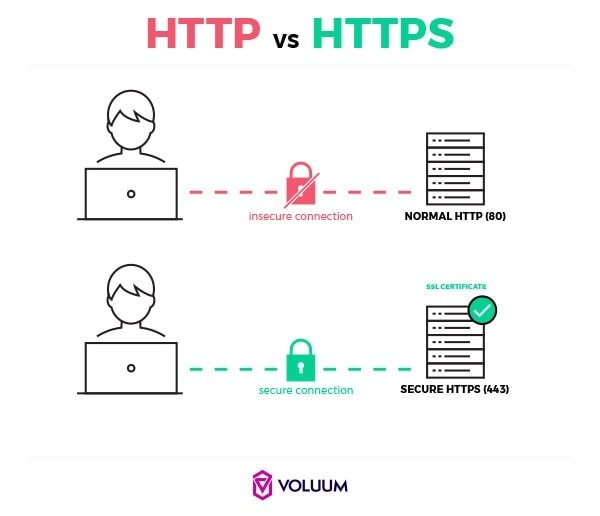
Look at the top-left corner of your web browser, just left of the web page address. Do you see the small lock icon? This means that our domain, as most on the Internet, uses an encrypted protocol (HTTPS) to ensure user’s safety.
If you currently use Chrome, the protocol type has been hidden from you. But if you double- click the address bar, you will see that Voluum actually uses the HTTPS connection.
HTTPS connection uses SSL certificates to:
- Identify that a web page that you visit is a web page it says it is.
- Encrypt communication between your computer and a web page that you visit.
These SSL certificates bind a digital cryptographic key with the details of a company’s identity.
In short, with the HTTPS connection, you get to the web page you wanted, not to a fake one, and you send secure information.
Want to know how Chrome cookie block may affect you? Look for answers to the questions below:
What if I weren’t using SSL before the Chrome 80 update in my affiliate campaigns?
Most probably you have lost some clients. Since July 2018 and Chrome 68 update, all users that visit web pages that don’t have SSL installed see a warning message. This message says that the connection they use is not secure.
In your case, many clients may have chosen not to click any further not because your offer was not attractive but because they were deterred.
In contrast, some of our clients noticed a significant conversion boosts when they’ve implemented a secure connection throughout their campaigns.
What if I still don’t use SSL after the Chrome 80 update in my affiliate campaigns?
If you track your campaigns with Voluum and you don’t use SSL, several things will be affected:
- Impression tracking pixel: An impression will still be counted in Voluum, however, there will be no connection between it and a visit. All information from custom variables will be lost. It will be as if two completely separate people made two actions: one generated an impression, and the other clicked on the ad.
- The redirect method of tracking clicks relies on having a certain parameter stored in a cookie. When no cookie with this parameter is found, a failsafe mechanism launches and searches for this parameter in a referrer. This means that in a typical scenario, click-tracking should still work. However, if any additional redirects, re-routes or page reloads between an ad and a landing page take place, this parameter may be lost and the click tracking will not work.
- Conversion tracking pixel: this solution will stop working at all.
What won’t be affected:
- Tracking with a Direct Tracking Pixel or Redirectless methods;
- Postback URL
What if I already use SSL in my affiliate campaigns?
We’ve already introduced important changes to how Voluum handles cookies. These changes mean that all Voluum features and solutions will work without interruptions and no action from your side is required.
What if I want to be on the safe side and be sure that everything will work?
Firstly and most importantly, make sure that you use an SSL certificate throughout the whole funnel. This means that you need to have it enabled on:
- Your tracking domain – either on a dedicated domain or on a custom domain.
- Your landing page.
- Offer page. If you get your offers from an affiliate network, make sure that it supports a secure connection.
If you don’t use HTTPS connection consequently throughout the whole funnel (for example, you won’t enable SSL on your landing page), this will be seen as a conflict by all modern browsers and a warning message will be displayed.
More information is available in Voluum knowledge-base articles on secure domains.
Once you go with the secure connection, make sure that you have updated your tracking links with HTTPS.
For those of you that have been using HTTPS for some time – make sure that the SSL certificate did not expire.
Secondly, we recommend switching to direct methods of tracking. In Voluum, there are two features that do this:
- Direct Tracking Pixel
- Redirectless Tracking
Direct tracking is future-proof, as it is also in-line with Google’s and Facebook’s growing dislike towards redirects.
What Should Marketers Expect After All Third-Party Cookies Are Blocked?
The situation post-Chrome cookie block will not last forever. In a year, Google will block all third-party cookies, no matter if they were placed by secure or non-secure domains.
There will still be an option to use a redirect method of tracking for some cases, but a direct method of tracking will be a recommended one.
Get Voluum with the direct method of tracking and stay safe.
Frequently Asked Questions
Question: What changes did Chrome introduce regarding third-party cookies?
Chrome now blocks all third-party cookies set by non-secure (non-HTTPS) domains, making it harder for websites to track users across different sites unless they use secure connections.
Question: How does this update impact affiliate marketers?
Marketers running campaigns on non-secure domains may lose tracking functionality, affecting conversion tracking and data accuracy. Switching to HTTPS and updating tracking methods is strongly recommended.
Question: What should I do to keep my campaign tracking accurate?
Ensure all domains in your funnel use SSL (HTTPS), update your tracking links, and consider using direct tracking or redirectless methods, such as those offered by Voluum, to future-proof your campaigns.
Question: Are any tracking methods unaffected by the Chrome cookie block?
Yes, direct tracking pixel and redirectless tracking methods, as well as postback URLs, are not impacted by Chrome’s block on non-secure third-party cookies.
Question: Will Google block all third-party cookies in the future?
Yes, Google has announced plans to block all third-party cookies, even those on secure domains, within about a year, so direct tracking methods will become even more important.



 Facebook
 Telegram