
Is the Amazon Affiliate Program Still Profitable in 2025? Complete Guide

The Amazon Associates Program remains one of the most popular ways to earn money online by recommending products, even in 2025. With millions of available products, a global audience, and trusted brand reputation, Amazon continues to attract both new and experienced affiliates. However, recent changes—like varying commission rates and new traffic monetization initiatives—mean that earning solid income now requires a strategic and data-driven approach. Powerful tracking tools can help affiliates optimize performance and maintain profitability in the evolving landscape.
Recently, Amazon started testing a new initiative called Native Commerce Advertising. It’s designed to reward publishers not just when someone buys something, but even when they drive traffic to Amazon—no purchase needed. Big names like CNN and Vox Media are already testing it, and if it rolls out more widely, it could open new doors for affiliates too.
Whether you’re new to affiliate marketing or looking to level up your strategy, Amazon’s program still offers solid potential. Let’s break down how it works today, what’s new, and what to watch for in 2025.
The question we’re here to investigate today: is Amazon still worth it?
No banner with provided ID found
In case you were wondering, the answer isn’t unfortunately an easy yes-or-no. However, if you take a look at the pros & cons, consider your level of expertise, and what you need/want to do, then you’ll find the answer within 💜
This article’s a long one, with parts that might not be news for you. Feel free to skip ahead.
No banner with provided ID found
What Is the Amazon Associates Program?
The Amazon Associates Program is one of the most popular and beginner-friendly affiliate marketing platforms out there, making it a solid starting point for anyone looking to monetize their content or earn passive income through paid advertising.
The process is straightforward: you sign up for free, generate unique affiliate links to products, and earn a commission whenever someone clicks your link and completes a purchase. What’s even better is that you don’t just earn on the product you recommended—you’ll get a cut of everything the customer buys during that same session.
One of the biggest advantages of the Amazon Associates Program is trust. Because most people already have an Amazon account (and likely shop there regularly), they’re more likely to complete a purchase, which boosts your chances of earning a commission. Compared to smaller affiliate programs that might offer higher commission percentages, Amazon tends to convert better thanks to its brand reputation, wide product selection, and fast shipping.
As for what kinds of traffic work best, Amazon’s affiliate program tends to perform really well with high-intent, product-focused content. Think:
- review blogs
- comparison videos
- gift guides
- “best of” roundups
- advertorial articles
- tutorials.
Amazon Affiliate Commission Rates in 2025
Amazon’s affiliate commission rates in 2025 still vary quite a bit depending on the product category. While some categories offer generous payouts, others are much more modest—so knowing what you’re promoting really matters.
Here’s a quick breakdown of the current rates:
High-commission categories:
- Amazon Games: 20%
- Luxury Beauty, Amazon Explore: 10%
- Digital Music, Handmade, Digital Video: 5%
Mid-range categories:
- Physical Books, Kitchen, Automotive: 4.5%
- Amazon Devices, Fashion & Accessories: 4%
- Toys, Furniture, Pet Products, Home Improvement: 3%
- PC Components, DVDs: 2.5%
- TVs, Digital Video Games: 2%
Low-commission categories:
- Amazon Fresh, Grocery, Health & Personal Care: 1%
- Gift Cards, some digital subscriptions: 0%
Amazon last made major changes to commission rates back in 2020, cutting many of them significantly. Those cuts are still in effect, which is why affiliates have become more strategic—focusing on higher-paying categories and optimizing for volume.
So, can it still bring in solid earnings for an affiliate like you?

How Much Can You Earn as an Amazon Affiliate?
Is Amazon Affiliate Marketing Profitable with Paid Traffic?
Let’s be real—if you’re planning to run Amazon affiliate offers using paid traffic, you’ve probably wondered: Is this even worth it anymore?
The answer is… yes, but only if you play it smart. Throwing money at Facebook or Taboola without a strategy will burn your budget fast. The right tracking platform is crucial for monitoring your ROI, optimizing your offers, and making paid campaigns on Amazon profitable.
Let’s break it down with some real-world averages for 2025:
- Earnings per click (EPC): Around $0.05–$0.11, depending on niche and geo.
- Cost per click (CPC): Facebook is getting pricey, averaging $0.77. Native ads are usually a bit cheaper, especially if you’re not targeting Tier 1 traffic.
- Conversion rate: Across the board, 1–3% is typical for paid traffic. If you’ve dialed in your funnel and creatives, you might hit 5% or more.
Bottom line: if you’re paying more for a click than you’re earning from it, you’re losing money. So the name of the game is keeping your CPC below your EPC—and that’s where optimization comes in.
What Does That Look Like in Practice?
Here are a few scenarios based on how much traffic you’re running:
1. The Hobbyist Affiliate
You’re testing the waters with about 10,000 clicks/month, maybe from low-cost native ads.
- CPC: $0.10
- EPC: $0.11
- Profit: ~$100/month
It’s not a full-time income, but hey—it covers your Spotify, coffee habit, and maybe a tool subscription.
2. The Side Hustler
You’ve got a few winners, dialed in your targeting, and you’re driving 50,000 clicks/month.
- CPC: $0.08
- EPC: $0.11
- Profit: ~$1,500/month
Now we’re talking real money—enough to reinvest or stash as savings.
3. The Full-Time Affiliate
You’ve got serious momentum, you’re buying 200,000 clicks/month, and your tracker is working overtime.
- CPC: $0.05
- EPC: $0.11
- Profit: ~$12,000/month
At this level, it’s a business. You’re optimizing campaigns daily, testing creatives constantly, and scaling anything that works.
Amazon Affiliate Program: Pros and Cons
We’ve established that Amazon Associates may not be the most fruitful affiliate marketing endeavor, however, it still comes with a heap of advantages. Read through these to get an idea of what Amazon can do for you.
✅ Pros ✅
It’s easy
Signing up to the Amazon Associates program is a breeze. I was able to do it in less than 15 minutes – and that’s including the five minutes it took to find my phone and confirm my password because I forgot it 😉 But seriously, if you’re familiar with the Amazon platform, have an account, and are more organized than me, the signup process couldn’t be easier.
Amazon is a trusted, recognized brand.
And that’s to say the very least – there are tons of people out there (about 200M people have Amazon Prime) ordering everything from deodorant to paintings worth hundreds of thousands of dollars on a daily basis. First off, this is an enormous benefit because customers are familiar with and trust the platform to order the goods you promote. Moreover, you too can be pretty confident that your customers are in good hands once they click on your link and leave your website.
Take a cut from their whole shopping cart.
Ok, this one takes a bit of explanation – and isn’t often seen in other affiliate programs. If a potential customer clicks on your link, and goes to Amazon but doesn’t buy anything, you still have a chance to make money! Within 24 hours of clicking on your link, you get a commission from anything they buy. This brings us to our next point…
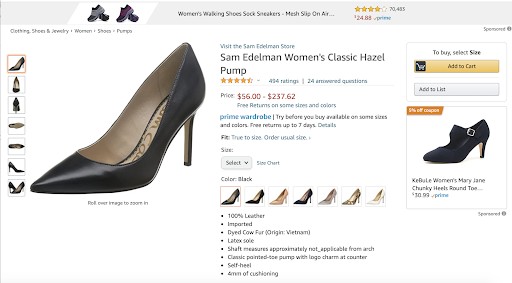
The Amazon shopping platform is ultra-super-maximized-optimized for conversions.
The product ratings, descriptions, comparisons, recommendations, images, and more are all in one spot, easy for the user to access and urge them to buy. The page below, for example, has everything I need to know about these heels, which really tempts me (even though I have nowhere to wear them 😉 )… the point is, that customers are much more likely to make a purchase on Amazon than anywhere else; with conversion rates on average ~9% (while most other sites hover around ~1%) you can bet that you will be getting some sort of commission on something eventually 😄
Promote anything your heart desires.
There’s no bigger online shopping platform than Amazon; most likely, if you can’t find it there, you won’t find it anywhere. Not only will you find a wide range of products in your niche or vertical, but also, as my friend Michal has pointed out in his article, Amazon is a great way to discover relevant content to market. Just take a look at what happens when you type in…
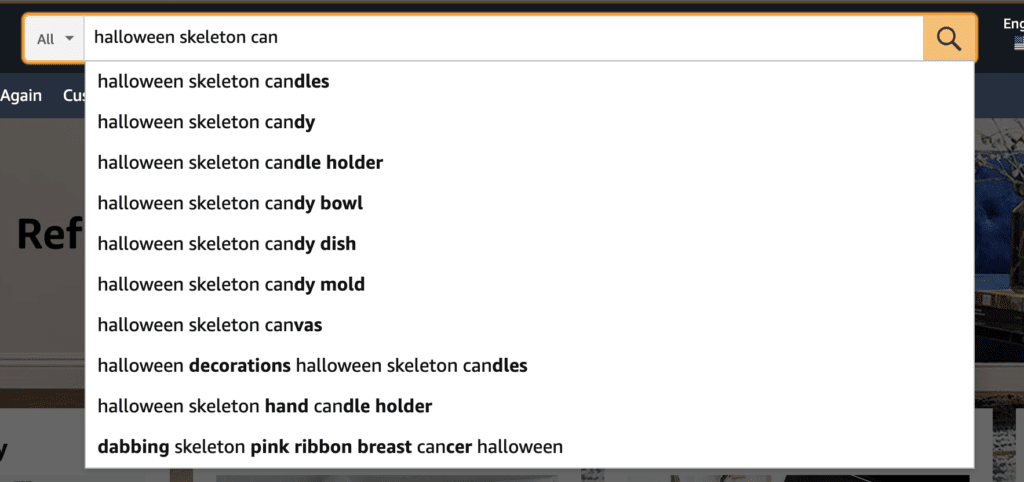
Pumpkin spice season is upon so people are gonna start shopping for Halloween decorations? Like skeleton candles? I had no idea that this exists. Maybe you did idk. Maybe Amazon just has everything and more. Point is, that it’s a niche product you can market if you have some sort of house decor/theme/party gear platform.
Reliable customer service.
Even though as an marketer you don’t usually deal with this part of the purchasing process, it’s always good to know that your recommendations and promotions will lead customers to an efficient, proactive company; thus they won’t hesitate to buy your recommendations the next time.
Included tools.
Amazon does the courtesy of providing its affiliates with a couple useful tools. Though they are Amazon-centric and not necessarily indispensable, they make the Amazon Associates experience even easier.
SiteStripe: A toolbar displayed at the top of any Amazon page where you can quickly access a given product’s text or image link. You can share to social media here too. More on using this tool in our How to section later.
Publisher Studio: This one is a browser extension (also available as Java Script) thanks to which you’ll link up items on Amazon in your content like articles or social media posts right from within the content editor. So if you find leaving your writing for a moment to grab a link annoying you should check this one out.
Link Checker: Type your link in to make sure that your URL to Amazon is tagged correctly so you can get your commissions.
Product Advertising API: Use this to include Amazon’s product descriptions, images, pricing, reviews, ratings, and recommendations to your affiliate site. With their PA API, this content will be continuously updated on your site. Learn why this is absolutely essential later in our T&C section.
OneLink: Install this script on your site to redirect international users to their relevant Amazon marketplace to not miss out on commissions from them. This is an important step because depending on which regional Amazon affiliate program you are registered in, versus what region your customer is buying from, you may miss out on commissions.
⛔ Cons ⛔
Low commissions
If you’ve compared Amazon Associates to most other affiliate programs – or you’ve been reading this article attentively from the beginning 😉 – you’ll know that their commissions are low. Like reallyyyy low. Of course, you’ll get Amazon fans who say that “oh but you get a cut from everything!” – sure, but your cut from everything is very low. In reality, the only way you’re going to make money off of Amazon is by selling in very large volumes or selling very expensive items.
*An important consideration: Amazon commissions are definitely low when compared to other Affiliate Networks… However! When compared to other big, trusted retailers like Walmart or Target, Amazon’s commission rates are about the same.
Short cookie duration
Compared to other affiliate programs, this “24-hour” cookie policy is not very generous at all. Most other affiliate networks have cookie policies for around 30 days or more – ie, if a shopper has clicked your link but goes back to the website two weeks later, you’ll still get a commission on that product. And once again, Amazon fans will defend it with “but you get a cut from everything they buy!” but as we know, that’s only for 24 hours.
Strict terms and conditions
It’s pretty easy to end up banned from Amazon. And when you get banned, you could be losing your commissions from the past weeks or months with little to no explanation. Though it’s not a foolproof solution, and their policy frequently changes, I’m providing you with some pointers on how not to get banned in a later section.
Tough road ahead
Lastly, and I have to warn… this is NOT a concrete, proven disadvantage… however, it really seems that Amazon simply does not prioritize their affiliate marketers. Every change they introduce to the Amazon Associates program is always a cut and almost always hurts affiliates. I mean, they had no qualms about slashing rates during the height of the pandemic, I don’t see them coming around any time soon. Just check out this detailed article on the History of Amazon Affiliate Program Rates that shows how categories have been consistently dropping since the program’s establishment by 20-80% even. Most likely, they will further limit the program.
The 2025 Outlook for Amazon Affiliates
So, what’s the outlook for Amazon affiliates as we move through 2025?
I’ll level with you—it’s still a mixed bag. Commission rates haven’t bounced back to where they once were, and there’s no guarantee they’ll climb anytime soon. But here’s the silver lining: there’s very little downside. Amazon remains the world’s largest online marketplace with an almost unbeatable reputation for fast shipping, solid customer service, and an immense product catalog.
When it comes to earnings, Amazon Associates sites can still range from pocket change to five-figure months, but you’ll need either big-ticket products (even a $3,000 sofa only nets you about $100 at today’s 3–4% rates) or seriously massive traffic volumes to hit those higher tiers. Later on, we’ll walk through strategies for driving and optimizing that traffic.
In short, the Amazon Associates Program in 2025 could be right for you if you:
- Want a risk-free way to dip your toes into affiliate marketing
- Need access to millions of products from a trusted brand
- Have a niche audience that loves quirky or specialized items
- Are looking to diversify your affiliate income streams
- Are simply curious about how to leverage Amazon’s platform
Stick around, and we’ll show you how to carve out your own slice of Amazon’s massive pie.

How to Set Up an Amazon Associates Account: Step-by-Step
Part I: Become an affiliate with Amazon
First things first: How do you qualify for the Amazon Associates program? Good news is, that’s relatively easy too. First, you’ll need a regular Amazon account. Second, a website, blog, Youtube channel, or an app. (Granted, this is the most crucial and important part of being an affiliate marketer, but we will cover this in more depth later on).
**It’s best to have a website that is already active and sees some traffic for two reasons: (1) In your Amazon Associates application you’ll need to describe specific aspects of your website (2) Without any traffic to start, you have a much higher chance of getting banned!
- Sign up for an Amazon Associates account using this link: Amazon.com Associates Central

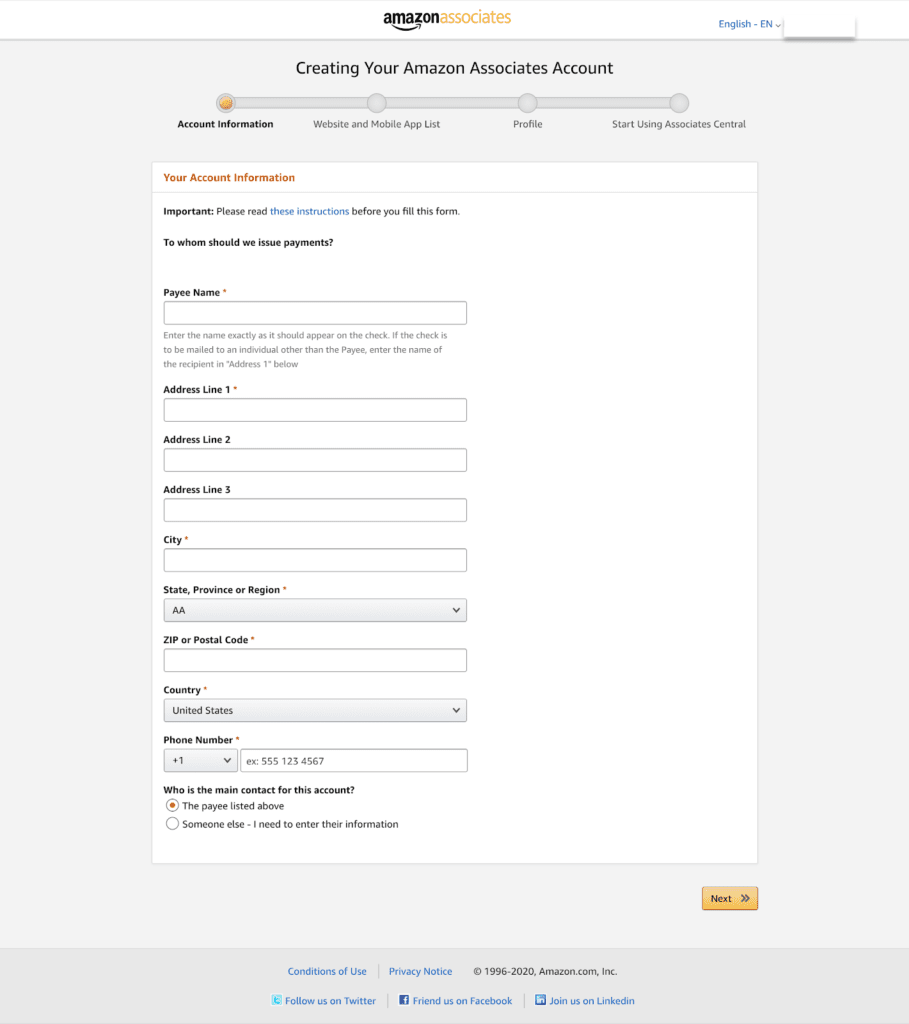
- Fill up necessary information.
- Next up, provide your website/ Youtube channel/ blog address or mobile app URL in the boxes shown below. As I mentioned, you’re going to need at least one of these upon sign up.
*Make sure you list every and all the websites/social media platforms/apps you’ll be posting offers on – otherwise you could get banned!
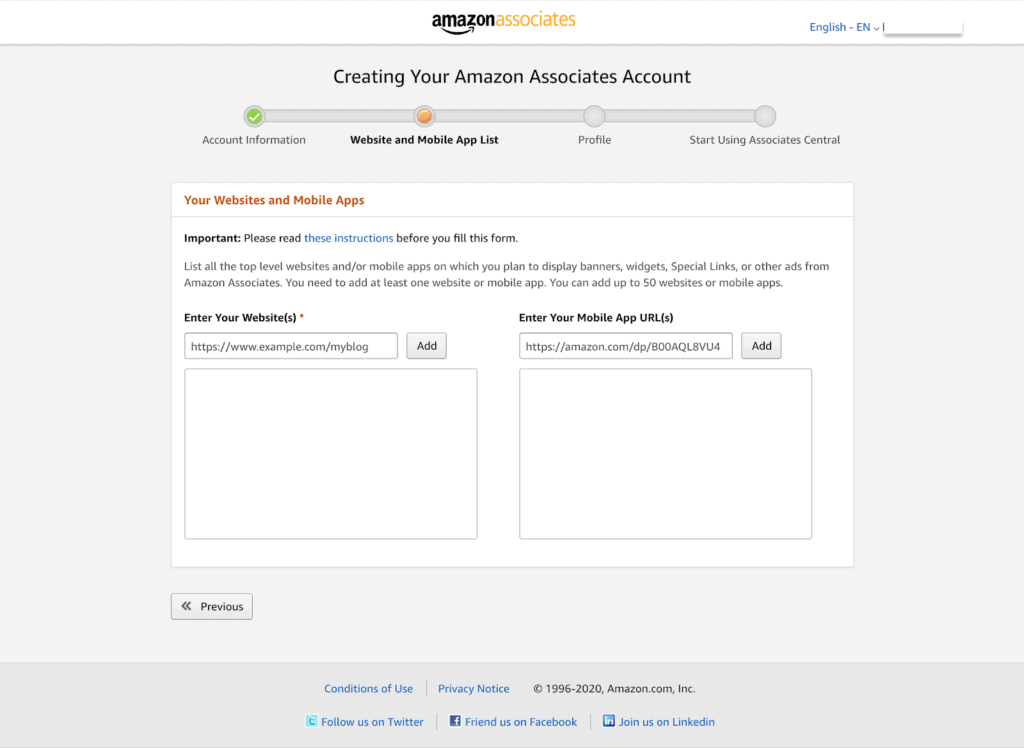
*Make sure to confirm that none of your websites or apps are NOT directed at children under 13. This will disqualify you from the program.

- Time to fill out a bunch of information about your website! Choose your Associates ID and provide a general idea of what your website/app is about. Then go on to answer questions on how you drive traffic to your platform and how you already/plan to monetize your site. This information is mainly to help Amazon customize content for you or offer suggestions – it can be changed later in your Amazon Account settings.
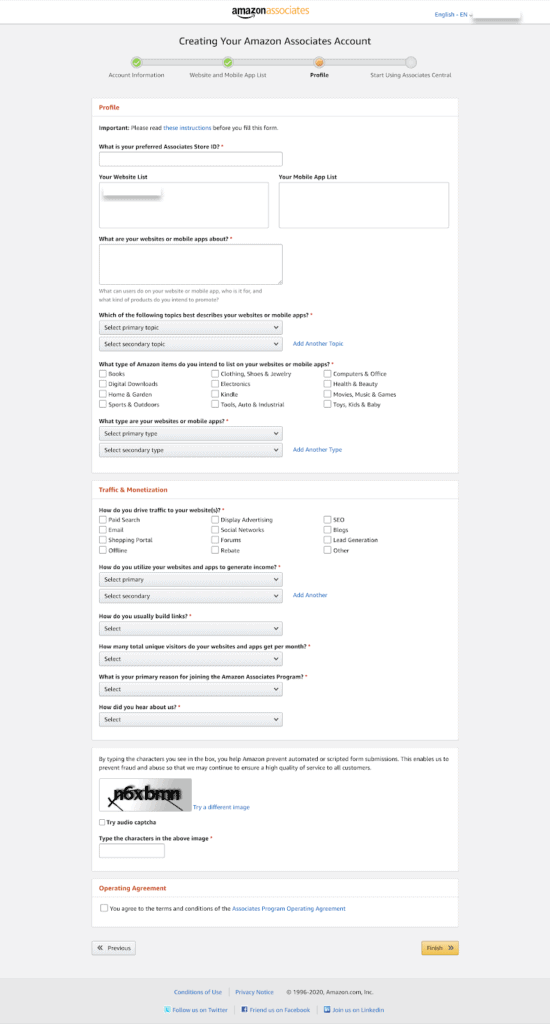
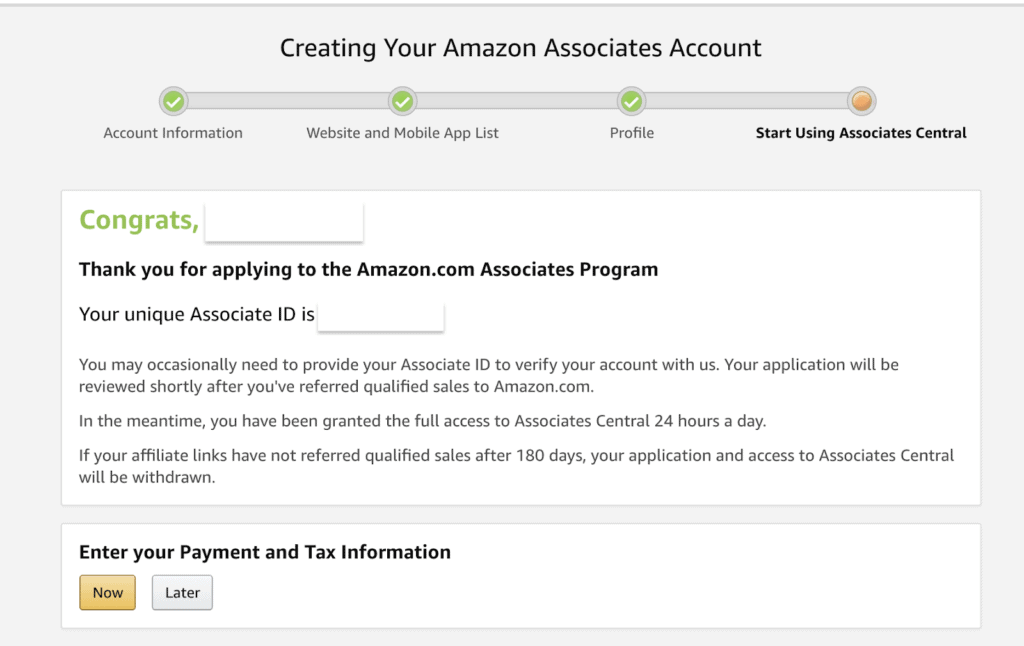
- That was it – you are now an Amazon affiliate! Granted, one important step is missing, how to get paid 😉 Click on “Now” to finish this last component of your profile.
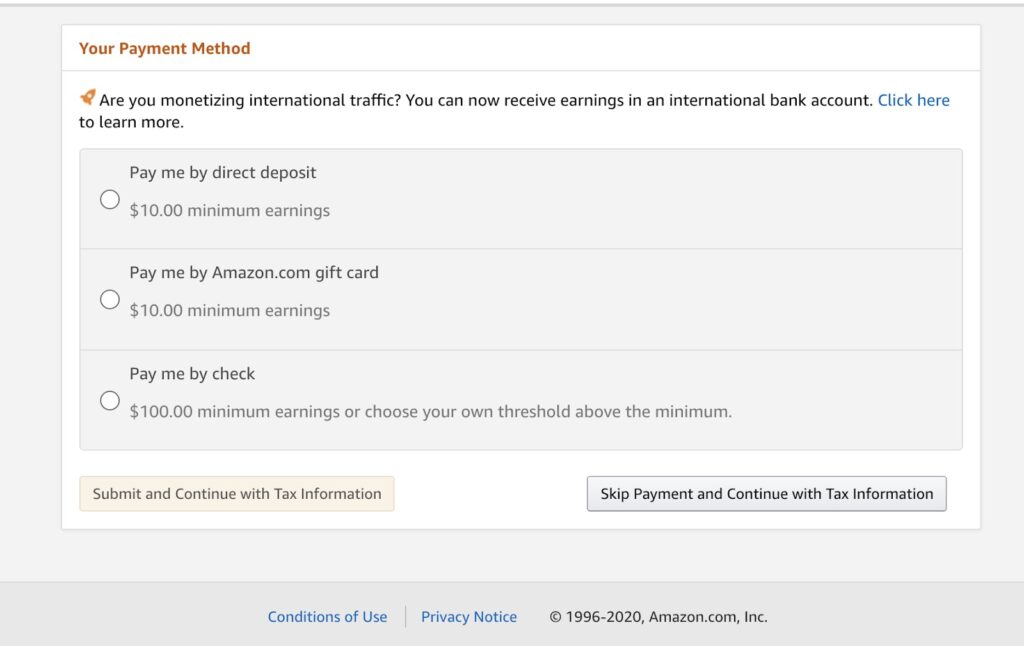
- There are 3 ways to get paid: direct deposit (depends on your country/bank), with an Amazon gift card, by check. Choose your payment method, but make sure to confirm it will work with your address, bank account etc.
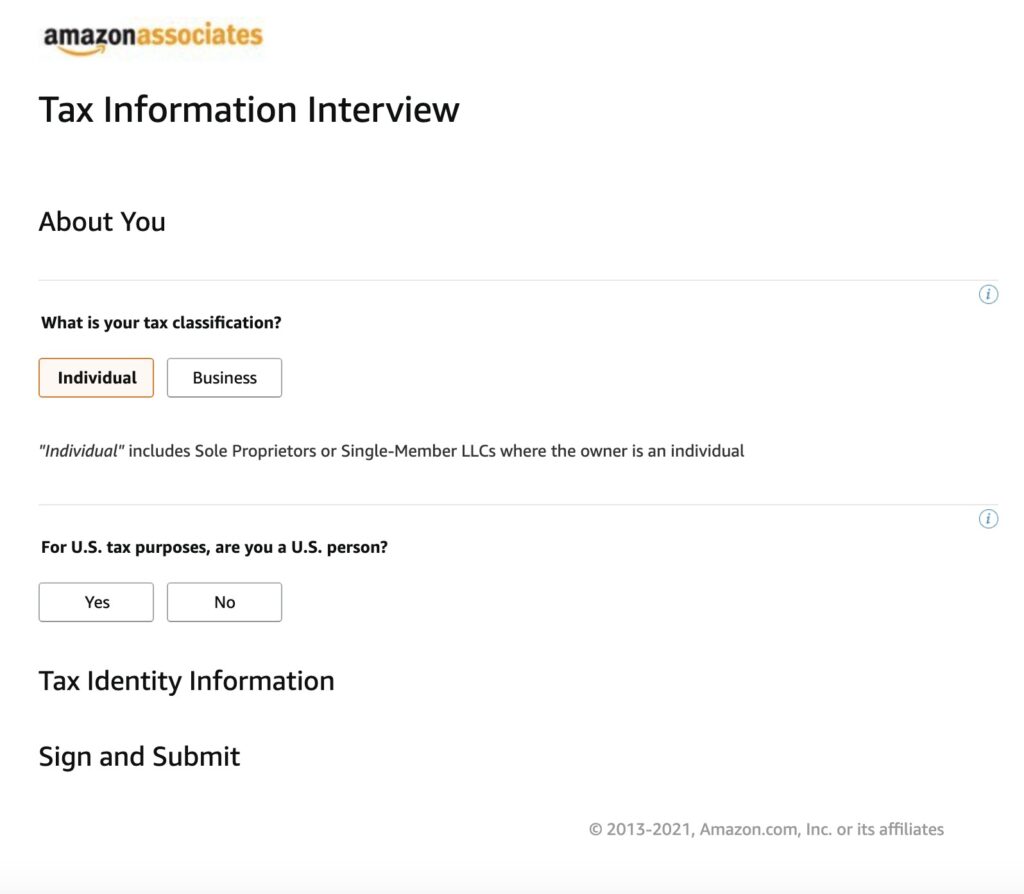
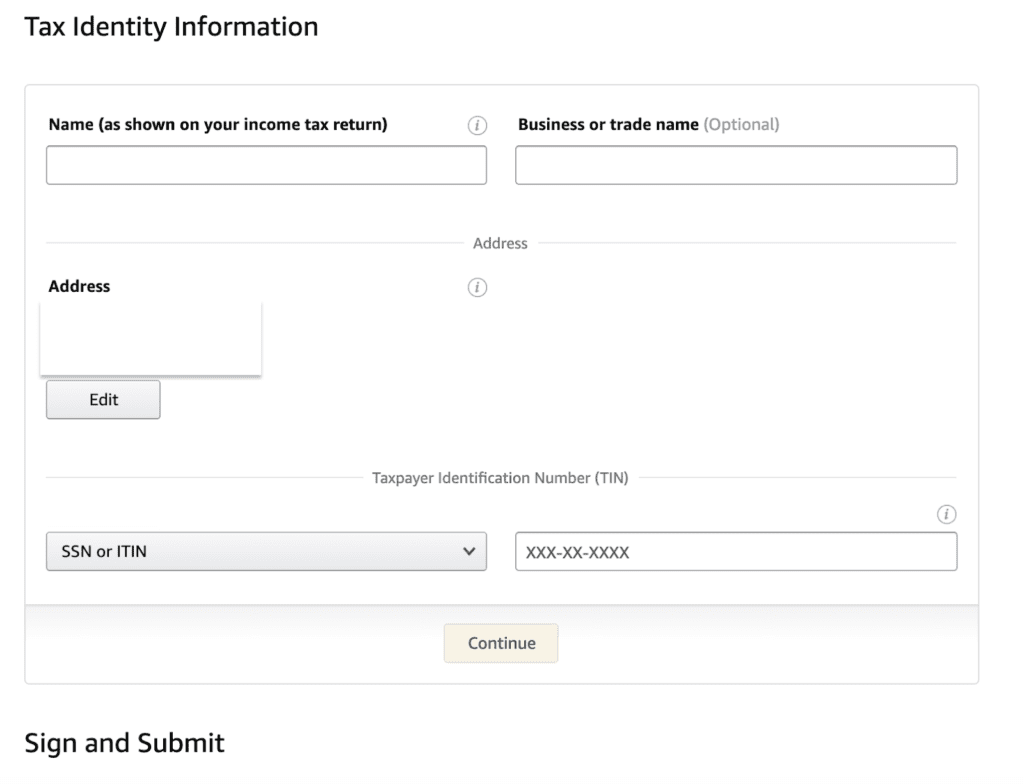
- Tax information depends on where you live, but the US Version is depicted below.
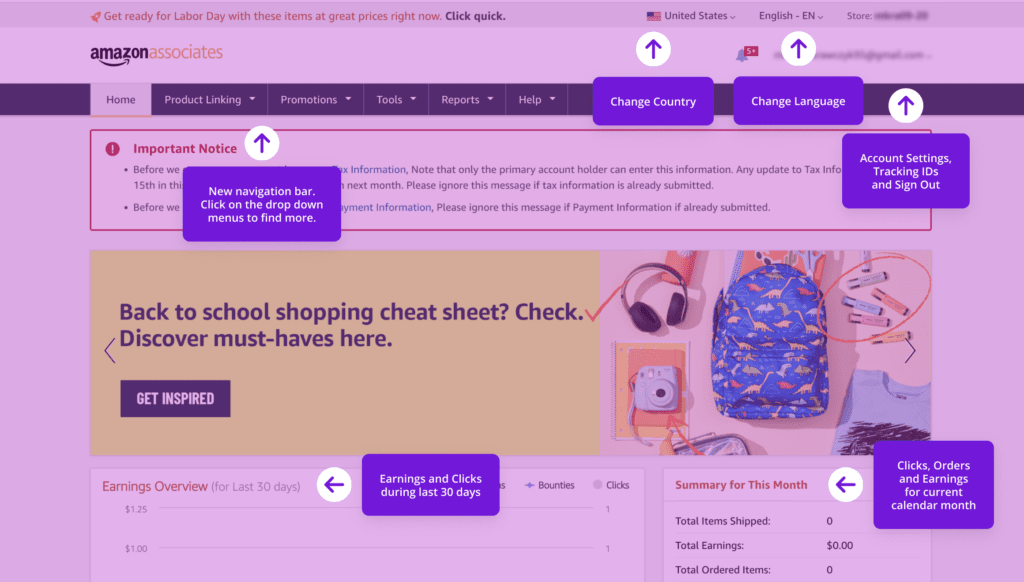
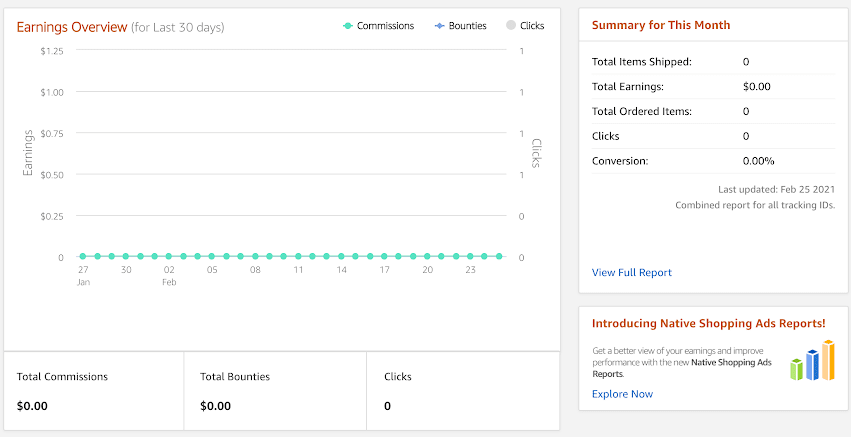
- Now, you are not only officially part of the Amazon program, but also all set up to get paid 😉 Below is your default Amazon Associates dashboard where you can search for product links, see your earnings overview, and a monthly summary. Check out a quick guide to where to find each.
Part II: How to Create Amazon Affiliate Links
You’ve enrolled in the Amazon affiliate program – what’s left to do? Choosing products to promote and getting your links. These are the links that you will be displaying in your website, blog, Youtube channel, or app.
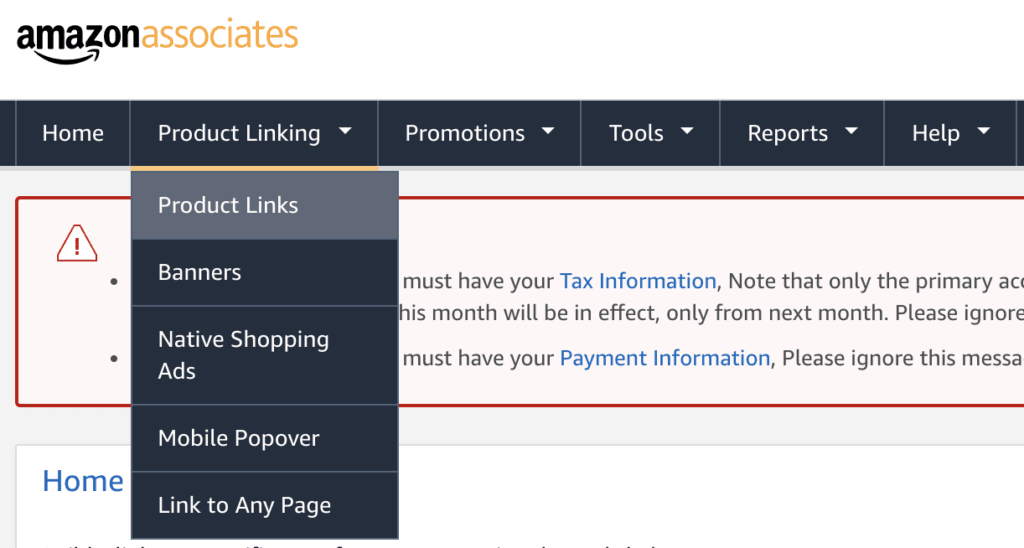
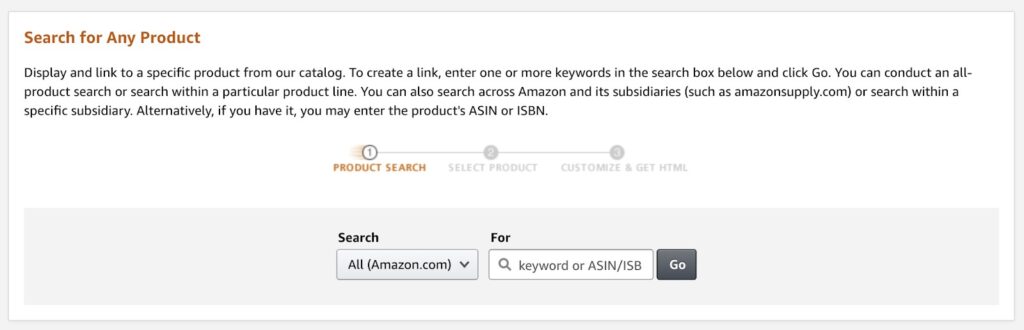
- Hover over the Product Linking menu and select the Product Links button.
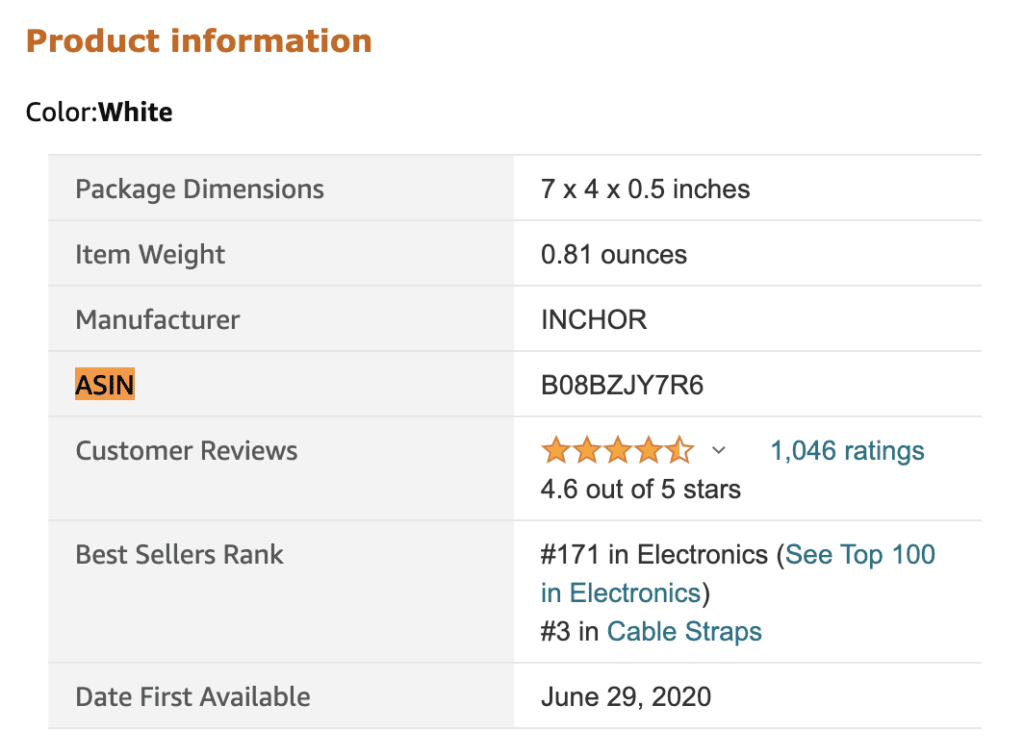
- Either search for a product, or type in the product’s specific ASIN number. The 10 figure ASIN is located in the Product Information of section, as shown below.
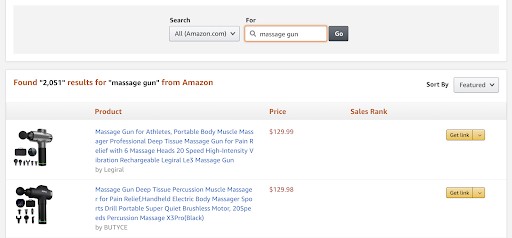
- Based on the search results, select the product you want to promote and click on “Get Link”.
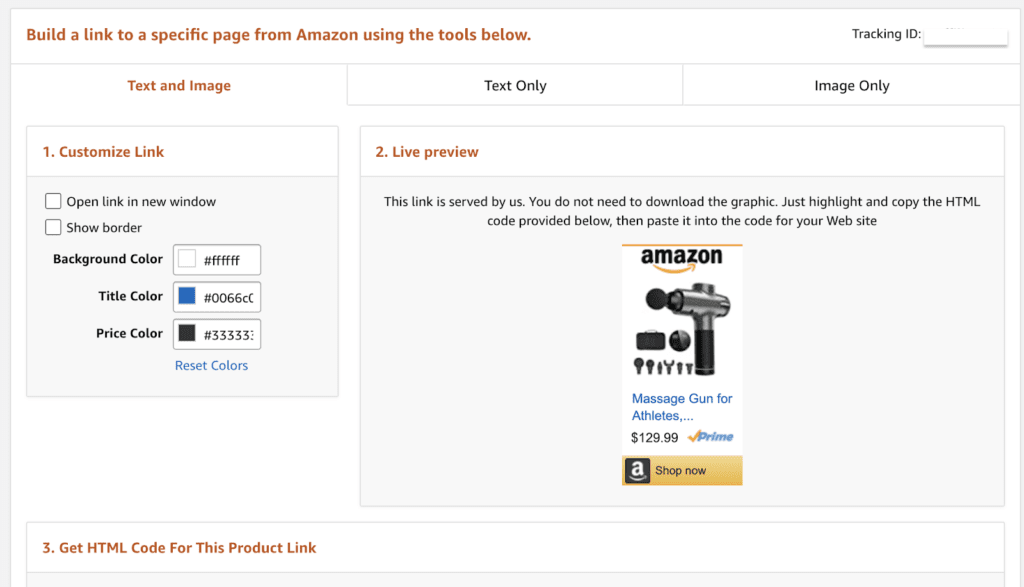
- You are now at the “Customize & Get HTML” final step. Here, you can choose whether you want your link in the form of text, image, or text and image. Below I have both “Text and Image” selected.
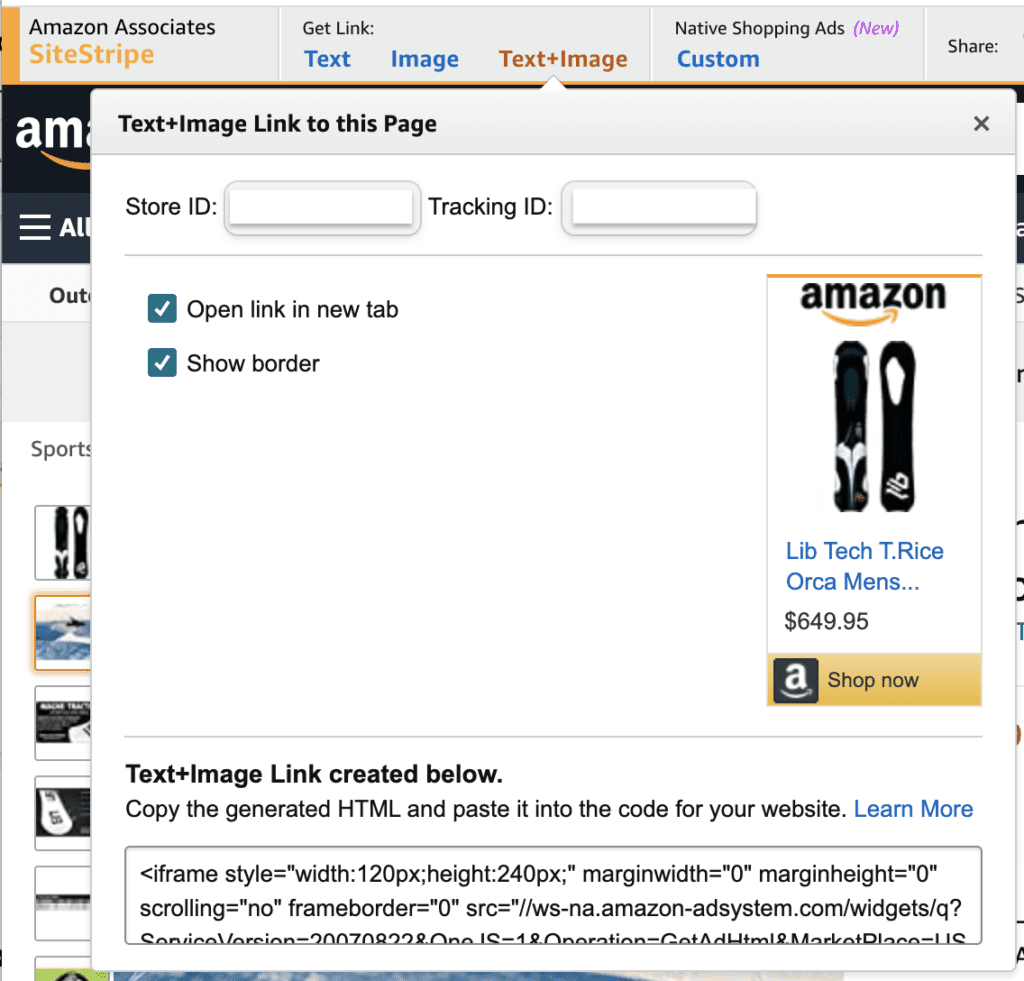
- Not exactly a fifth step, but rather another route to getting a product link is the “Amazon SiteStripe” function.

Simply click which format you want your ad in (Text, Image or Text + Image), a window will appear (as shown below), and copy and paste to your website.
Top Ways to Drive Traffic to Your Amazon Offers
Like you’ll find out in our next section, there’s a minimum number of sales you must reach through your affiliate link – otherwise, your Amazon Associates account gets banned! The minimum number of sales set by Amazon is low, but you’ve got to reach it, or else you’re out of the game… not to mention nowhere near a profit 😥
You’ll probably need to drive traffic to your offers.
As we’ve outlined previously, making money from Amazon offers comes with volume. Using a comprehensive affiliate tracker, you can test different traffic sources, optimize ad spend, and automate parts of your campaigns for better results. 🙂 But in all seriousness, in our next few campaign strategies outlined, an ad tracker is essential to optimizing and controlling your advertising strategies.
Also, remember! It’s better to link promoted ads to your website’s lander; here users can click on the official Amazon offer link and make their purchase!
- Email – If you have an email list, definitely use it to direct users to your website. Make sure to target people who are interested in your offers so you’re not spamming them.
- SEO – Search Engine Optimization is a source of unpaid traffic. It takes quite a long time and a lot of work to be effective. However, by making a niche site with niche products, you can target specific keywords with minimal competition to drive users to your sites.
- Native – SiteStripe allows you to share Amazon offers in native advertising. However, if you want to be more creative, have more control, and optimize your own campaigns to a tee, you should consider running your own native campaigns. Outbrain and Taboola are two of the best native traffic sources but try a demand site platform like a DSP where lots of traffic sources are available in one hub. Read more about the importance and increasing value of native advertising here.
- Social Media – Again, you can use SiteStripe to directly share Amazon offers to Twitter or Facebook. But what about the plethora of other trendy social media platforms? Try advertising on Instagram, Tiktok, or anywhere else with your own original campaigns.
- Paid ads (push, pop, search, etc) – Sometimes SEO just isn’t enough… and that’s where paid campaigns come into play. Try sources platforms like Google Ads, Zeropark, and PropellerAds, or just read through our ranking for best traffic sources here. However, make sure not to directly promote your Amazon link to any search engine results! Usually, you should promote your own website where you can expose customers to your offers.
There’s plenty of ways to get traffic to your site and Amazon affiliate program offers – but which ones will be successful? Check out our latest ratings of the best traffic sources out there. You’re going to have to test different platforms and sources to see what works best for your niche, and website.
To do all this well, you’re also going to have to stay on top of every impression, conversion and factor that goes into a successful campaign. How else could you do this than with Voluum Tracker?

Rules to Avoid Getting Banned from Amazon Associates
Like I mentioned, Amazon is indeed monitoring you and it’s not too hard to get shut down. This list of tips is not exhaustive, and the Amazon affiliate program policy frequently changes, so make sure to stay on top of things as best you can. Because if you do get shut down, you risk losing weeks or even months of revenue, usually with minimal explanation. So, aside from the (hopefully) straightforward, illegal things you shouldn’t be doing, here are some points to staying afloat with your Amazon affiliate program campaigns:
- The first hurdle to jump: make at least 3 sales in the first six months of opening your account. If you don’t, your account will be shut down – however you can open a new one afterwards. These sales can’t be from you, obviously. To avoid this issue, I advise you build up a website with some traffic and content before signing up to Amazon Associates. This way it won’t be as difficult to make these sales. Your friends/family shouldn’t use your link.
- Don’t cloak your Amazon links or modify them. In other words, no URL shorteners; offers hyperlinked to text or media must clearly show that users are going to Amazon. Also, identify yourself as an Amazon Associate and that you will earn commission off sales. This must be done with some kind of disclaimer placed near the offer.
- You cannot indicate any kind of reward or incentive for clicking on your affiliate link. This includes mentioning that buying through this link will benefit or support you, the affiliate. If you have followers who care that much about you, good for you – but sadly, you can’t use this to your advantage here.
- No misrepresentation of Amazon or your site. Definitely don’t try to make your website look like Amazon and don’t use their logo. (Of course, you can use the images provided via Sitestripe from Amazon.) You can’t insinuate any kind of partnership or endorsement from Amazon.
- Can’t display ratings/reviews/descriptions etc. And don’t mention prices either. Amazon doesn’t want you to display product attributes on your pages because their site is always updating and your figures or descriptions could be outdated. (That also means no copying images from Amazon) Of course, there is one exception here: if you use their API tool to integrate the content on your end with real-time updates. Also, you can of course provide your own, independent reviews.
- No posting links to non-public website platforms. So no posting on private platforms or in your paid course. Also, no posting links on forums. Basically, you can’t post on websites that you don’t control.
- No Amazon links in emails. No Amazon affiliate links in offline materials. You can’t have links in ebooks, brochures, texts either. An alternative? Use links that direct users to your offer page where they will then find the Amazon link.
- No promoting on social media except via SiteStripe. Also, no promoting links in search engine results. Here again, try to use links that direct users to your site where they can then access your offer links.

Success Stories: Top Amazon Affiliate Websites in 2025
So now you know how to join, how to get traffic and how not to get banned – but what about how to make money?
I’ve listed, detailed, and described 5 great Amazon Affiliate websites below – along with some successful strategies to learn from. These sites (originally) either mainly or exclusively focus on promoting and providing Amazon affiliate program offers.
However, I would preface this with a warning: as we’ve seen, it may not be a very profitable and reliable move to optimize your platform for only Amazon offers. Take these strategies with a grain of salt. Granted, many of these strategies can be effectively adapted for offers from other networks, so feel free to think outside the (Amazon delivery) box. In fact, many of these sites that were originally so focused on Amazon links around a year ago have now apparently started diversifying their affiliate offers.
Read through my brief summaries and visit their websites for even more insight.

A well-known review site of products from all categories. Part of the NYTimes family, it’s a place visited by computer nerds and tech enthusiasts alike, making it the perfect banner for affiliate links.
- Niche: Comprehensive product reviews (electronics, home goods, gadgets, etc.).
- Affiliate Links: Primarily Amazon Associates, but also links to Best Buy, The Home Depot, Apple, and others.
- Successful Strategies:
- Trust and Authority: Built on rigorous, hands-on testing and unbiased, in-depth reviews. They prioritize authentic recommendations over commission rates.
- Quality Content: Focuses on extremely thorough research (often hundreds of hours per review), resulting in high-quality, trustworthy content that readers rely on.
- Transparency: Clear about their affiliate model and review process, fostering reader trust.
- Diversification: While historically strong with Amazon, they incorporate links from various major retailers.

A website dedicated to PC entusiasts, helping them find the best PC parts and the best deals for them. Naturally, links are sponsored but hidden in plenty of informative content.
- Niche: PC components, PC building guides, compatibility checks.
- Affiliate Links: Significant use of Amazon Associates, alongside Newegg and other specialized retailers.
- Successful Strategies:
- Unique Tool: Developed a highly valuable, unique tool that simplifies the complex process of building a custom PC, ensuring compatibility between parts.
- Community Focus: Built a strong community around PC building, offering forums and user-completed build examples.
- User Experience: The site is primarily a functional tool, not just a content blog. It directly assists users in their purchasing journey by comparing prices and checking compatibility.
- Niche Authority: Established itself as the go-to resource in the PC building niche.

A legendary portal for everyone who like unusual gifts or accessories, who put design over function, and above else, enjoyment over price. The ebst place to find gadgets, clothing or computer parts – in short, the place where people spend money.
- Niche: Novelty items, quirky gifts, unusual gadgets.
- Affiliate Links: Heavily features Amazon Associates, but also includes Etsy, Awin, and direct manufacturer links.
- Successful Strategies:
- Viral Content: Focuses on unique, bizarre, and highly shareable products, generating traffic through curiosity and social sharing.
- Capitalizing on Variety: Leverages the vast and diverse product range available on platforms like Amazon and Etsy.
- Entertainment Value: The site offers entertainment and discovery, not just product listings.
- Diversified Sources: Successfully integrated links beyond Amazon, likely adapting to commission structure changes.

A comprehensive guide for people bent on outdoor living. This is a review site mixing honest and informative cotnent with affiliate links beneath.
- Niche: Outdoor gear reviews (hiking, climbing, skiing, camping, etc.).
- Affiliate Links: Primarily Amazon Associates, but likely includes other outdoor retailers.
- Successful Strategies:
- Rigorous Testing: Known for extensive, side-by-side field testing of products, providing credible, real-world comparisons.
- Detailed Reviews: Offers in-depth analysis covering performance, features, pros, and cons for each product category.
- Clear Rankings: Uses comparative ratings and clear “best for” recommendations, simplifying choices for consumers.
- Niche Authority: Established strong credibility within the outdoor enthusiast community.

There are virtually no amounts of money a parent of a newborn wouldn’t spend. This site helps parents make informed choices regarding chiildren accessories, clothing or toys.
- Niche: Baby products (strollers, car seats, monitors, etc.).
- Affiliate Links: Primarily Amazon Associates.
- Successful Strategies:
- Expert-Led: Founded by a pediatrician mom, lending credibility and expertise to reviews.
- In-Depth Testing: Focuses on detailed, comparative testing specifically relevant to baby products’ safety and usability.
- Targeted Audience: Caters specifically to the needs and concerns of parents, building trust within that demographic.
- Comprehensive Coverage: Reviews a wide range of essential baby gear, becoming a one-stop resource for new parents.
So, Is Amazon’s Affiliate Program Worth It This Year?
Like most things in life, the answer to this question isn’t black and white. Sorry about that.
The truth is, this article lays out the facts. We clearly weren’t sponsored by Amazon and we don’t stand to gain for their losses either.
If you’ve read the pros and cons, you’ll know for yourself whether Amazon Associates is a worthwhile business venture for you.
Though Amazon may have really low commission rates for most categories they offer an indisputably valuable trove of information. Their setup is easy; all you need is a website with traffic.
Should you choose Amazon Associates as part of your strategy, Voluum’s advanced features can help you test, optimize, and even automate affiliate campaigns, ensuring you make the most of your traffic and advertising budget.
FAQ
1. What exactly is the Amazon Associates Program?
The Amazon Associates Program is Amazon’s official affiliate marketing program. It allows content creators (like bloggers, website owners, or YouTubers) to sign up for free and earn money by promoting products sold on Amazon. You get unique links to share, and when someone clicks your link and makes a purchase on Amazon, you earn a commission. It’s popular because Amazon is a widely trusted brand with millions of products.
2. How do I actually earn money with this program?
You earn money through commissions. When a visitor clicks on your special Amazon affiliate link and buys anything on Amazon within a 24-hour window (this is the ‘cookie duration’), you get a percentage of that sale. Commission rates vary by product category, ranging from 1% (like groceries) up to 20% (for Amazon Games). A key benefit is that you earn commission on the entire shopping cart of the customer during that 24-hour period, not just the specific product you linked to.
3. What do I need to get started as an Amazon Associate?
Signing up is relatively easy if you meet the basic requirements. You’ll need:
- A regular Amazon account.
- An active website, blog, YouTube channel, or mobile app where you’ll promote products.
- Your platform should have some original content already published. Amazon prefers sites with existing traffic, partly because you need to make at least 3 qualifying sales within your first 180 days to keep your account active.
4. Can I realistically make good money as a beginner?
It varies greatly. You can make money, ranging from a small side income (“hobbyist level” covering small expenses) to potentially a full-time income, but it requires effort and strategy. Because commission rates on many popular categories are quite low (often 1-4%), making significant money usually requires either selling very high-priced items or generating a large volume of sales through substantial website traffic. Success often depends on your niche, traffic generation methods (SEO, paid ads, etc.), and how effectively you can convert visitors into buyers. Using paid traffic requires careful management to ensure your earnings per click (EPC) are higher than your cost per click (CPC).
5. What are the most important rules I need to follow to avoid getting banned?
Amazon has strict terms, and getting banned means losing potential commissions. Key rules for beginners include:
- Make 3 Sales: You must generate at least three qualifying sales within the first 180 days.
- Disclose Your Relationship: You MUST clearly state on your site that you are an Amazon Associate and may earn from qualifying purchases. This disclaimer needs to be easily visible.
- Don’t Cloak Links: Use the links Amazon provides. Don’t use URL shorteners or try to hide that the link goes to Amazon.
- No Links in Emails/Offline: You cannot put affiliate links directly into emails, ebooks, PDFs, or any offline materials. Link users to your website page where the Amazon link resides instead.
- Don’t Manually List Prices/Reviews: Avoid stating specific prices or copying Amazon reviews/ratings directly onto your site, as this information changes frequently. Use the Product Advertising API if you want to display up-to-date info directly from Amazon.
- Use Public Platforms: Only post links on websites, public social media profiles (using SiteStripe where appropriate), or apps that you own and control. Don’t post in private forums or groups you don’t manage.



 Facebook
 Telegram