


The Hidden Cost of Running Without a Central Dashboard
Performance advertising moves fast. When you’re buying across various channels, every platform brings its own reporting logic, attribution model, and cost structure. Reconciling all of that into something actionable stops being a quick task and starts becoming a job in itself.
That was the situation in which a media buyer, one of Adcash’s prime clients, found themselves in as their volume grew. Without a central place to match media costs against affiliate revenue, optimization slowed down and decision-making got harder. Figuring out which campaigns, zones, or creatives were genuinely driving results meant jumping between systems and doing a lot of manual cross-referencing. It was workable, but far from optimal.
They needed a single source of truth. Not just one that pulled data together, but one that made it possible to act on that data quickly.
Why Voluum, and Why From the Start
Adcash recommended Voluum for them and that endorsement carried weight.
After a couple of years of daily use, Voluum become central to how their operation runs.
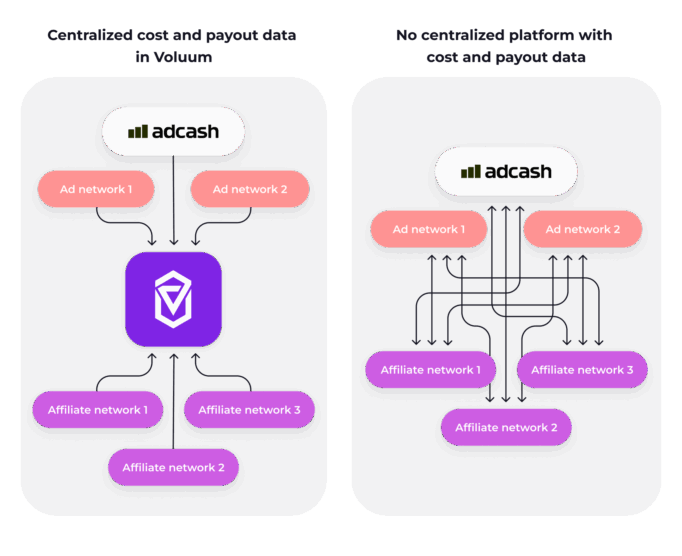
The initial draw was practical: reliable cost syncing across all traffic sources, including Adcash, zone and source management, and all optimization opportunities that Voluum unlocked. What kept them on it was how those features held up in practice.
Because most affiliate platforms support S2S tracking, Voluum became the one place where media cost, revenue, and profit could be seen side by side. That alone removed a significant amount of daily friction. The cost syncing worked consistently across their source mix, which made cross-source analysis trustworthy rather than approximate. The Automizer handled the kind of repetitive optimization tasks that used to eat into team time: pausing placements that weren’t performing, adjusting bids based on live results, enforcing logic overnight when no one was watching. That saved the client hours on manual work
The reporting depth also made a difference. Being able to group and drill down by more than one dimension at a time meant they could understand performance at the intersection of source, zone, creative, and offer, all at once, rather than running separate reports and trying to connect the dots manually. The Anti-Fraud Kit added a further layer of confidence that spend was reaching real users, which matters a great deal on high-volume campaigns where bad traffic quietly chips away at margin.
The Results
Since moving to Voluum, the client has recorded a 37% increase in FTDs, a 22% improvement in ROI from ads, and recovered 30 hours of team time per week. Those numbers reflect what consistent, unified data and around-the-clock automation actually unlock at scale.







 Facebook
 Telegram