

The online gambling industry is not slowing down. Not even close. Global iGaming revenue is projected to surpass $655 billion in 2026, driven by mobile-first players, crypto-native platforms, freshly regulated markets in Latin America and the US, and an arms race of live casino content that would have seemed science fiction a decade ago. For operators, affiliates, and anyone trying to build a profitable gaming business, the single most important decision you make is who powers your platform.
Pick the wrong iGaming software provider and you are fighting with your own infrastructure: compliance headaches, game integration bottlenecks, payment failures at the worst possible moment. Pick the right one and the tech fades into the background while you focus on growing your brand.
This guide breaks down the top iGaming software providers and top iGaming solutions providers of 2026 into two connected lists, explains exactly what separates the good from the great, and gives you a practical framework for making that decision.
What Is the Difference Between an iGaming Software Provider and an iGaming Solutions Provider?
Before diving into the lists, it helps to draw a clear line between these two categories, because a lot of guides throw them into the same pot and leave you more confused than when you started.
iGaming software providers are companies that develop and supply the core technology stack: the games themselves, the platform engine, the sportsbook logic, the RNG certification, the math models. Think Evolution Gaming writing live dealer software or Pragmatic Play shipping a new slot title every couple of weeks.
iGaming solutions providers are broader in scope. They deliver end-to-end infrastructure, which means not just the software but the Player Account Management (PAM) system, payment gateways, KYC and AML compliance modules, bonus engines, back-office dashboards, and often white-label or turnkey setups that let an operator launch an entire casino in a matter of months. Think SoftSwiss or EveryMatrix: companies where “just the games” is barely scratching the surface of what they actually do.
The two categories overlap significantly. Some of the best providers in the industry sit comfortably in both camps.
How We Picked These Providers
With literally hundreds of companies claiming to be leaders in this space, a clear selection framework matters. Here is what we actually looked at:
Regulatory standing and market access. In 2026, compliance is no longer just a legal checkbox. It is a commercial advantage. The providers on this list hold licenses in multiple jurisdictions, including demanding ones like the UKGC, MGA, and increasingly, US state regulators. If a provider cannot get you into Brazil, the UK, or New Jersey, they are limiting your ceiling from day one.
Technology architecture. The gap between platforms that were built for scale and those that were not becomes obvious the moment traffic spikes or a market regulation changes. We looked for cloud-native infrastructure, API-first design, and platforms that can handle multi-vertical operations without duct-tape integrations.
Game depth and aggregation. Players come for content. A platform that gates you into a narrow library or forces painful custom integrations for top studios is a real problem. Game count matters, but so does the quality, the variety, and the relationship with top studios like Pragmatic Play, Evolution, and NetEnt.
Crypto and payment flexibility. By 2026, around 38% of online casinos accept USDT as a standard payment method, and over half of all bonuses are reportedly paid in stablecoins. Providers that have made crypto a first-class citizen rather than an afterthought are simply better positioned for where the market is heading.
Support for operators at different stages. A startup launching its first white-label casino has completely different needs than an established operator processing millions in monthly GGR. The best providers can serve both, often with modular pricing and deployment options.
Track record and client roster. Proven results across real operators in real regulated markets beat press releases every time. We weighted providers that have powered recognizable brands and can show actual case studies.
Top iGaming Software Providers in 2026
1. Evolution Gaming

If there is one company that has redefined what “premium iGaming software” looks like, it is Evolution. Starting as a live casino specialist, Evolution has turned itself into a content conglomerate through smart acquisitions: NetEnt, Red Tiger, Big Time Gaming, Nolimit City, Ezugi, and DigiWheel all sit under its umbrella.
What makes Evolution stand out in 2026 is less about the sheer volume of games and more about the benchmark it sets for immersive live experiences. Their live dealer tables are the gold standard operators measure everything else against. Live Blackjack, Lightning Roulette, Crazy Time, and their growing roster of game show formats keep players in sessions longer than almost anything else in the market.
They hold broad licenses across the UK, Malta, multiple US states, Canada, Sweden, and beyond, making them one of the few content providers that can genuinely support global operator ambitions. For any operator where live casino is a serious revenue vertical, Evolution is not optional.
2. Pragmatic Play

Pragmatic Play has had a remarkable rise. Founded in 2015, the company has turned consistent, high-quality output into one of the most recognizable catalogs in online gaming. Gates of Olympus, Big Bass Bonanza, The Dog House Megaways, Sugar Rush: these are not just popular slots, they are cultural touchstones for online casino players worldwide.
What operators actually love about Pragmatic is the operational simplicity. A single API unlocks their entire suite: slots, live casino, virtual sports, bingo, and a growing sportsbook vertical. Their mobile-first development approach means games perform reliably across devices without operators needing to manage separate mobile builds.
Their regional expansion strategy is aggressive and deliberate. They have been steadily growing in Latin America, Asia, and Europe simultaneously, which makes them an excellent partner for operators with multi-market ambitions. Add the Drops and Wins tournament system, which runs across hundreds of operator sites and creates genuine cross-brand player excitement, and you have a content provider that also acts as a retention engine.
3. Microgaming
Few companies can claim to have built the foundations of an entire industry, but Microgaming genuinely can. They were among the first to launch a real-money online casino and they pioneered online poker rooms before most people had broadband internet. That heritage could easily make a company complacent. Instead, Microgaming has used decades of revenue and relationships to build one of the widest-reaching game networks in the world.
Their progressive jackpot network, home to Mega Moolah and WowPot, continues to generate the kind of life-changing payouts that get news coverage and drive organic player acquisition for operators. In 2026, Microgaming is deepening its footprint in Latin America and strengthening RNG certification for US market compliance, two of the most commercially significant expansion areas right now.
The Microgaming Poker Network remains active across dozens of rooms, and their mobile-optimized portfolio now sits above 800 titles. For operators who want the reassurance of a name that players already trust, Microgaming delivers that instantly.
4. Play’n GO
Play’n GO has built its reputation on one clear principle: regulated markets first, everywhere. While some game studios chase volume, Play’n GO goes deep on compliance in challenging jurisdictions and then builds player-focused content on top of that foundation.
Their HTML5 library covers slots, table games, and video poker with consistently high production values, and they have been particularly strong in Scandinavian and Northern European markets where regulatory standards are strict. The Book of Dead series alone has generated a loyal player following that rivals anything in the industry.
In 2026, their appeal to operators is less about being the flashiest name and more about being the most dependable: games that load reliably, pass certification in tough markets, and perform consistently on mobile. That kind of operational reliability is worth more than most operators realize until they experience what bad integration looks like.
5. NetEnt (via Evolution)
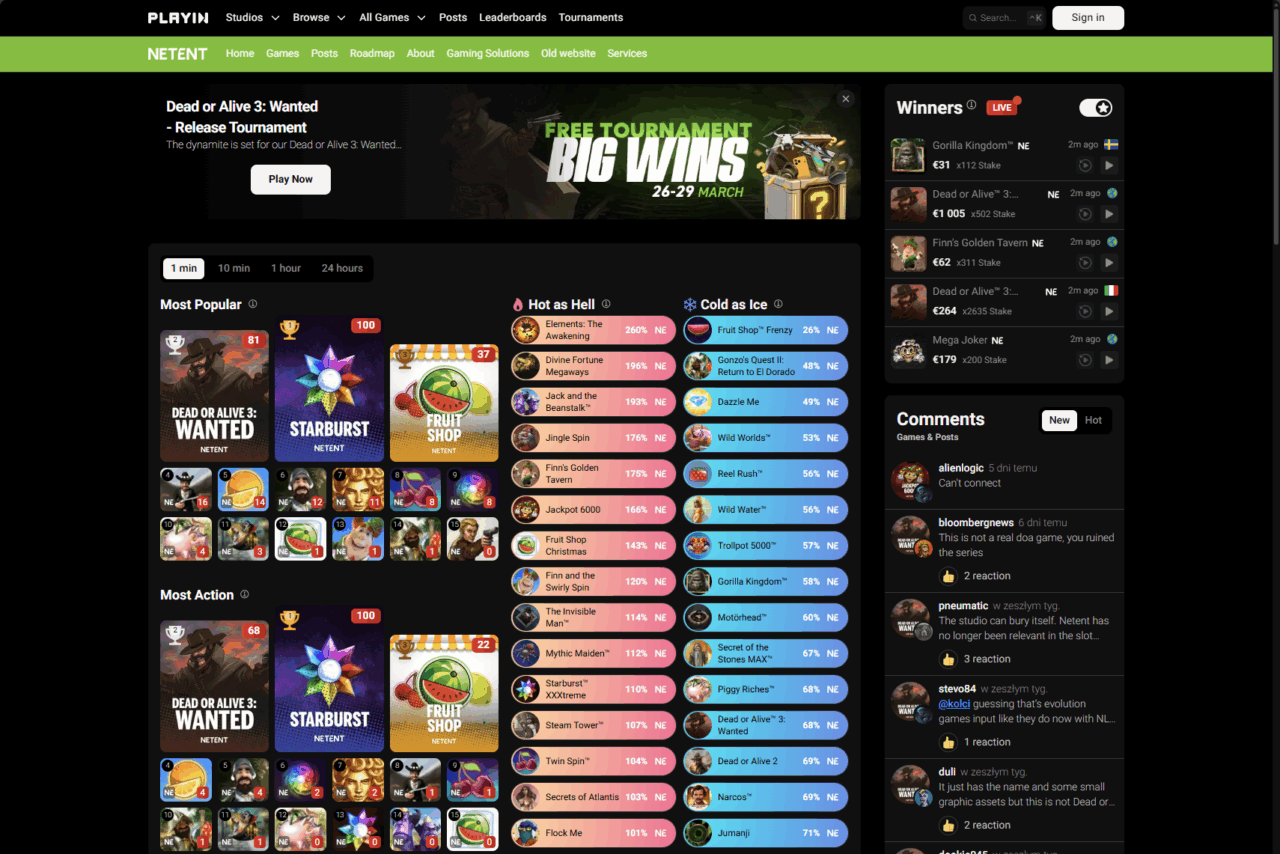
Technically now part of the Evolution family since the 2020 acquisition, NetEnt still carries its own identity in the market and for good reason. Starburst, Gonzo’s Quest, and Divine Fortune remain some of the most recognized titles in the entire industry, and their ability to convert first-time depositors remains unmatched by many newer studios.
NetEnt’s strength in 2026 lies in two things: brand recognition that operators can lean on for player acquisition, and polished HTML5 mechanics that still hold up technically. The integration benefits of being inside the Evolution ecosystem mean operators can access NetEnt alongside Red Tiger and Nolimit City through a single connection, which simplifies an otherwise complex aggregation decision.
Top iGaming Solutions Providers in 2026
1. SoftSwiss
SoftSwiss began as a white-label casino platform and has quietly evolved into one of the most comprehensive iGaming ecosystems on the market. What started in 2009 with a focus on crypto payments has become a multi-product infrastructure provider covering a Casino Platform, Game Aggregator, Sportsbook, Jackpot Aggregator, and back-office management tools that would satisfy most enterprise-grade operators.
The crypto story is real and it matters. SoftSwiss was among the first major platforms to bet on Bitcoin and alternative payment rails, and that foresight has turned into a genuine competitive advantage as stablecoin transactions and crypto withdrawals become expected features rather than novelties. Their Game Aggregator connects operators to 200+ studios through a single API, giving access to massive content depth without the integration overhead.
In 2026, SoftSwiss has added AI-powered retention tools and anti-fraud solutions to its managed services stack. If you are launching a crypto-forward casino or targeting players in markets where traditional payment rails are unreliable, SoftSwiss is one of the first platforms worth serious evaluation.
2. EveryMatrix
EveryMatrix occupies a fascinating position in the market: a pure B2B company with no consumer-facing operations whatsoever, which means their entire focus is on making operators successful. Founded in 2008 and headquartered in Malta, the company now employs over 1,500 people across 16 offices and serves customers ranging from scrappy new entrants to some of the biggest state-owned lottery operators in Europe.
Their product suite is genuinely modular. Operators can use CasinoEngine for game aggregation (access to over 45,000 titles from 360+ suppliers), GamMatrix for player account management and compliance, OddsMatrix for their sportsbook data feed, PartnerMatrix for affiliate management, and MoneyMatrix for payments. The key word is “or”: these products can work together as a full turnkey stack, or bolt onto an existing infrastructure where needed. That flexibility is rarer than it sounds.
What makes EveryMatrix particularly interesting heading into the second half of 2026 is their World Cup positioning. Their new Pass The Stats feature for sportsbook turns player-prop bets into engagement tools by rolling stakes to substitutes when players are taken off, which is exactly the kind of product innovation that drives acquisition and in-play handle simultaneously.
Their US footprint is growing rapidly, with licenses in Connecticut, Michigan, New Jersey, Pennsylvania, West Virginia, and Ontario. The betOcean deal in New Jersey, completed in under four months including regulatory approval, shows they can move quickly in demanding regulated markets.
3. Playtech
Playtech is simultaneously a top iGaming software provider and one of the most complete solutions providers in the industry. Founded in 1999, the company has grown from a standalone casino developer into a global platform ecosystem that powers over 40,000 betting kiosks worldwide and holds 170+ licenses across different markets.
Their Player Account Management system is the backbone of what Playtech calls its omnichannel experience: a single wallet that travels with the player across sports betting, live casino, poker, and bingo without any friction. For operators building multi-product brands, that kind of unified session experience has a measurable impact on lifetime value.
Through acquisitions like Quickspin and Eyecon, Playtech also owns exclusive content that operators cannot source elsewhere. Their APIgrator hub lets operators launch thousands of games from hundreds of providers in a single technical session, which significantly reduces time-to-market for new verticals. If budget is available and the ambition is to build a proper multi-channel brand, Playtech delivers the full package.
4. BetConstruct
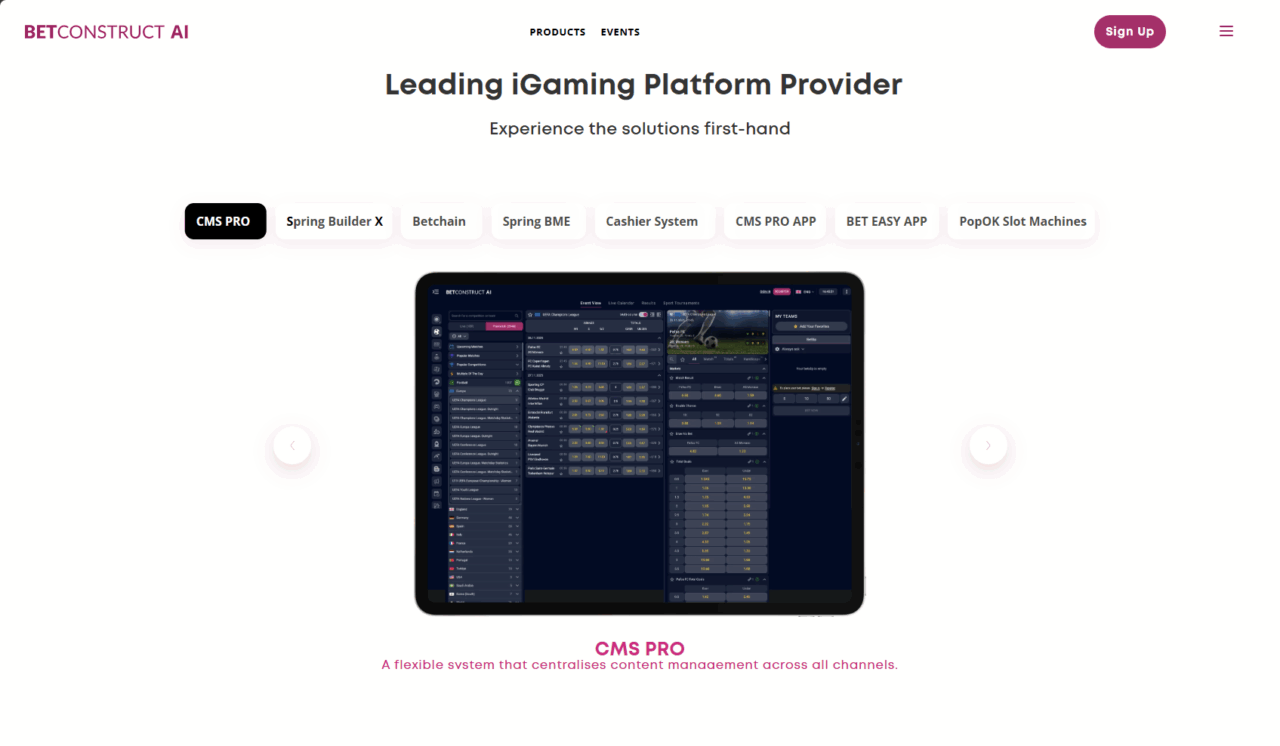
BetConstruct has steadily built a reputation as one of the most versatile solutions providers for operators who need serious sports betting capabilities alongside their casino product. Their platform covers casino, sportsbook, live betting, virtual sports, poker, esports, and fantasy sports, which is a breadth that few competitors match.
What distinguishes BetConstruct is the degree of operator control built into the platform. Rather than locking clients into preset configurations, they expose the kind of back-end controls that sophisticated teams actually need: front-end customization, odds management tools, player segmentation, and a risk management layer that scales with transaction volume. Their Spring platform is particularly well regarded for operators who want flexibility without the cost of building entirely custom tech.
They have been particularly active in Eastern Europe, Central Asia, and Africa, markets where their blend of localization, multilingual support, and flexible payment options translates directly into operator revenue.
5. Kambi
For operators who want a world-class sports betting product and are willing to integrate it as a dedicated vertical rather than an add-on module, Kambi is the answer most industry professionals point to. This Malta-based provider works with over 30 operators globally, and their client list includes some of the largest sports betting brands in the world.
Their differentiator is data. Kambi’s sportsbook is built around a genuinely sophisticated odds compilation and risk management engine, giving operators meaningful control over key player-facing elements like the front end and pricing in ways that white-label competitors often cannot. In 2025, they earned a Nevada gaming license and announced a Turnkey Sportsbook partnership with Latin American operator RedCap, signaling clear momentum in two of the most strategically important sports betting markets for 2026.
If live is Evolution’s domain in casino, Kambi holds a similar position in sports.
6. Slotegrator
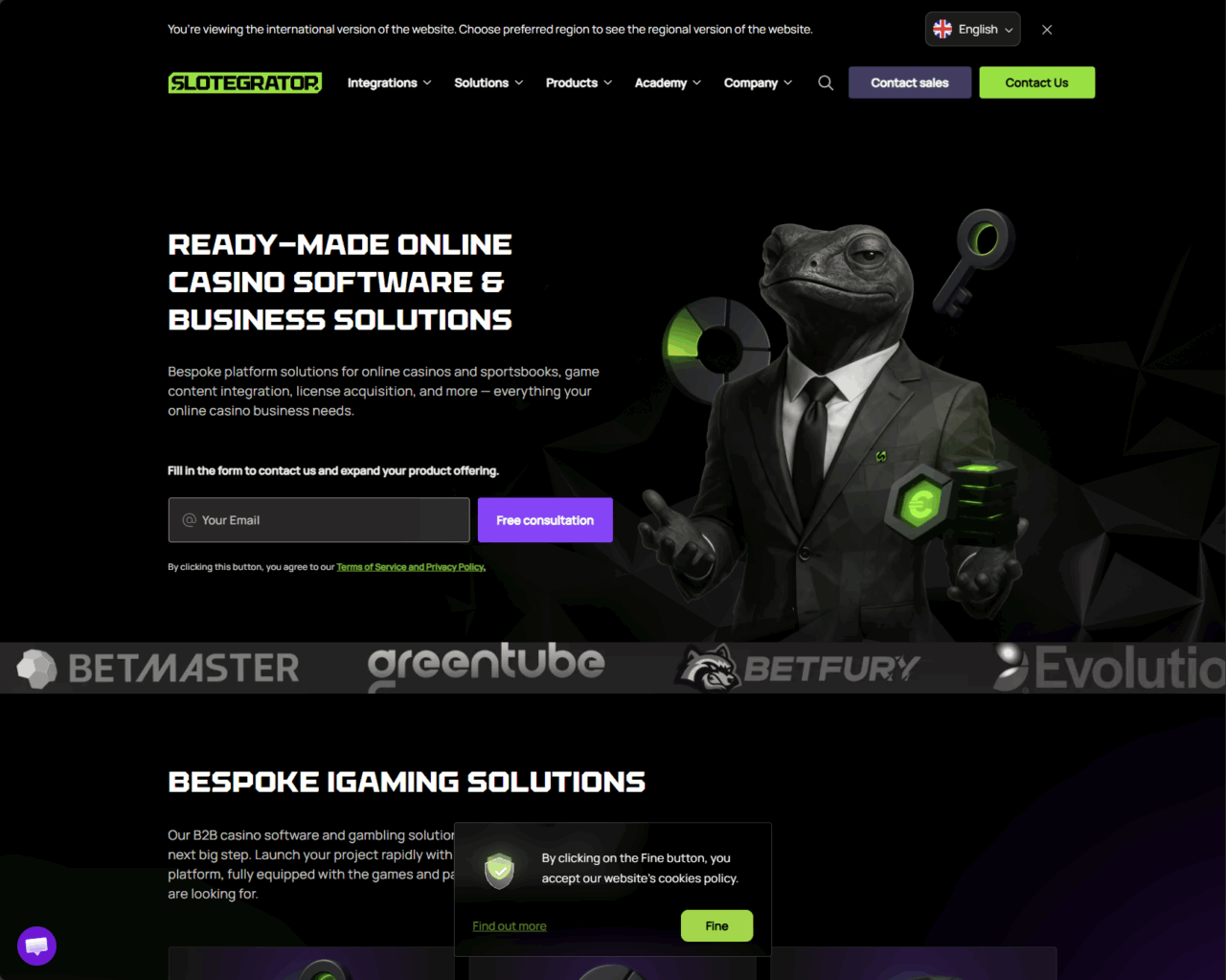
Slotegrator sits in an interesting middle ground: more comprehensive than a pure game aggregator but lighter-weight than a full enterprise solutions provider, which makes them a practical entry point for operators at earlier stages of growth or those managing several brands simultaneously.
Their 2026 platform features an aggregation library exceeding 40,000 games from 180+ providers. The Moneygrator AI Bot for automated payment management handles a lot of the operational friction that consumes operator time at scale, and Casino Builder 2.0 lets teams get a functional front end live quickly while they configure the back end in parallel. For operators who want to move fast without sacrificing game depth or payment coverage, Slotegrator consistently ranks as one of the more practical choices.
Tracking Performance Across iGaming Providers: Where Voluum Fits In
Choosing the right platform and content providers is only half the equation. The other half is understanding what is actually working once traffic is flowing.
This is where affiliate and performance tracking becomes critical for iGaming operators and affiliates. Voluum, a dedicated ad tracker built for performance marketers, is widely used across the iGaming affiliate space to track conversions across multiple traffic sources, campaigns, and GEOs in real time. When you are running campaigns across different regions, different payment methods, and different operator offers simultaneously, having a single dashboard where you can see what is converting and what is burning budget is not a nice-to-have. It is operational infrastructure.
For iGaming affiliates in particular, the ability to track post-click behavior, attribute first deposit conversions accurately, and split-test landing pages across different software environments makes the difference between scaling a campaign and guessing at it. Voluum integrates with major traffic sources and platforms, making it a natural complement to any serious iGaming operation regardless of which software provider sits underneath.
How to Actually Choose Between These Providers
Reading a list like this is useful. Knowing how to apply it is more useful.
Start with your go-to-market strategy. Are you launching fresh in a regulated market with a tight timeline? White-label solutions from SoftSwiss or Slotegrator get you to market in weeks rather than months. Are you building a multi-vertical brand with serious sports betting ambitions? EveryMatrix’s modular stack or Kambi’s dedicated sportsbook deserves a proper evaluation. Is live casino your revenue driver? Then the content question is almost settled before you start.
Think about crypto. If your target audience includes players who prefer crypto deposits and stablecoin withdrawals, choosing a platform that treats crypto as a secondary feature rather than a first-class payment rail will cost you conversions from day one.
Model your compliance path. The jurisdictions you want to operate in will narrow your provider choices more than almost any other factor. Not every provider has certifications in every market, and getting regulatory approval for new technology takes time you may not have.
Finally, do not underestimate the value of actual support. High transaction volumes mean payment failures and technical incidents are not hypotheticals, they are scheduled events. Providers who assign dedicated support teams to accounts that qualify by volume are not just a nice benefit, they are operational necessities.
Final Thoughts
The iGaming market in 2026 rewards operators who treat technology decisions as strategic choices rather than procurement exercises. The providers on this list are not interchangeable. Each has genuine strengths, natural use cases, and real-world limitations that become clear under load.
Take the time to stress-test assumptions before you sign. Model the revenue share versus licensing fee math for your projected volumes. Ask for references from operators in your target GEOs. Review the compliance roadmap for markets you plan to enter in the next 18 months.
The best iGaming software provider for your business is the one whose architecture matches your strategy, not the one with the biggest name on the sales deck.



 Facebook
 Telegram