

Your acquisition team knows that a player came from a TikTok campaign in Brazil, on a specific creative, on a Tuesday. Your CRM team knows that the same player deposited three times, went quiet and responds to free spins. In most iGaming operators, those two facts never meet.
That’s a missed opportunity on both sides. Retention journeys get built without knowing where players came from, and acquisition budgets get set without knowing which sources bring players who stay. This guide shows how to get Voluum’s click and campaign data into iGaming CRMs such as Optimove, Fast Track or Salesforce, which fields to map, which retention use cases it unlocks and how to send CRM-driven revenue back to Voluum.
Why Acquisition Data Belongs in Your iGaming CRM
An iGaming CRM decides who gets which bonus, message and journey. Most of its inputs are behavioral: deposits, game preferences, session frequency. Acquisition context adds a layer the behavior alone can’t show: the channel, campaign and creative that brought the player in, and what that player was promised in the ad.
That context changes decisions. A player acquired with a sports welcome offer during a major tournament needs a different first week than one who came from a slots creative. A traffic source whose players churn after one deposit deserves a different onboarding, or a smaller budget. Our article on moving from FTDs to lifetime value makes the case from the acquisition side; this one closes the loop from the CRM side.
How Voluum Data Reaches the iGaming CRM
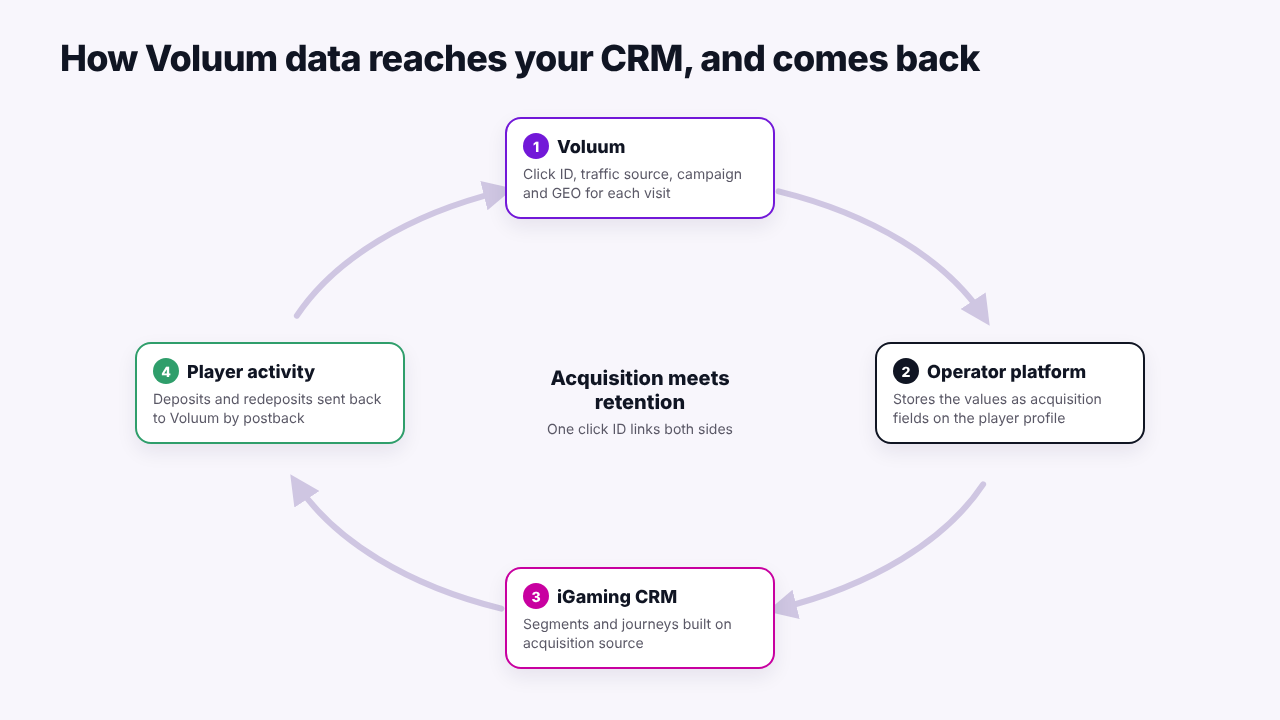
In most setups, the CRM doesn’t connect to Voluum directly. It gets player data from the operator’s platform, so the practical path is to put Voluum’s data on the player profile at registration, where the CRM can pick it up like any other attribute. For campaign-level figures, such as cost and ROI, Voluum’s reporting API fills the gap.
Route 1: Pass Voluum Tokens Through the Offer URL
Voluum replaces tracking tokens in your offer URL with real values for every visit. Add the ones you want the CRM to see as parameters on the URL that leads to registration:
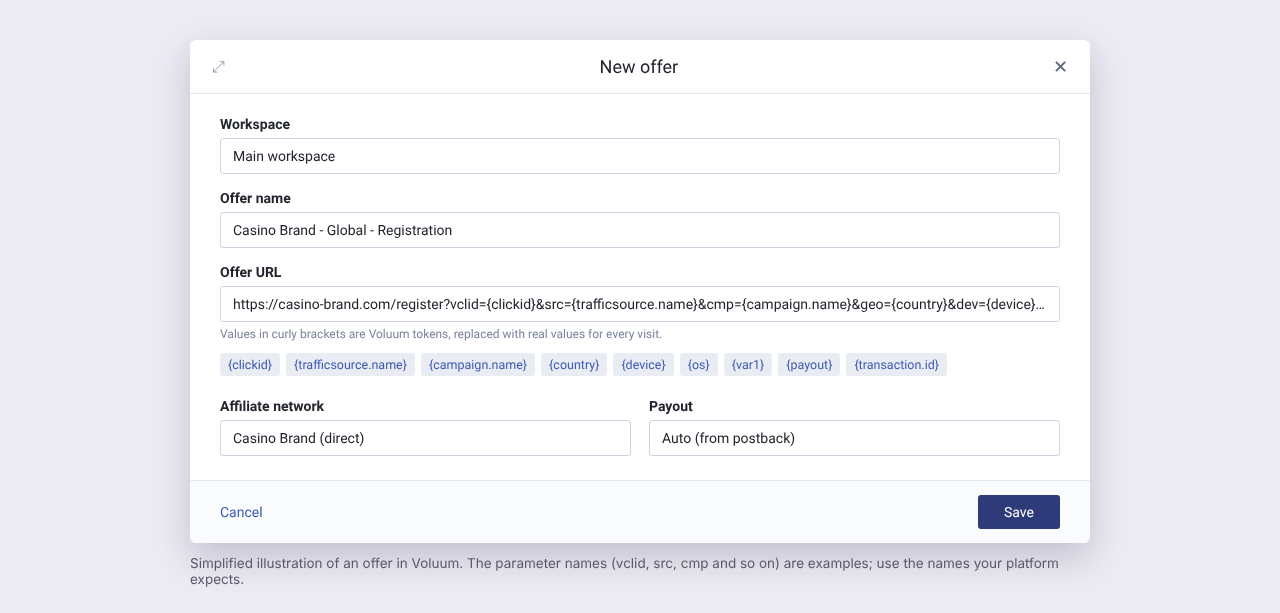
The operator’s registration flow then needs to read those parameters and store them on the player profile, usually as acquisition or marketing attributes. This step happens on the operator’s side, so it needs a developer or the platform provider. Once the values are on the profile, the platform’s regular sync sends them to the CRM along with everything else.
Route 2: Pull Campaign Data Through the Voluum API
Some data doesn’t belong on an individual player, such as campaign spend, CPA or ROI by source. For that, the Voluum API exposes report data that a data team can load into a warehouse or BI tool and join with CRM data by campaign or click ID. API access depends on your Voluum plan, and access keys keep scripts from needing your password. For lighter automations, workflow tools such as n8n can call the API too, as in our guide to Voluum conversion alerts with n8n.
Field-Mapping Table
Here’s a starting point for which Voluum tokens to pass and how to store them. The parameter and field names are examples; use your platform’s naming.
| Voluum token | Example URL parameter | CRM player attribute | What it enables |
|---|---|---|---|
| {clickid} | vclid | Acquisition click ID | Matching the player to their original visit and sending postbacks |
| {trafficsource.name} | src | Acquisition source | Journeys and reports by channel |
| {campaign.name} | cmp | Acquisition campaign | Lifetime value by campaign |
| {country} | geo | Acquisition GEO | Localized onboarding and offers |
| {device} or {os} | dev | Acquisition device | App versus web journeys |
| {var1} (for example, a creative ID) | crt | Acquisition creative | Matching welcome offers to the ad the player saw |
Keep the click ID even if you map nothing else. It’s the key that connects the CRM’s view of a player to Voluum’s view of the click, and it’s what makes the return path below work.
Retention Use Cases
Once acquisition data sits in your iGaming CRM, four use cases open up straight away.
Onboarding That Matches the Ad
A player who clicked a sports-betting creative and one who clicked a slots creative can land on the same registration page. With the acquisition creative and campaign on the profile, the CRM can send each one a first week of messages that continues the story the ad started, instead of a generic welcome.
Lifetime Value by Source, Not Just FTDs
Group players by acquisition source and campaign in the CRM, and you can compare 30, 60 or 90-day value per source. That’s the number that should set acquisition budgets, and it’s far more honest than first deposits alone. Our guide to advanced player segmentation goes deeper into building those cohorts.
Event-Driven Cohorts
Players acquired around a big event, such as the 2026 World Cup, often behave alike afterwards. Tag them by campaign and plan a reactivation journey before the event ends, rather than discovering the drop-off weeks later.
Quality Signals for Acquisition
When the CRM can see which sources bring players who fail verification, abuse bonuses or never redeposit, acquisition teams can act on it. Combined with the KYC events covered in our article on AML and KYC in iGaming affiliate marketing, this turns traffic quality from a hunch into a report.
Closing the Loop: Send CRM-Driven Revenue Back to Voluum
Retention revenue shouldn’t disappear from the acquisition view. When a CRM journey brings a player back to deposit, the operator’s platform can report that deposit to Voluum with a postback that carries the stored click ID.
- Use separate conversion types. Set up registrations, first deposits and redeposits as custom conversions, so each gets its own column.
- Send a unique transaction ID with every deposit. Voluum counts the same click ID and transaction ID only once, so redeposits need their own txid.
- Report revenue, not just counts. Pass the deposit or net revenue as payout, so ROI by campaign reflects long-term value.
With that in place, a Voluum report by traffic source shows not just which campaigns win first deposits, but which ones keep paying. Our guide to tracking first-time deposits and the iGaming tracking setup guide cover the postback side in detail.
A Note on Optimove, Fast Track and Salesforce
Optimove, Fast Track and Salesforce are all used by iGaming operators, and all three work with custom customer attributes fed from the operator’s data. The exact mechanics differ: field names, sync frequency and how new attributes are added depend on your setup and contract. Before you start, ask your CRM team three questions: which custom player attributes the CRM accepts, how often the platform syncs them, and whether historical values can be backfilled for existing players.
Two practical rules apply whichever iGaming CRM you use. Store acquisition data once, at registration, and never overwrite it later. And keep it free of personal data: click IDs, source names and campaign names identify a marketing journey, not a person.
Turn Acquisition Data Into Retention Decisions
Voluum gives every visit a click ID and records the traffic source, campaign, creative and GEO behind it, so your CRM can treat each player in context and your acquisition reports can count the revenue that retention brings back. You can even ask an AI assistant for those breakdowns through Voluum MCP. See how Voluum works.
Frequently Asked Questions
What is an iGaming CRM?
An iGaming CRM is a customer relationship platform built for online gambling operators. It segments players by behavior and value, and runs bonuses, messages and journeys across email, SMS, push and on-site channels. Optimove, Fast Track and Salesforce are among the platforms used in the industry.
How do I get ad tracker data into my CRM?
Pass the tracker’s click ID and campaign values in the offer URL, have the operator’s registration flow store them on the player profile, and let the regular platform-to-CRM sync carry them over. For campaign-level figures such as cost and ROI, load report data from the tracker’s API into a warehouse or BI tool.
Which acquisition fields should a CRM store?
At minimum, the tracker’s click ID, plus the traffic source, campaign, GEO and device. Creative or placement IDs are useful if you want onboarding to match the ad. Store them once at registration, keep them unchanged afterwards and avoid any personal data in these fields.
Can retention revenue be attributed to acquisition campaigns?
Yes. If the operator stores the tracker’s click ID on the player profile, every later deposit can be reported to the tracker by postback with that click ID and a unique transaction ID. The tracker then credits the revenue to the original campaign, so reports show long-term value per source.
Does Voluum integrate with Optimove or Fast Track?
The common setup doesn’t require a direct connection. Voluum passes acquisition data to the operator’s platform through the offer URL, the platform syncs it to the CRM, and deposits come back to Voluum by postback. Campaign-level data can be pulled from the Voluum API, depending on your plan.



 Facebook
 Telegram


