

Most trackers put a price on their pricing page. Hyros puts a form there instead. You pick your business model and monthly revenue, book a demo, and the number arrives on the call. Hyros’ own FAQ says the price follows the revenue it tracks for you.
That works for a coaching business with one funnel and a sales team. It’s a harder fit when you buy push, pop and native traffic across ten sources and get paid by a handful of affiliate networks.
Short answer: the best Hyros alternatives depend on how you make money. Affiliates and media buyers running many traffic sources should start with Voluum or RedTrack. AnyTrack suits affiliates who mainly need network conversions sent back to ad platforms. Cometly, Wicked Reports, Triple Whale and SegMetrics fit lead gen, e-commerce and info-product teams that want Hyros-style attribution with a different focus or, in most cases, a published price.
Disclosure: Voluum is our product. We reviewed it with the same template as every other tool here, limitations included.
How we compared the tools: for every one of the Hyros alternatives below, we used each vendor’s own website, pricing page and documentation, checked in November 2026. We know Voluum from the inside. We didn’t run identical traffic through all eight tools, so this is a structured comparison rather than a lab test. Where a vendor doesn’t publish something, we say so. For the wider field of trackers, see our ad tracking software comparison.
What Hyros Does Well
Hyros builds its tracking around business models: e-commerce stores, SaaS, courses and coaching, and businesses that sell on booked calls. Its integrations page lists about 70 connections, from ad platforms and carts to CRMs, schedulers like Calendly and iClosed, and call tracking through CallRail and Ringba.
According to Hyros, it runs off your existing UTMs, every plan includes a setup team, an AI analyst and a Claude MCP connection, and it backs the product with a guarantee: your ads grow or you don’t pay.
If you sell a $2,000 course through webinars and sales calls, that’s a strong package. The journey is long, the sale happens in a CRM or a calendar, and Hyros is built to stitch those steps together. We covered the differences in more depth in Hyros vs Voluum.
Why Media Buyers Look for Hyros Alternatives
The first reason is cost visibility. Hyros quotes each customer individually, and the price follows tracked revenue. For a media buyer testing new offers on thin margins, a bill that grows with revenue (not with profit) is hard to plan around, and you can’t compare it with other tools until you’ve sat through a demo.
The second is traffic coverage. As of November 2026, Hyros lists Meta, Google, TikTok, Bing, Pinterest, LinkedIn, X, Snapchat, Reddit and AppLovin among its advertising integrations. Push, pop and native networks such as Taboola, Outbrain or Zeropark aren’t on that list.
The third is where conversions come from. Affiliates get paid by networks that report conversions through S2S postbacks carrying a click ID. Hyros’ integrations center on stores, checkouts and CRMs. ClickBank and Digistore24 are there, so some affiliate setups work, but campaign tools like lander rotation, offer split tests and per-source cost sync aren’t what it’s built for. iGaming isn’t among its listed business models either.
None of that makes Hyros a bad tool. It makes it a tool built for someone else.
The 7 Best Hyros Alternatives in 2026
Each of the Hyros alternatives below gets the same treatment: who it’s for, where it does better than Hyros, where it falls short, and what it costs. Prices are on monthly billing and were checked on the vendors’ sites in November 2026.
1. Voluum: Best for Multi-Source Affiliate and iGaming Campaigns
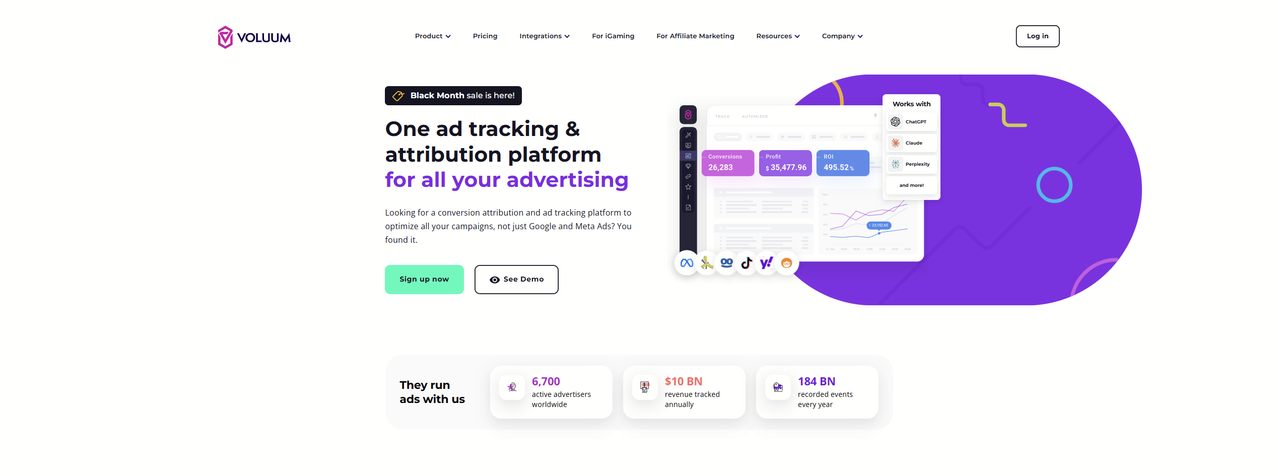
Voluum is a cloud ad tracker for media buyers, affiliates and iGaming teams who buy traffic from many sources. Every click gets a click ID, conversions come back by S2S postback or pixel, and you see cost, revenue and ROI by traffic source, campaign, lander, offer and GEO in real time.
Where it does better than Hyros: it’s built for the campaign side of affiliate work. Automizer connects traffic sources such as Taboola, Outbrain, MGID, Zeropark and EvaDav, plus Meta, Google and TikTok, to sync costs and run auto-rules. Traffic Distribution AI shifts traffic toward the landers and paths that earn the most, and the Anti-Fraud Kit flags suspicious clicks before they eat your budget (more in our bot traffic guide). For iGaming, Business plans add the iGaming Hub and an Affilka integration; see our roundup of iGaming tracking solutions. Voluum MCP lets you connect the AI assistant you already use to your data, as shown in these MCP workflows. Plans are published, and there’s a 14-day platform preview with no payment details required.
Where it falls short: Voluum credits each conversion to the visit whose click ID came back, which in a typical affiliate funnel lines up with last-click. If your sales close weeks later in a CRM or on a call, it won’t give you the multi-touch customer journey Hyros does (our attribution models guide explains the difference). Some features are tiered, too. The Anti-Fraud Kit starts on the Scale plan, Automizer is free up to $1,000 of monthly ad spend and paid above that, and, according to the pricing page, Conversion API postbacks to the major ad platforms are an add-on on Agency and included on Enterprise.
Pricing: Profit $149 per month, Scale $349, Start-up $599, Agency $999 and Enterprise $1,999, with event limits and overage on every plan (Voluum pricing, checked November 2026). Our Voluum pricing breakdown compares the plans with other trackers.
2. RedTrack: Best for Affiliates Who Want CAPI on Every Plan
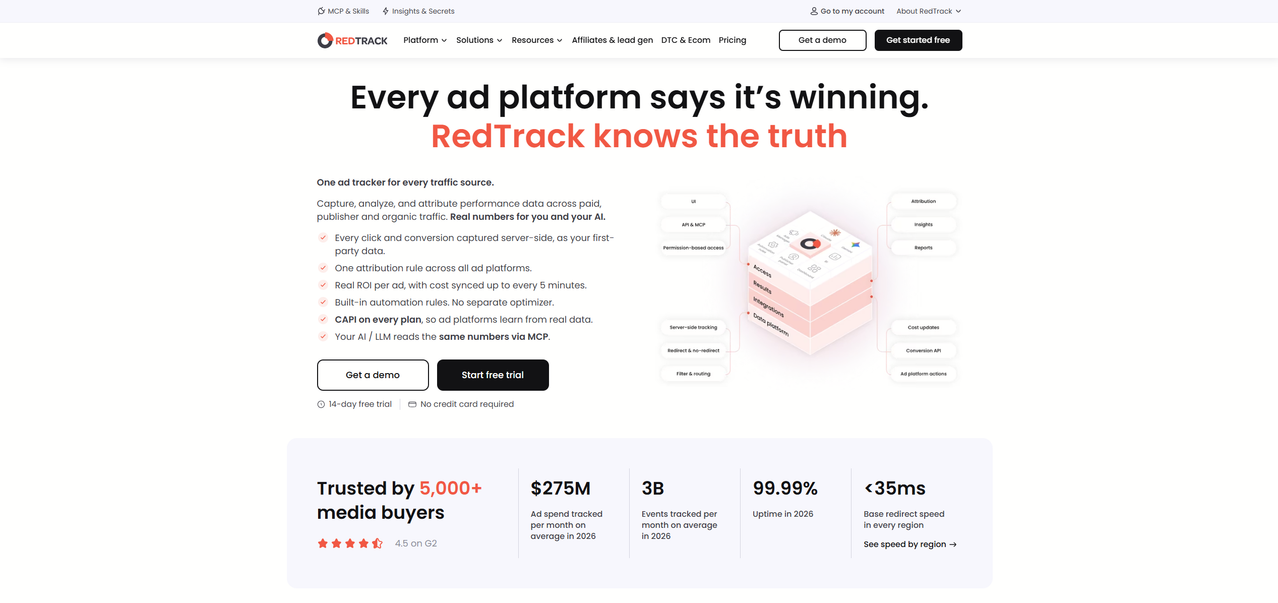
RedTrack is a cloud tracker with two product lines, one for affiliates and lead gen and one for e-commerce brands. The affiliate side covers redirect and direct tracking, S2S postbacks, MCP and API access, and ad-level cost sync from Meta, Google, TikTok and networks like Taboola, Outbrain, Zeropark, ExoClick and RichPush.
Where it does better than Hyros: every price is published, there’s a 14-day free trial, and Conversion API to eight ad platforms is included from the entry plan. It also covers the push and native sources Hyros doesn’t, and lists iGaming among its use cases.
Where it falls short: on the Solo plan, ad spend syncs every 60 minutes, and faster sync is a paid add-on priced by your ad spend. Scale Rules and editing campaigns from its Ads Manager are add-ons below the Enterprise plan. Multi-touch journey reports sit in the e-commerce product line rather than the affiliate plans.
Pricing: for affiliates and lead gen, Solo $169 per month, Team $399 and Enterprise $999, with annual discounts. E-commerce plans start with a free Relay plan, then Brand at $99 per month at the lowest revenue tier (RedTrack pricing, checked November 2026).
3. Cometly: Best for B2B and Lead Gen Pipelines
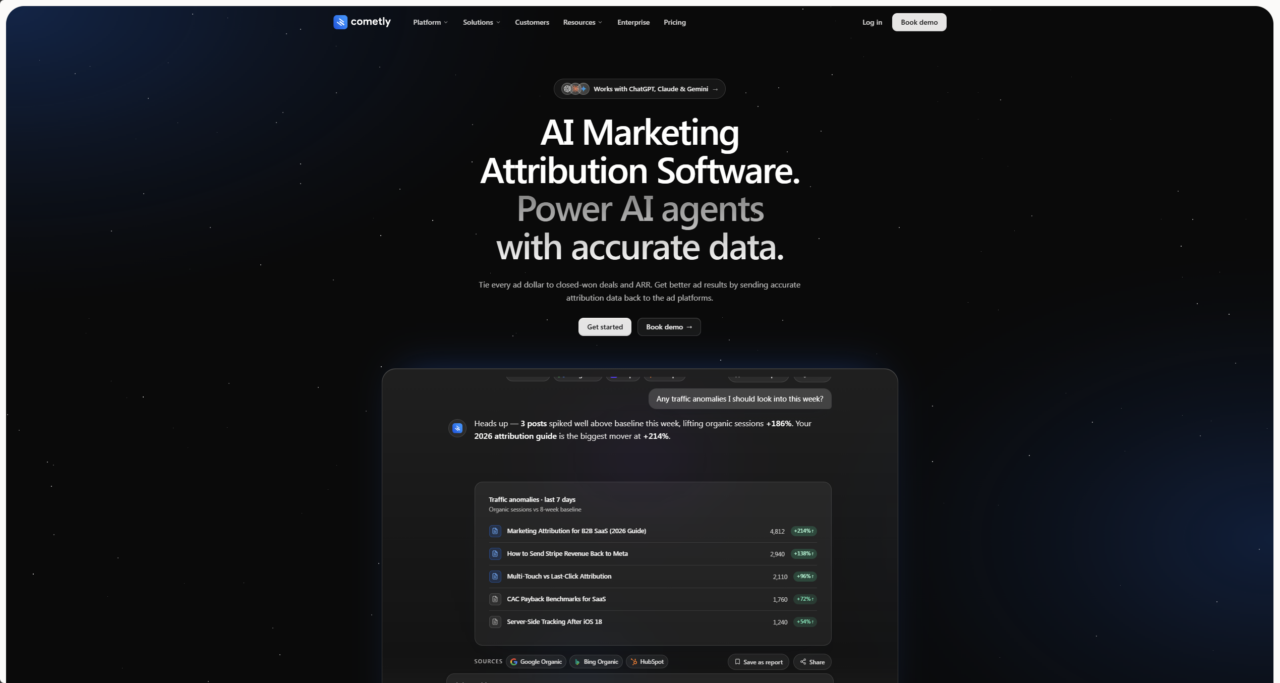
Cometly is the alternative closest to Hyros in spirit: ad attribution tied to revenue, with AI on top. As of November 2026, it positions itself around pipeline, showing which ads drive leads and revenue from first touch to closed deal. Its Core plan includes a pixel, server-side tracking, multi-touch attribution, Conversion API, an AI Ads Manager, MCP access and 70+ integrations.
Where it does better than Hyros: the pricing logic is public (tiers follow your monthly pageviews rather than revenue), you can pay monthly or annually with 20% off annual, and the CRM and warehouse focus suits B2B teams with long sales cycles.
Where it falls short: you still get your exact price on a call, and there’s no free trial. Ad platform connections cover Meta, Google, LinkedIn, TikTok, Microsoft, Reddit and Snapchat, with no push, pop or native networks or affiliate network postbacks listed.
Pricing: Core and Enterprise plans, sized to monthly pageviews and quoted by sales (Cometly pricing, checked November 2026).
4. AnyTrack: Best for Syncing Affiliate Conversions to Ad Platforms
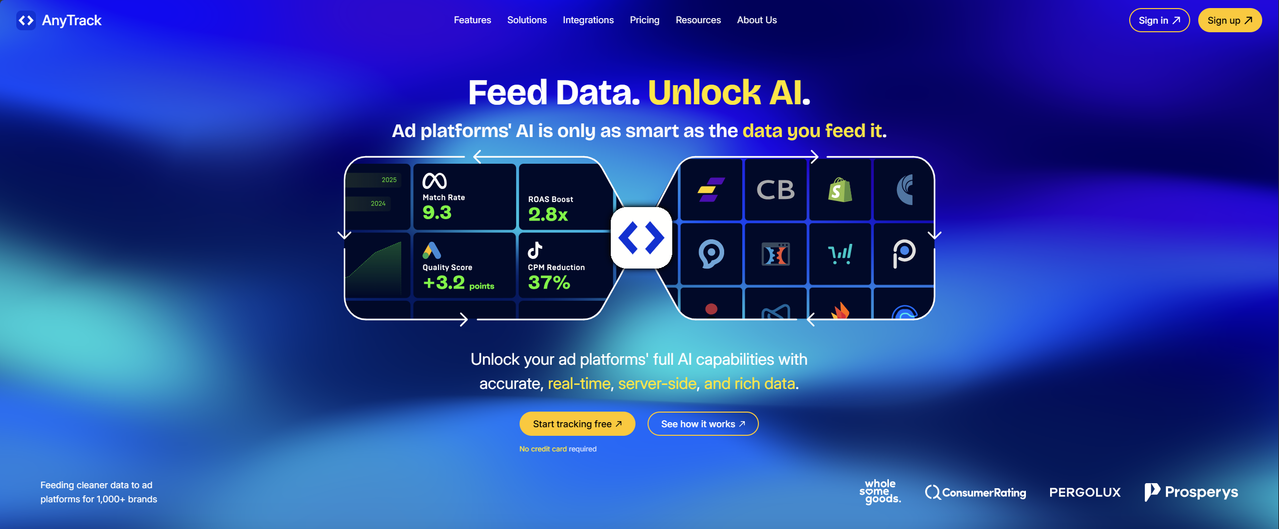
AnyTrack connects conversion sources to ad platforms. Its documentation lists integrations with dozens of affiliate networks such as MaxBounty, Impact and Digistore24, affiliate software like Everflow, CAKE, Cellxpert and Income Access, and ad integrations for Meta, Google, TikTok, Microsoft, ChatGPT Ads, Taboola and Outbrain.
Where it does better than Hyros: it speaks the affiliate’s language. Network conversions come in and go back to the ad platforms through Conversion API, with no demo required. There’s a free plan and published paid tiers.
Where it falls short: it’s a conversion sync tool rather than a full campaign tracker, so you won’t find a rules engine, traffic distribution or lander rotation in its plans. Pricing is by sessions with overage fees, and the free plan doesn’t include Conversion API to ad platforms.
Pricing: Free (5,000 sessions), Starter $100 per month, Personal $150 and Advance $300 (AnyTrack pricing model, checked November 2026).
5. Wicked Reports: Best for Subscription and E-commerce LTV
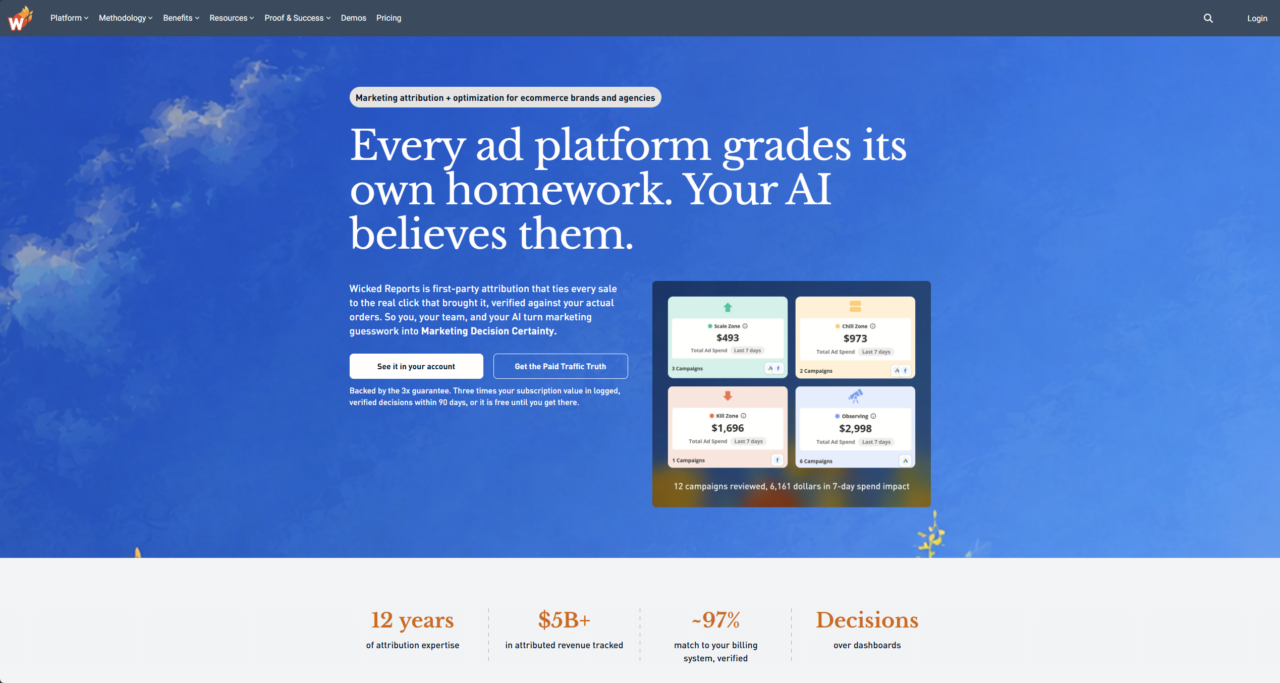
Wicked Reports is multi-touch attribution for e-commerce and subscription brands. Its strengths are long lookback windows, cohort and lifetime value reports, and a view of which ads bring in customers who keep paying.
Where it does better than Hyros: pricing is published by revenue band, and LTV reporting sits at the center of the product rather than on the side.
Where it falls short: like Hyros, the bill grows with your revenue, and Meta CAPI (Advanced Signal) and its 5 Forces AI analysis are $199 add-ons each below the Maximize plan. It’s built for brands with their own carts and CRMs, not for affiliate offers.
Pricing: Measure $499 per month for up to $2.5 million in annual revenue, Scale $699, Maximize $999 and Enterprise from $4,999 (Wicked Reports pricing, checked November 2026).
6. Triple Whale: Best for Shopify Brands
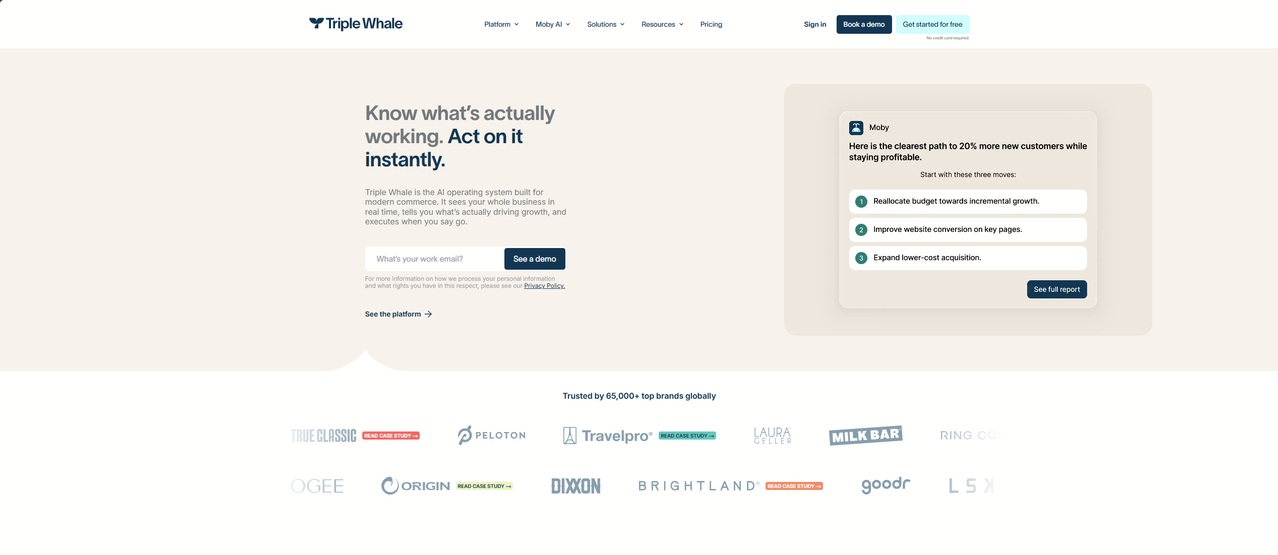
Triple Whale is an analytics and attribution platform for e-commerce brands, especially on Shopify. Its Foundation plan includes the Triple Pixel, multi-touch attribution with configurable windows, post-purchase surveys, dashboards, SQL analysis, its AI assistant Moby and read-only MCP access.
Where it does better than Hyros: there’s a free plan, the store analytics go deep, and the Automate plan adds scheduled Moby automations and actions that can pause or scale ads in connected platforms, with approval settings you control.
Where it falls short: it’s store-centric, so it adds little for affiliates who don’t own the checkout. Pricing depends on your GMV and plan, and the Enterprise measurement tools (MMM and incrementality testing) are generally aimed at brands above $10 million in annual GMV.
Pricing: a free plan, then Foundation, Automate and Enterprise, priced by annual GMV; Enterprise is custom (Triple Whale pricing, checked November 2026).
7. SegMetrics: Best for Coaching and Info-Product Funnels
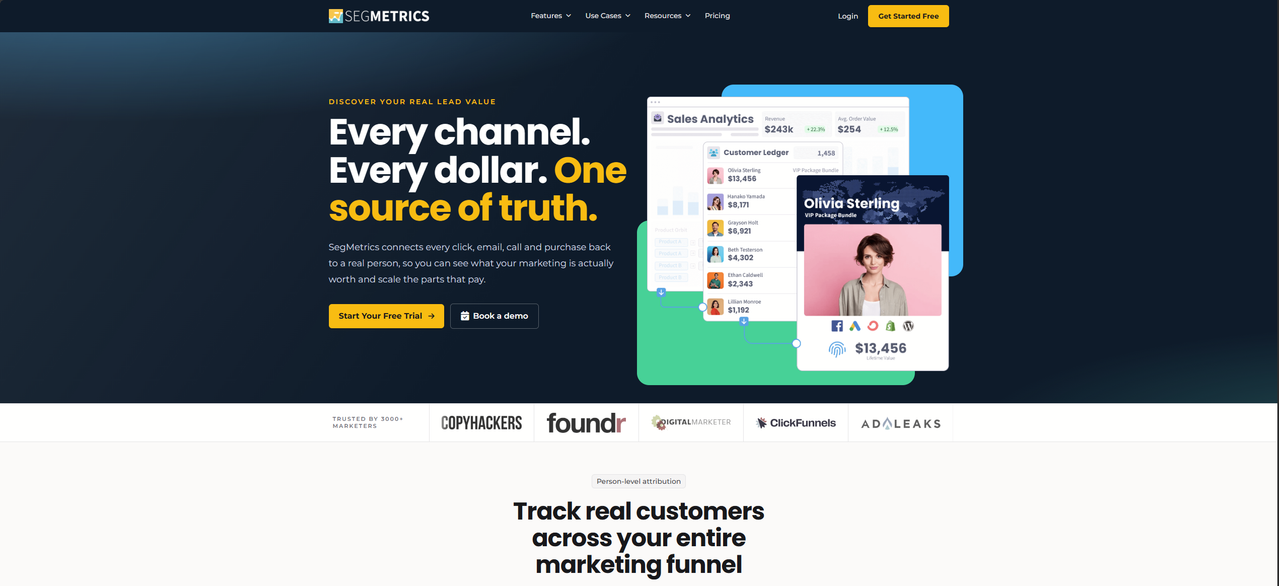
SegMetrics is multi-touch attribution for info products, coaching, e-commerce and SaaS. Its native email and CRM connections track the middle of the funnel, such as webinar attendance, nurture emails and booked calls, and it imports historical data from the tools you connect.
Where it does better than Hyros: it’s the most like-for-like swap for a course or coaching business, with published prices, a 14-day free trial, 100+ integrations and unlimited users on every plan.
Where it falls short: pricing is by active contacts, sending conversions back to ad platforms starts on the Grow plan, and server-side tracking is reserved for Scale. Like Hyros, it isn’t built for paid traffic arbitrage.
Pricing: Launch $57 per month, Grow $197 and Scale $397 for 10,000 active contacts, plus an Enterprise plan for companies above $10 million in yearly revenue (SegMetrics pricing, checked November 2026).
Hyros Alternatives Compared
The table sums up how each tool handles the things that matter most to affiliates and media buyers. “Not listed” means we couldn’t find the capability on the vendor’s site in November 2026.
| Tool | Best for | Pricing model | Entry price (monthly) | Affiliate network postbacks | Push, pop and native sources | iGaming |
|---|---|---|---|---|---|---|
| Hyros | Calls, courses, SaaS and stores | Custom, by tracked revenue | Quoted on a call | ClickBank and Digistore24 integrations | Not listed | Not a listed business model |
| Voluum | Multi-source affiliate campaigns | Plan tiers with event limits | $149 | Yes, S2S postbacks | Yes, cost sync and auto-rules | Dedicated iGaming features |
| RedTrack | Affiliates who want CAPI on every plan | Plan tiers with event limits | $169 | Yes, S2S postbacks | Yes, cost sync | Listed use case |
| Cometly | B2B and lead gen pipelines | Custom, by pageviews | Quoted on a call | Not listed | Not listed | Not listed |
| AnyTrack | Syncing network conversions to ad platforms | Tiers by sessions | Free, then $100 | Yes, network integrations | Taboola and Outbrain | Cellxpert and Income Access integrations |
| Wicked Reports | Subscription and e-commerce LTV | Tiers by annual revenue | $499 | Not listed | Not listed | Not listed |
| Triple Whale | Shopify brands | Tiers by GMV | Free plan, then by GMV | Not listed | Not listed | Not listed |
| SegMetrics | Coaching and info-product funnels | Tiers by active contacts | $57 | Not listed | Not listed | Not listed |
Should You Stay on Hyros?
Maybe. If most of your revenue closes on calls or in a CRM, your traffic runs on Meta, Google and YouTube, and the done-with-you setup and the guarantee matter more to you than a published price, Hyros is doing the job it was built for.
Switching attribution tools mid-scale also costs you a few weeks of clean comparisons. Move for a structural reason, like a different traffic mix, a different conversion source or a cost model that no longer fits, not because one dashboard looked off for a week. If you’re still deciding what kind of tool you need, our conversion tracking software comparison covers the conversion-level view.
How to Switch Without Losing Attribution Data
The safest switch is a boring one. Run both tools side by side until the numbers make sense, then cut over.
- Map what Hyros tracks today: conversion sources, ad accounts, custom events and the reports your team actually opens.
- Set up the new tool next to Hyros, not instead of it, and keep both running for at least one full conversion cycle (for high-ticket offers, the time from first click to a closed sale).
- Connect conversion sources: postback URLs with the click ID token for affiliate networks, and store or CRM integrations for your own products.
- Decide which tool sends Conversion API events to each ad platform, so Meta or Google doesn’t receive the same purchase twice.
- Compare both tools against your source of truth, such as the network dashboard or payment processor, rather than against each other.
If browser-based tracking is part of why you’re switching, read our guide to server-side tracking before you rebuild the setup.
See How Voluum Handles Your Traffic
If your revenue comes from affiliate offers or iGaming campaigns bought across push, pop, native and social traffic, take a look at Voluum’s plans and pricing. Prices are on the page, and the 14-day platform preview doesn’t ask for payment details.
Frequently Asked Questions
What are the best Hyros alternatives?
The best Hyros alternatives depend on your business model. For affiliates and media buyers on many traffic sources, Voluum and RedTrack are the closest fit. AnyTrack suits affiliates who sync network conversions to ad platforms. Cometly fits B2B pipelines, Wicked Reports and Triple Whale fit e-commerce brands, and SegMetrics fits coaching and info-product funnels.
How much does Hyros cost?
Hyros doesn’t publish fixed prices. As of November 2026, its pricing page asks for your business model and monthly revenue, and the team quotes a custom price on a demo call. Hyros says the price follows the revenue it tracks and that every plan includes setup help, an AI analyst and MCP access.
Is Hyros good for affiliate marketing?
It can work for affiliates promoting ClickBank or Digistore24 offers on Meta or Google, since Hyros integrates with both. It’s a weaker fit for affiliates who buy push, pop or native traffic or get paid by many CPA networks, because its integrations focus on ad platforms, stores and CRMs rather than postback-driven campaigns.
What is the difference between Hyros and Voluum?
Hyros is an attribution platform built around customer journeys that end in a store, CRM or booked call, with custom pricing based on tracked revenue. Voluum is a click tracker built around campaigns, landers and offers across many traffic sources, with S2S postbacks, automation and fraud detection, and published plans from $149 per month.
Is there a cheaper alternative to Hyros?
Most alternatives publish lower entry prices. As of November 2026, AnyTrack has a free plan and paid plans from $100 per month, SegMetrics starts at $57 per month for 10,000 active contacts, Voluum at $149 and RedTrack at $169 on monthly billing. Compare total cost at your volume, since most tools charge overage fees.



 Facebook
 Telegram


