
Google’s New iGaming Advertising Rules in 2026: What Changed and How to Stay Compliant

It’s a Tuesday morning in September. An agency running casino campaigns for six operators opens Google Ads and finds that one client’s certificate has been revoked. Annoying, but fixable, right? Then the second notice arrives. The agency’s manager account can’t apply for new gambling certificates anymore. Not for that client. For any of them.
That scenario stopped being hypothetical in 2026. Google’s gambling ads policy changed three times this year, and each change moved the risk a little further up the chain: from the ad, to the account, to the agency behind it.
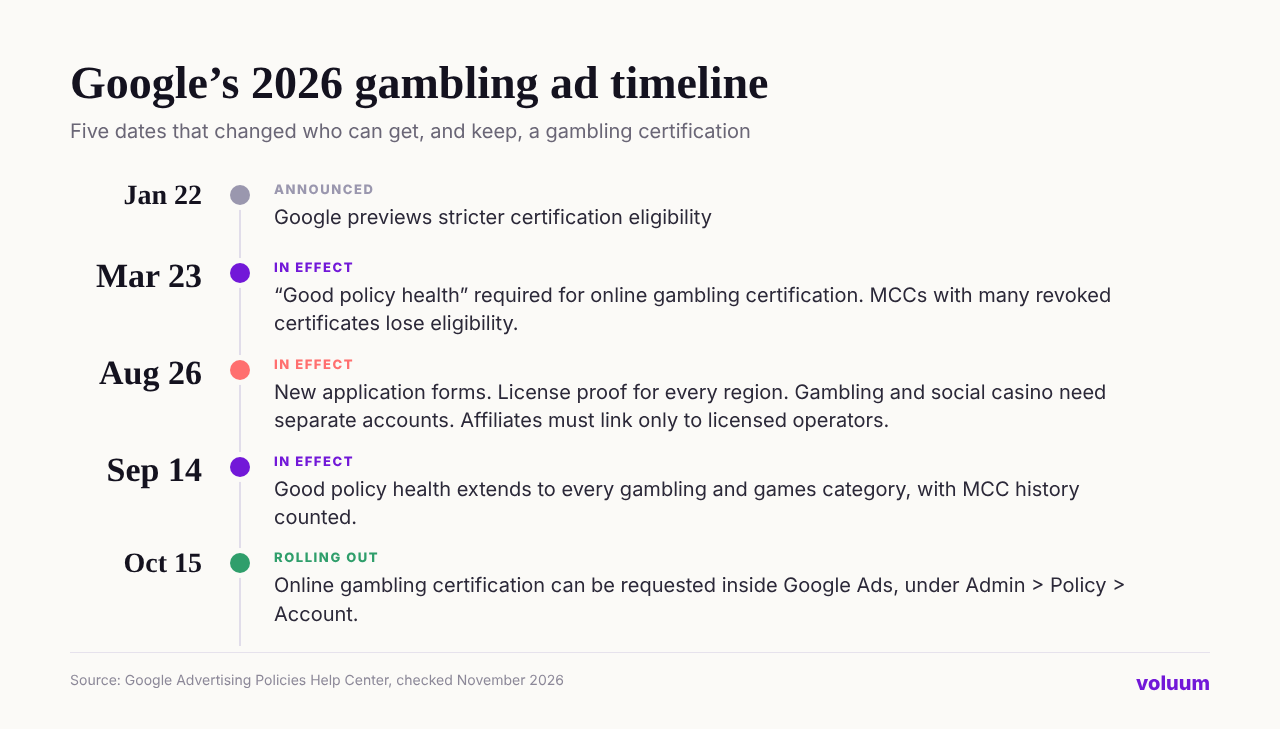
Here’s the gist. Since March 23, accounts need “good policy health” to get online gambling certification. Since August 26, every region needs its own license proof, gambling and social casino can’t share an account, and affiliates may only link to licensed operators. Since September 14, those rules cover every gambling and games category, and a manager account’s history can block all of its clients. This guide walks through each change and what operators, affiliates and agencies should do now.
What Changed in Google’s Gambling Ads Policy in 2026
March 23: Your Account’s Past Starts to Count
Google announced it in January, and the March update to the Gambling and games policy made it real: accounts seeking certification must demonstrate good policy health. Think of it as a credit score for compliance. A license still gets you to the door, but your history decides whether it opens.
The same update put manager accounts on notice. An MCC with a significant volume of revoked gambling certificates among the accounts it manages, or with many accounts caught violating the policy while relying on a certificate, loses the ability to apply for new online gambling certificates and has existing ones revoked.
August 26: New Forms, Stricter Paperwork
On August 26, Google replaced its certification applications and standards for all online gambling jurisdictions, online non-casino games that need certification and social casino games. In practice, three things got stricter.
First, you need a valid local license for every region you target, with evidence, and if the link between the advertiser, the licensed entity and the domain isn’t obvious, you must document it. Any material change to your application means recertifying, and skipping that step can get the account suspended.
Second, one Google Ads account can no longer hold both an online gambling and a social casino certification, or certifications for two different social casino country groups. If you run both, you need separate accounts.
Third, affiliates and aggregators got their own rules. They must link only to operators licensed in the targeted region and show a footer statement saying so on the advertised domain.
September 14: One Rule for Every Category
The July announcement took effect on September 14 and extended good policy health to every category in the Gambling and games policy, from online casinos to social casino and skill games. It also tightened the MCC rule: repeated revocations, or managed accounts repeatedly flagged for gambling violations, cost the manager account its eligibility for new online gambling certificates and may cost it existing ones.
What exactly counts as good policy health? Google doesn’t publish the scoring criteria. The safe reading is simple: no open policy violations, no pattern of disapprovals and no history of revoked certificates, in your account or anywhere above it.
October 15: Applying From Inside Google Ads
The latest change is a process one. Google is gradually letting advertisers apply for online gambling certification inside their account, under Admin, then Policy, then Account. The requirements are the same; only the route is shorter. Not every account sees the option yet.
Will Your Domain Pass the Check?
Domain rules aren’t new, but Google repeated them in both the March and July announcements, which usually means plenty of applications fail on them. Certification isn’t available for sites on free hosting platforms, subdomains of third-party hosts, domains with no connection to gambling, or second-level domains the advertiser doesn’t own and operate.
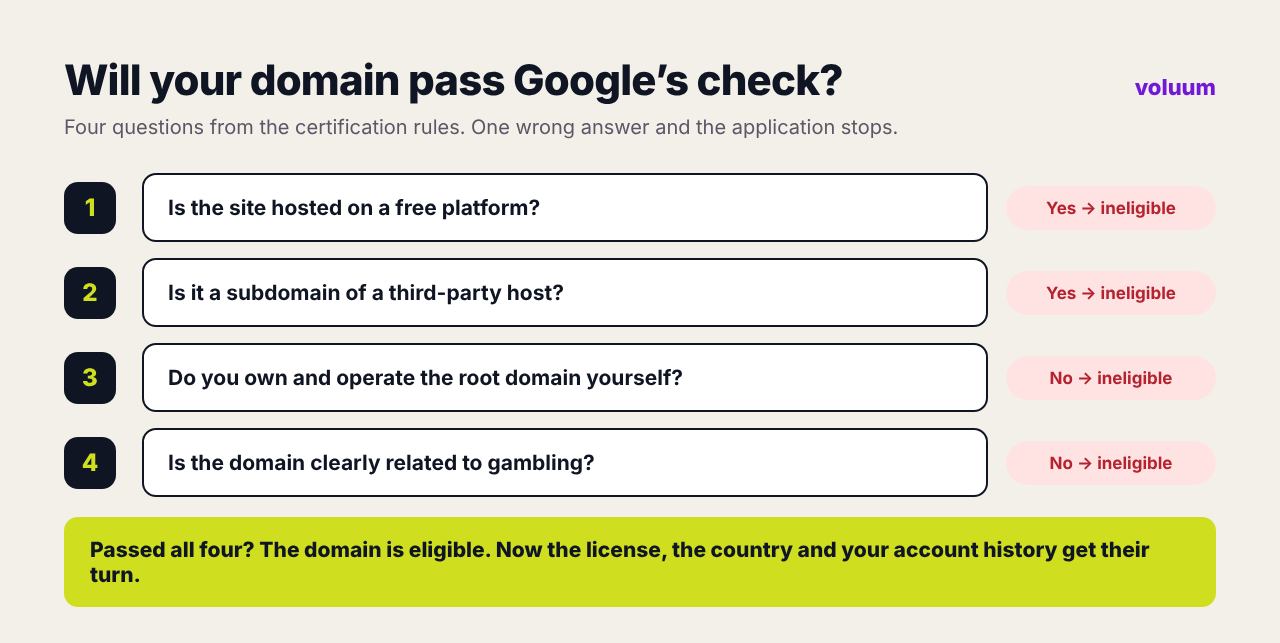
That last one catches more people than you’d expect. If a partner, a white-label provider or a former agency registered the domain, you may be advertising a site you don’t legally control. Check the registrant before you apply, not after a rejection.
Why Agencies Should Lose a Little Sleep
For operators, the 2026 gambling ads policy raises the bar. For agencies, it changes the math.
Before 2026, one reckless client mostly hurt itself. Now a manager account works like a shared bank account with a joint credit rating: enough bad behavior from a few clients, and everyone under the same MCC pays. One revocation won’t sink you. A pattern will.
So what’s a sensible structure? Keep gambling clients with a strong compliance record separate from new or riskier ones, so one client’s history can’t drag the rest down. Review every client’s ad and keyword statuses on a schedule, not only when something breaks. And put your onboarding through the same checks Google will apply, so you find a missing license or a borrowed domain before Google does.
What to Do Now: A Checklist by Role
Most of what the new gambling ads policy asks for is housekeeping. Here’s who should check what:
| If you are | Check this now |
|---|---|
| An operator | A valid license and evidence for every region you target, the domain registered to your business, and a separate account if you also run social casino |
| An affiliate or aggregator | Outbound links only to operators licensed in the targeted region, the required footer statement on your domain and informational content that meets Google’s rules |
| An agency or MCC owner | Each client’s policy health, a clear structure that isolates riskier clients and a recertification process for any material change |
| Anyone tracking Google Ads clicks | A redirect-free setup, such as direct tracking on your landing page, or only certified trackers if you use a tracking template |
Licensing itself differs a lot by market. Our guides to iGaming regulation in the EU and iGaming advertising in Brazil cover two of the busiest ones.
What If Your Certification Is Revoked?
Don’t panic, and don’t open a fresh account to work around it. Google treats new accounts created to dodge enforcement as circumvention, which can turn a fixable problem into a suspension.
- Read the reason. The notice in Google Ads usually points to the policy area, such as licensing, destination or the domain.
- Fix the cause first. Update the license evidence, correct the domain ownership or remove the violating ads and keywords.
- Recertify or appeal with documents. Show what changed. If your application details changed materially, recertification isn’t optional.
- Move fast. Google stopped accepting in-account appeals for policy decisions older than six months in July 2026, so old problems get harder to reverse.
- Audit the neighbors. If you manage other gambling accounts under the same MCC, check them now. Their history is now partly yours.
Keep Tracking Clean While Google Watches Closer
Stricter certification doesn’t change what makes a campaign profitable, but it does change how much a sloppy setup can cost you. Two tracking details matter more than ever.
The first is how you track the click. Google Ads is strict about redirects: only certified click trackers are accepted in the tracking template, and every hop in a redirect chain has to qualify. The simplest way to stay on the right side of that rule is to skip redirects altogether. Voluum’s direct tracking setup for Google Ads records visits with a script on your landing page, so the ad points straight at your own domain and there’s nothing in the chain for a reviewer to question. For the record, Voluum also appears on Google’s list of certified click trackers, but for Google Ads campaigns the direct method is the one to use.
The second is the signal you send back. With fewer accounts and less room for mistakes, every conversion Google’s bidding learns from counts. Passing conversions back with the GCLID or through a Conversion API keeps Smart Bidding working on real deposits, not guesses. Our iGaming tracking setup guide shows how to wire it in Voluum, and automated rules can pause anything that starts to drift.
And if Google’s rules for your market are too tight, you’re not stuck. Organic search, tracked properly with iGaming SEO tracking, plus other iGaming traffic sources and gambling CPA networks can carry part of the volume. For seasonal peaks, our 2026 World Cup playbook shows how operators spread spend across channels.
Keep Your Google Campaigns Measurable and Compliant
Google is checking your account, your MCC and your domain. Your tracking shouldn’t add one more thing to worry about. Voluum tracks Google Ads without redirects, ties every deposit back to the click with S2S postbacks and puts Google next to every other traffic source in one report. See how Voluum works.
Frequently Asked Questions
What is Google’s gambling ads policy in 2026?
Google’s gambling ads policy lets licensed operators and eligible affiliates advertise in approved countries once they’re certified. In 2026, Google added a good policy health requirement for certification, new application forms with license proof for every region, separate accounts for gambling and social casino, and stricter rules for manager accounts and affiliates.
How do I get Google Ads gambling certification?
Hold a valid license for each country you want to target, use a domain you own that’s clearly related to gambling and keep your account free of policy violations. Then apply through the certification form or, where the option has rolled out, inside Google Ads under Admin, Policy and Account. Each country needs its own application.
What does good policy health mean for Google Ads?
Google hasn’t published exact criteria. In practice, it means a clean compliance record: no open policy violations, no repeated disapprovals and no history of revoked gambling certificates, both in your account and in any manager account above it. Since September 14, 2026, it applies to every gambling and games category.
Can affiliates still run gambling ads on Google?
Yes, in countries where Google allows gambling-promoting content, if they’re certified. Since August 26, 2026, affiliates and aggregators must link only to operators licensed in the targeted region and show a footer statement on their domain confirming that. Social casino affiliates and aggregators aren’t allowed.
Can a manager account lose gambling certification for all clients?
It can lose the ability to apply for new online gambling certificates, and existing ones may be revoked. That happens when accounts under the MCC have certificates revoked repeatedly or keep getting flagged for gambling violations while using a certificate. That’s why agencies should separate riskier clients and review policy health regularly.



 Facebook
 Telegram


