


Voluum Glossary
What is iGaming
iGaming: iGaming, short for interactive gaming, is the industry of placing real-money bets online, through websites and mobile apps. It covers online casinos, sports betting, poker, lottery and bingo, plus related formats such as sweepstakes and social casinos, and includes the operators that run them, the affiliates that promote them and the players who use them.
Meaning and Usage
The “i” in iGaming stands for interactive, which in practice means online. Gaming, in this context, means gambling: wagering money or something of value on an uncertain outcome. iGaming therefore refers to gambling conducted over the internet rather than in a physical venue.
The term has two common uses. In most of the industry, iGaming covers all forms of online gambling. In the United States, many regulators and operators use it more narrowly for online casino games only, treating online sports betting as a separate category. This glossary uses the broader meaning.
iGaming Verticals
iGaming is usually divided into verticals that differ in how players take part and how the operator earns revenue:
| Vertical | What players do | How the operator earns | Common affiliate deals |
|---|---|---|---|
| Online casino | Play slots, table games and live dealer games | The house edge built into each game | CPA, RevShare or hybrid |
| Sportsbook | Bet on sports and esports, before or during events | The margin built into the odds | CPA or RevShare |
| Poker | Play against other players in cash games and tournaments | Rake, a small share of each pot or entry fee | Mostly RevShare |
| Lottery and bingo | Buy tickets or cards for scheduled draws | The difference between ticket sales and prizes | CPA or RevShare |
| Sweepstakes and social casino | Play casino-style games with virtual coins, sometimes redeemable for prizes | Sales of virtual currency | Mostly CPA |
Sports betting is described in more detail in its own glossary entry.
How the iGaming Industry Works
The iGaming industry rests on three core parties: the operator, the affiliate and the player.
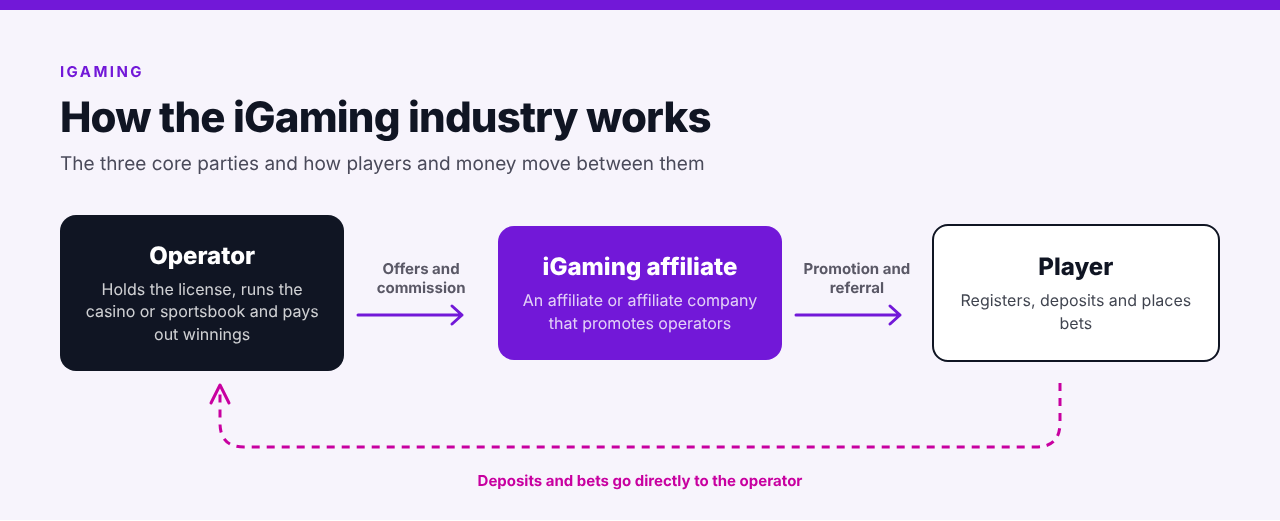
The operator holds the gambling license, runs the casino, sportsbook or other product, accepts deposits and pays out winnings. Some operators license game content or platform software from technology suppliers, while many develop their own.
The iGaming affiliate promotes operators and refers players to them. Affiliates range from individual media buyers to affiliate companies running review sites, content networks or paid traffic. They are paid by the operator, usually per first-time deposit (CPA), as a share of the revenue their players generate (RevShare), or a combination of both.
The player registers with the operator, deposits money and places bets. Deposits and bets go directly to the operator, not through the affiliate.
Legal Framework
iGaming is regulated country by country, and in some countries state by state or province by province. Jurisdictions generally fall into three groups: those that license and regulate online gambling, those that prohibit it, and those with partial or unclear rules.
In regulated markets, an operator needs a license from the relevant authority for each market it serves. Licensing obligations typically include age and identity verification (KYC), anti-money laundering (AML) controls, responsible gambling tools such as deposit limits and self-exclusion, rules on advertising and bonuses, and gambling taxes. Some markets license only certain verticals, for example sports betting but not online casino.
Affiliates are affected as well. Several regulated markets, including many US states, require affiliates to register or hold a vendor license, and most regulators hold operators responsible for how their affiliates advertise. Ad platforms add their own requirements on top of national law. Google, for example, requires gambling advertisers to be certified for each country they target.
For market-specific detail, see the guides to iGaming regulation in the EU, iGaming advertising in Brazil and Google’s 2026 gambling ad rules.
Borderline Cases
Several products sit at the edge of the iGaming definition, and their legal status depends on how each jurisdiction classifies them.
Prediction Markets
Prediction markets let users trade contracts on the outcome of future events, such as elections, economic data or sports results. In the United States, platforms like Kalshi operate as exchanges registered with the Commodity Futures Trading Commission and argue that their contracts are financial derivatives rather than bets. Several states treat sports-related contracts as unlicensed sports betting. Federal appeals courts are divided: the Third Circuit sided with Kalshi in April 2026, while the Ninth and Sixth Circuits ruled that states can apply their gambling laws. In Great Britain, contracts on sports and politics require a gambling license.
Fantasy Sports
Fantasy sports, and daily fantasy sports in particular, involve building a team of real athletes and winning prizes based on their performance. In the United States, they are generally treated as games of skill rather than gambling and are permitted in most states, some of which license them separately. A smaller number of states classify paid fantasy contests as gambling and restrict them. Other countries apply their own definitions, and some regulate fantasy sports under gambling law.
Sweepstakes and Social Casinos
Social casinos offer casino-style games played with virtual currency that has no cash value. Sweepstakes casinos add a second currency that can be redeemed for prizes, and operate under sweepstakes rules rather than gambling licenses, mainly in the United States. Their legal position varies by state, and a growing number of states have restricted or banned the sweepstakes model.
Market Size
Estimates of the iGaming market differ widely depending on scope. According to Statista Market Insights, online gambling revenue passed $121 billion in 2025 and is projected to exceed $123 billion in 2026, close to a fifth of a total gambling market above $650 billion. H2 Gambling Capital, which also counts offshore and unlicensed activity, estimates global online gross win at about $365 billion in 2026 and expects online gambling to overtake land-based gambling by 2029.
The difference comes mainly from what each source includes: regulated markets only or offshore activity as well, and whether lottery and social formats are counted. Market figures should be cited together with their source and scope.
iGaming Affiliate Marketing
Affiliate marketing is one of the main ways operators acquire players, which makes iGaming one of the largest verticals in performance marketing. Because a conversion is a chain of events, from registration to first deposit to ongoing play, affiliates rely on postback tracking to track first-time deposits and later activity, and they evaluate traffic with affiliate marketing KPIs and player lifetime value.
Related guides: iGaming tracking setup and gambling CPA networks.
Tracking iGaming Campaigns With Voluum
Voluum tracks each iGaming conversion, from registration to first deposit and beyond, back to the traffic source, campaign and GEO that produced it. See how Voluum works.
Frequently Asked Questions
What is iGaming?
iGaming is online gambling: placing real-money bets through websites and mobile apps. It includes online casinos, sports betting, poker, lottery and bingo, along with sweepstakes and social casino formats, and the operators, affiliates and players involved in them.
What does the “i” in iGaming stand for?
The “i” stands for interactive, meaning the gambling takes place online rather than in a physical venue. In the United States, the term is often used more narrowly for online casino games, separate from online sports betting.
Is iGaming legal?
It depends on the jurisdiction. Many countries license and regulate online gambling, others prohibit it, and some allow only certain verticals such as sports betting or lottery. In federal countries like the United States, the rules can differ from state to state.
Are prediction markets part of iGaming?
Their status is disputed. In the United States, prediction market platforms operate as exchanges regulated by the Commodity Futures Trading Commission, while several states treat sports-related contracts as gambling, and federal appeals courts have reached different conclusions. In Great Britain, contracts on sports and politics require a gambling license.
How do iGaming affiliates make money?
iGaming affiliates refer players to operators and are paid per first-time deposit (CPA), as a share of the revenue those players generate (RevShare), or through a hybrid of both. Payouts depend on deposits and ongoing play, so affiliates use postback tracking to connect each player to the traffic that referred them.


 Facebook
 Telegram


