
Casino Marketing Strategy: How Sportsbook and Casino Brands Use Voluum for ROI Optimization

What does a depositing player cost you on Google this week? Not a registration, a deposit. For many sportsbook and casino operators, that question takes a morning of exports to answer, and by the time the spreadsheet is ready, the campaigns have moved on.
The operators in this article stopped answering it by hand. One runs slots under a Romanian license, the other works in Southeast Asian markets where campaigns, domains and landing pages change constantly. Their setups look different, but they fixed the same thing.
Short answer: a casino marketing strategy that holds up on ROI starts with one view of cost and player value. Sportsbook and casino operators use Voluum to bring ad costs, clicks and backend conversions such as registrations and first-time deposits (FTDs) into one place, send those conversions back to ad platforms, and cut the campaigns that don’t pay.
Why iGaming ROI Breaks Down Inside an Operator
Picture the acquisition team at a mid-sized operator. Google and Meta report clicks and registrations. The player account platform knows who deposited and how much. Partner traffic reports through the affiliate platform. Three systems, three versions of the truth, and none of them shows cost and deposits side by side.
The cost isn’t only the hours spent stitching reports together. Ad platforms optimize toward the signals they receive. If they only see registrations, they find more people who register, not more people who deposit. Our guide on moving from FTDs to player lifetime value explains why that gap grows further down the funnel.
For an operator, iGaming ROI comes down to two questions: what did this player cost, and what is this player worth? Answering both means joining cost data and backend conversions on the same click. Once that’s done, numbers like break-even ROAS stop being theory and start setting budgets.
How Two Operators Took Control of Their Numbers
Both examples come from Voluum’s published case studies, and all figures are as each operator reported them.
GemBet: Basic Reports in a Market That Won’t Sit Still
GemBet promotes its own iGaming offers in Southeast Asia, in markets its case study describes as dynamic and largely unregulated. Campaigns, domains and landing pages change often. For a long time, the operator relied only on partner traffic, with results analyzed in Google Sheets.
Adding paid traffic changed the math. Spreadsheet data arrives late, and paid traffic that climbs in the morning can drop to zero by the afternoon. GemBet made Voluum its source of truth for visits and clicks, kept MyAffiliates for counting signups and managing partners, and brought both data sets together in one sheet.
Nothing about that setup is advanced. Yet GemBet reports a 300% CPA improvement from acting on basic numbers, plus hours saved on launching campaigns, switching domains and running A/B tests. Its media buyers now spend that time on new angles instead of checking whether campaigns are profitable.
The lesson for operators in fast-moving markets: live data beats perfect data that arrives a day late.
MaxBet: A Licensed Operator on Google and Meta
MaxBet runs online slots under a Romanian license, which lets it advertise on Google and Facebook in that market. Most of its traffic comes from those two platforms, with partner and organic traffic on top. That mix is typical for a licensed operator, and so was the problem: visit and cost data on one side, conversions in the company’s backend on the other.
MaxBet connected Google and Facebook to Voluum through Automizer and reported backend conversions to Voluum by postback. Cost and revenue finally sat in the same report. Voluum could also pass conversion data back to Google and Facebook, so their bidding learned from real outcomes rather than surface signals.
The result was 25% year-over-year growth in registrations and FTDs. In MaxBet’s words, a reliable measurement framework let the team increase budgets over time while staying in control of efficiency.
That last point matters more than the percentage. Scaling spend is easy. Scaling it without losing sight of cost per depositing player is the hard part.
What Your Affiliate Partners Need From You
Most operators don’t live on paid traffic alone. GemBet started with partner traffic and MaxBet still uses it, so the quality of the data you share with affiliates shapes the quality of the players they send.
Revpanda, an iGaming affiliate working with more than 600 partner brands, shows what that looks like from the other side. Its traffic comes mostly from SEO, and it relies on conversion postbacks from those brands, collected in Voluum and sent on to Microsoft Power BI through Scheduled Reports. With that data in place, Revpanda reports a 10% higher conversion rate, lower costs and less manual work.
For an operator, the takeaway is practical. Affiliates who receive reliable registration and FTD postbacks can steer traffic toward what converts for you. Affiliates who don’t are guessing, and you’re paying for their guesses.
What Sportsbook and Casino Marketing Setups Have in Common
Different licenses, different markets, same backbone. In each case, one system took responsibility for joining cost to conversions, and that data then drove decisions, ad platform bidding or partner optimization.
| Company | Role | Main traffic | Where conversions come from | Voluum features used | Reported result |
|---|---|---|---|---|---|
| GemBet | Operator, Southeast Asia | Paid and partner traffic | MyAffiliates (signups) | Reports and analytics | 300% CPA improvement |
| MaxBet | Operator, Romanian license | Google, Facebook, partners, organic | Company backend, by postback | Automizer, conversion tracking, reports | +25% YoY registrations and FTDs |
| Revpanda | Affiliate partner of 600+ brands | Mostly SEO | Brands’ postbacks | Conversion tracking, Scheduled Reports | +10% conversion rate |
Notice what isn’t in the table: an elaborate setup on day one. GemBet’s gain came from basic reports. MaxBet added backend postbacks and platform integrations once the basics were in place.
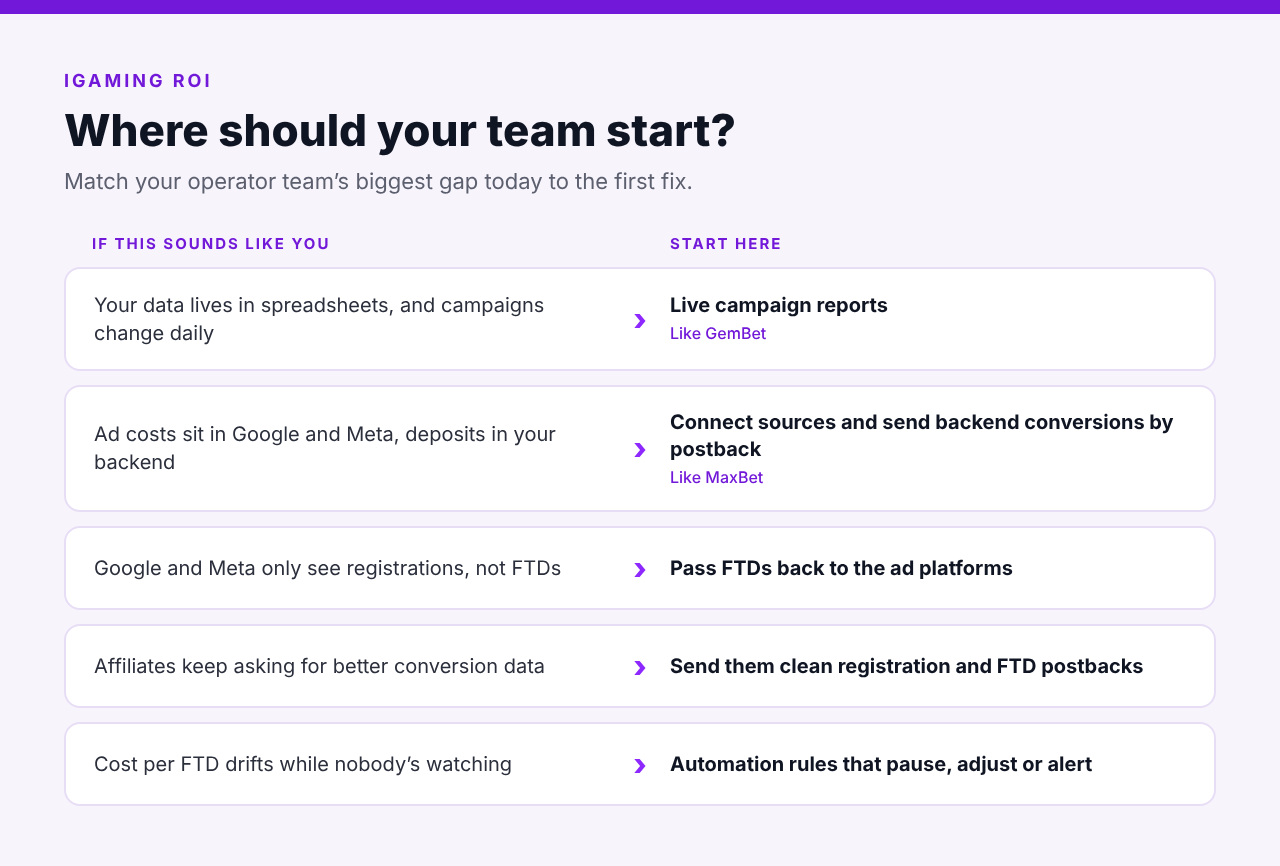
So where should your team start? It depends on what’s broken today. If your data lives in spreadsheets and campaigns change daily, start with live campaign reports, as GemBet did. If ad costs and deposits sit in different systems, connect your traffic sources and send backend conversions by postback, like MaxBet. If Google and Meta only see registrations, pass FTDs back to them. If affiliates keep asking for better data, send them clean registration and FTD postbacks. And if cost per FTD drifts while nobody’s watching, put automation rules on it.
How to Build This Casino Marketing Strategy in Voluum
You don’t need everything at once. These steps follow the order the operators above took, from seeing the numbers to acting on them automatically:
- Connect your traffic sources. Integrations pull cost into Voluum, so ROI is calculated on real spend instead of estimates. Our iGaming tracking setup guide walks through campaigns, flows and tracking domains.
- Split conversions by event. Set up registrations, FTDs and redeposits as custom conversions, so each one gets its own column and you see cost per FTD, not just cost per signup.
- Send backend conversions by postback. Your player account platform fires an S2S postback with the click ID, the event type, the payout and a transaction ID. Voluum’s postback parameters cover each one, and our article on postbacks and dynamic parameters shows a full example. If you manage partners in Affilka, the Affilka integration connects the two platforms.
- Pass conversions back to the ad platforms. Google and Meta bid better once they receive FTDs instead of registrations, which is part of what MaxBet set up. See our guides to Google enhanced conversions with a tracker and the Meta Conversions API.
- Automate the routine. Automizer rules pause placements, change bids or send alerts when cost per FTD drifts. Our automated rules guide for iGaming has rules you can copy.
- Keep the data clean and shared. The Anti-Fraud Kit flags suspicious visits and clicks, and Scheduled Reports send data to BI tools and teams on a schedule.
One thing to watch as you scale: gambling ad policies differ by platform and license, so check Google’s current iGaming ad rules and the traffic sources open to your license before you move budget.
See What Voluum Can Do for Your iGaming Campaigns
If your cost data and your FTDs still live in different places, start there. See how Voluum’s iGaming tracking joins them, and run it on your own campaigns during the 14-day platform preview, no payment details required.
Frequently Asked Questions
What is a good casino marketing strategy for paid traffic?
A good casino marketing strategy for paid traffic optimizes for depositing players, not clicks or signups. For an operator, that means tracking cost and backend conversions on the same click, splitting registrations, FTDs and redeposits into separate events, sending FTDs back to ad platforms so their bidding learns from them, and cutting sources whose cost per FTD stays above player value.
What does sportsbook marketing need from a tracker?
Sportsbook marketing runs on short, event-driven peaks, so a tracker needs live data, fast campaign changes and conversions that arrive quickly. In practice, that means S2S postbacks from the operator’s backend, separate registration and FTD events, cost pulled from traffic sources, and automation rules that react when cost per FTD rises during a busy match day.
How do you measure iGaming ROI?
Measure iGaming ROI by comparing what a player cost with what that player brings in. Start with cost per FTD by source and campaign, then add deposit or net gaming revenue (NGR) value over 30, 60 or 90 days. ROI is that value minus acquisition cost, divided by acquisition cost. Separate conversion events keep FTDs and redeposits from blurring together.
Can Voluum send FTDs back to Google and Meta?
Yes. Voluum’s integrations can pass conversions it receives, including FTDs reported by postback from an operator’s backend, back to ad platforms such as Google and Meta. Their bidding then learns from depositing players instead of registrations. MaxBet, a licensed operator, connected Google and Facebook this way and reports 25% year-over-year growth in registrations and FTDs.
Do operators need an ad tracker if they already use an affiliate platform?
Usually, yes. Affiliate platforms such as MyAffiliates or Affilka manage partners and count signups and deposits, but they don’t see ad costs, landing page tests or traffic source details. An ad tracker joins that cost and traffic data with backend conversions, which is how GemBet and MaxBet got a full view of their acquisition ROI.



 Facebook
 Telegram


