
If your Ads Manager dashboard says one thing and your bank account says another, you are not alone. Signal loss, attribution windows and modeled conversions mean Meta’s own numbers rarely match real revenue.
Short answer: affiliates and media buyers running Meta next to other traffic sources will get the most from Voluum or AnyTrack. Shopify brands should look at Elevar or Polar Analytics, and lead gen or long-sales-cycle businesses at Ruler Analytics or Wicked Reports.
Disclosure: Voluum is our product. We reviewed it with the same template as every other tool, limitations included.
Quick Comparison: Facebook Ad Tracking Tools at a Glance
| Tool | Best for | Tracking method | Multi-channel |
| Voluum | Affiliates, media buyers and performance teams | Redirect and direct tracking, S2S postback, Conversions API | Yes |
| AnyTrack | Affiliates syncing conversions back to ad platforms | Tracking tag, S2S postback, Conversions API | Yes |
| Elevar | Shopify stores | Server-side data layer, Conversions API | Yes (ad and analytics destinations) |
| Polar Analytics | E-commerce brands wanting BI plus attribution | First-party pixel, server-side events | Yes |
| Rockerbox | Larger multi-channel brands | First-party pixel, MTA, MMM, incrementality | Yes |
| Wicked Reports | Subscription and long-sales-cycle businesses | First-party tracking, CRM sync | Yes |
| SegMetrics | Funnel and info-product businesses | Contact-level tracking, CRM sync | Yes |
| Ruler Analytics | B2B and lead gen with offline or phone conversions | First-party tracking, call and form tracking, CRM sync | Yes |
| Stape | Teams building their own server-side setup | Server GTM hosting, Conversions API Gateway | Yes (via tags) |
| Meta Ads Manager + Conversions API | Single-channel advertisers | Meta Pixel plus Conversions API | No |
What Is Facebook Ad Tracking Software?
Facebook ad tracking software records what happens after someone clicks your Meta ad, ties each conversion back to the campaign, ad set and ad that drove it, and usually sends that data back to Meta so the algorithm can optimize. Most tools also bring in cost data so you can see real profit, not just reported conversions.
Native reporting in Ads Manager is a good starting point, but it only sees what Meta can see. Once your funnel includes redirects, affiliate offers, external checkouts, a CRM or other traffic sources, you need a system that sits outside Meta and acts as your own source of truth.
Meta Pixel vs Conversions API
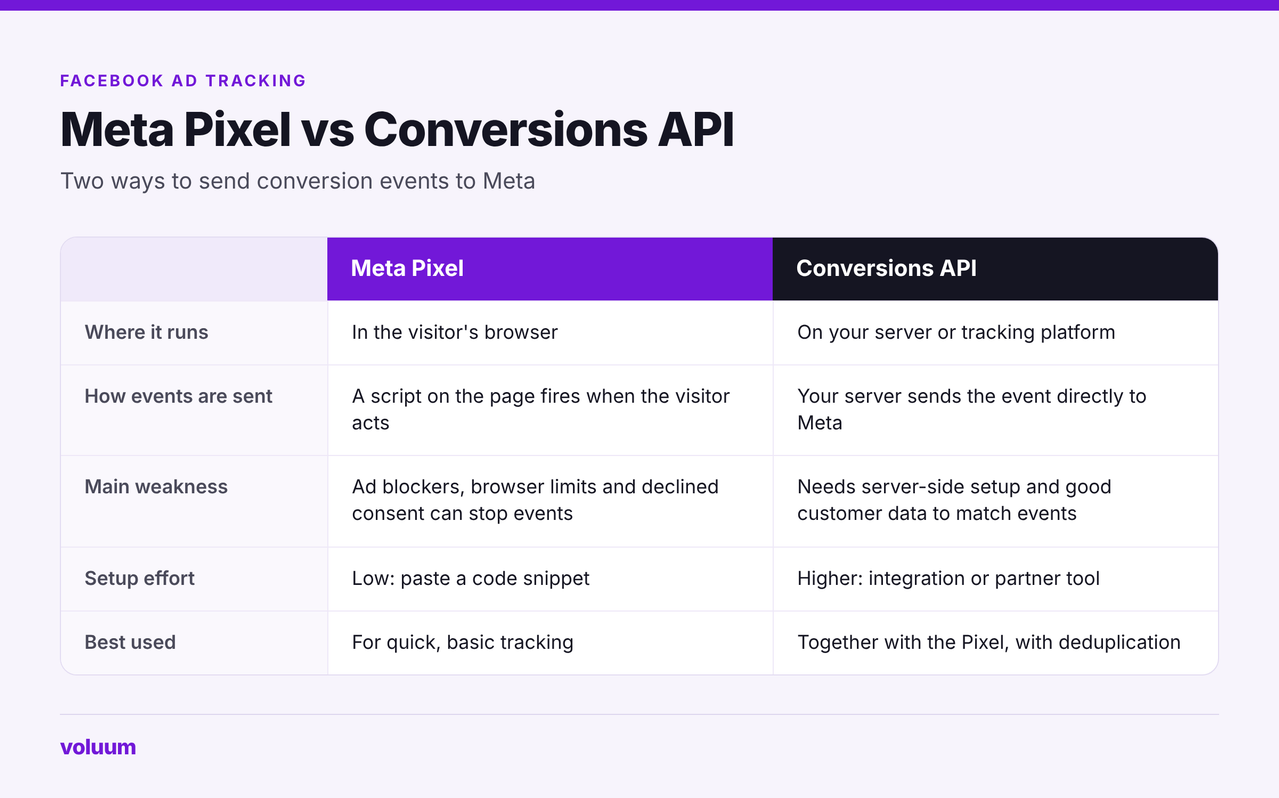
The Meta Pixel is a browser-side script that fires events from the visitor’s device. It is easy to install but loses data to ad blockers, browser privacy features and consent choices. The Conversions API (CAPI) sends the same events from a server, which makes delivery more reliable and lets you include conversions that happen off your site, such as an affiliate network postback or a closed deal in your CRM. Meta recommends running both together with deduplication.
Why Ads Manager and Your Real Numbers Differ
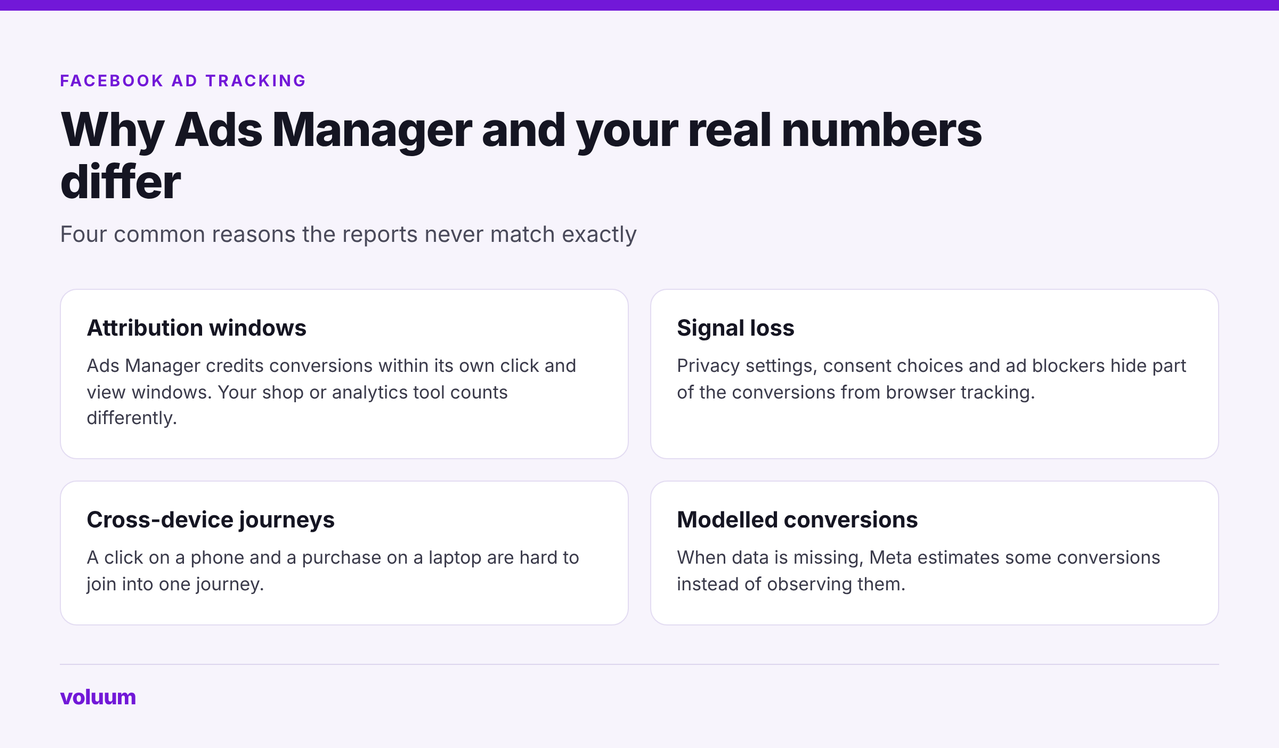
A gap between Ads Manager and your backend is normal. The usual causes are:
- Attribution windows. Meta credits conversions within its default click and view windows, which may not match how your analytics or affiliate network counts them.
- Signal loss. iOS privacy changes, consent banners and ad blockers stop some events from reaching Meta, so part of what it reports is modeled.
- Cross-device journeys. A user who clicks on mobile and buys on desktop can be counted differently by each system.
- Modeled and delayed conversions. Meta estimates some conversions and may report them days after the click, while your backend logs them on the actual date.
How We Evaluated the Tools
Voluum is our own product, so we know it from the inside. For every other tool, we relied on public documentation, pricing pages and user reviews, checked in October 2026. Every tool, Voluum included, gets a section on where it falls short.
We also grouped the tools by use case instead of forcing one ranking. A Shopify brand and an affiliate media buyer need very different things, and a single “number one” would not help either of them.
Evaluation Criteria
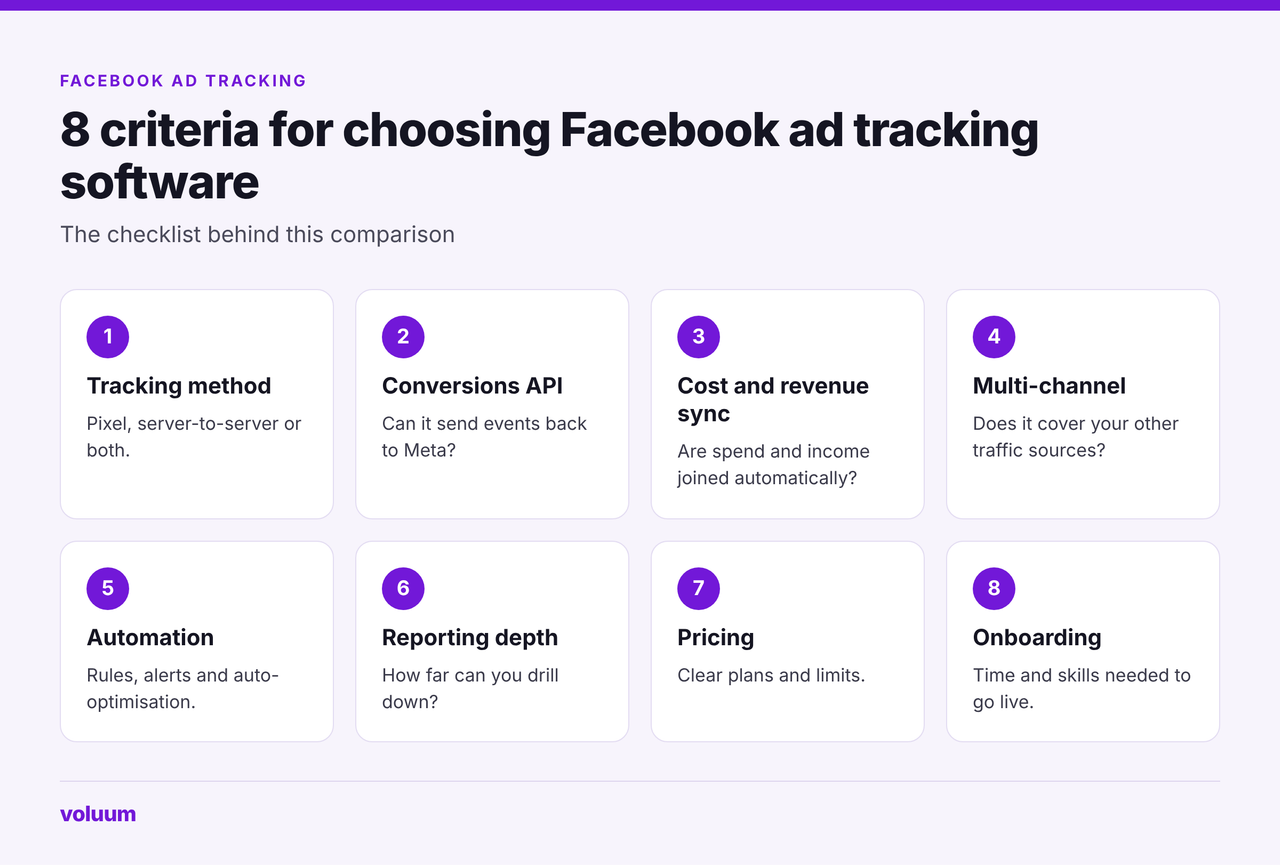
We looked at eight factors: tracking accuracy and method, Conversions API support, cost and revenue sync, multi-channel coverage, automation, reporting depth, pricing transparency and onboarding effort. Accuracy and CAPI support carry the most weight, since they decide whether Meta’s algorithm gets clean data to optimize on.
Best Facebook Ad Trackers for Affiliates and Media Buyers
Affiliate and arbitrage campaigns have a specific problem: the conversion often happens on a page you do not own, and Meta never sees it unless your tracker reports it back. These two tools are built around that workflow.
1. Voluum
Verdict: A full ad tracker for performance teams who run Meta alongside other paid sources and want one view of cost, revenue and profit.
Key Facebook tracking features. Voluum connects to your Meta ad account through a dedicated integration, pulls in spend automatically and sends conversions back through the Conversions API, including those reported by affiliate networks via S2S postback. You can track with redirect links or redirectless direct tracking, compare Meta with every other traffic source in the same reports, and use Automizer rules to pause or adjust campaigns when they cross thresholds you set.
Where it falls short. Voluum is built for performance marketers, so teams that only need a simple e-commerce dashboard may find it more than they need. The setup also assumes some familiarity with tracking concepts like postbacks and tokens, and it does not offer marketing mix modeling.
Pricing. Tiered monthly plans based on event volume and features.
Best for: Affiliates, media buyers and agencies running Meta next to other traffic sources who need cost sync, CAPI and automation in one place.
2. AnyTrack
Verdict: A lightweight, redirectless option for affiliates and content publishers who want conversions from affiliate networks pushed back into Meta with little setup.
Key Facebook tracking features. AnyTrack is a Meta Business Partner and uses a single tracking tag on your site. Its AutoScan feature detects affiliate links and appends tracking parameters, and direct integrations with over 100 affiliate networks let it receive postbacks and forward them to Meta. The Conversions API setup tags each event with an event ID and deduplicates conversions before sending them, so Meta counts each one once.
Where it falls short. It works best when traffic lands on a site you control, so it is less suited to direct-linking setups. Reporting and automation are lighter than in a full ad tracker, and Conversions API delivery requires the Starter plan or higher.
Pricing. A free entry option plus paid tiers.
Best for: Affiliate publishers and smaller media buyers sending traffic to their own pages and wanting a quick CAPI connection.
Best Facebook Ad Tracking Software for E-commerce
Online stores usually control the checkout, so the challenge is less about catching off-site conversions and more about sending complete, well-matched purchase data to Meta and reconciling it with store revenue.
3. Elevar
Verdict: A focused server-side tracking layer for Shopify stores that want cleaner purchase data flowing into Meta and other platforms.
Key Facebook tracking features. Elevar builds a server-side data layer on top of Shopify and sends events to the Conversions API alongside the browser pixel, with deduplication handled for you. It also enriches events with customer identifiers to improve match quality and monitors your tracking so you can spot broken events before they cost you optimization data.
Where it falls short. Elevar is built around Shopify, so stores on other platforms have fewer options. It is a tracking and data-quality tool rather than an attribution dashboard, so you will still need somewhere else to analyze performance.
Pricing. Tiered plans that scale with monthly order volume.
Best for: Shopify brands whose main goal is reliable server-side tracking for Meta and Google.
4. Polar Analytics
Verdict: A business intelligence platform for e-commerce brands that want attribution, ad spend and store metrics in one dashboard.
Key Facebook tracking features. Polar connects your Meta ad account and store data, adds its own first-party pixel for attribution, and can send enriched server-side events back to Meta to improve signal quality. Its main strength is reporting: blended metrics like MER sit next to channel-level attribution, so finance and marketing look at the same numbers.
Where it falls short. It is designed for e-commerce, so affiliate and lead gen workflows are not a good fit. Teams that only want tracking may pay for BI features they will not use.
Pricing. Plans scale with store revenue and selected modules.
Best for: DTC brands that want attribution inside a broader analytics dashboard.
5. Rockerbox
Verdict: An enterprise measurement platform for large brands that need to compare Meta against many online and offline channels.
Key Facebook tracking features. Rockerbox centralizes conversion and ad spend data across channels and combines multi-touch attribution, marketing mix modeling and incrementality testing. That mix helps answer how much Meta is truly adding, not just what it claims. DoubleVerify completed its acquisition of Rockerbox in March 2025, so check the current product name and packaging before you evaluate it.
Where it falls short. It is aimed at larger budgets and teams, with a longer onboarding than self-serve tools. It focuses on measurement, so it is not the tool for day-to-day bid automation or quick CAPI setup.
Pricing. Custom quote.
Best for: Brands spending across many paid, organic and offline channels that need executive-level measurement.
Best Facebook Ad Attribution Tools for Lead Gen and Long Sales Cycles
When a Meta lead turns into revenue weeks or months later, Ads Manager’s attribution window closes long before the sale. These tools connect the original ad click to what happens in your CRM.
6. Wicked Reports
Verdict: An attribution platform built around customer lifetime value, useful when the first purchase is only the start.
Key Facebook tracking features. Wicked Reports combines first-party click tracking with CRM and e-commerce data, so it can credit Meta for repeat purchases and subscription revenue, not only the first order. It offers several attribution views, including first click and new-versus-returning customer splits, and can send conversion data back to Meta.
Where it falls short. Setup depends on clean CRM and order data, which takes time to connect. It is less focused on real-time campaign management, so media buyers making hourly decisions may find it slow for that job.
Pricing. Tiered by revenue or contact volume.
Best for: Subscription, membership and repeat-purchase businesses that judge Meta on LTV.
7. SegMetrics
Verdict: Contact-level attribution for funnel and info-product businesses that live in their email and CRM tools.
Key Facebook tracking features. SegMetrics ties each lead back to the ad that brought it in, then follows that contact through email sequences, webinars and checkouts. Reports show revenue by campaign over long lookback windows, which suits launches and evergreen funnels where buyers convert over weeks.
Where it falls short. Its strength is reporting on what already happened rather than automating budget decisions. It depends heavily on your CRM and checkout integrations, so unsupported tools mean extra setup work.
Pricing. Tiered by number of contacts.
Best for: Course creators, coaches and info-product sellers running Meta into lead funnels.
8. Ruler Analytics
Verdict: A strong fit for B2B and service businesses where conversions happen over the phone, through forms or offline.
Key Facebook tracking features. Ruler captures the source of each visitor, follows them to a form fill or tracked phone call, and passes the lead into your CRM. When a deal closes, it can send the revenue back to your ad platforms, giving Meta a signal tied to real sales instead of raw leads.
Where it falls short. The setup involves CRM, call tracking and form integrations, so onboarding is heavier than a simple pixel tool. It is designed for lead gen, so e-commerce and affiliate teams will not get much from it.
Pricing. Tiered plans, with call tracking and some features on higher tiers.
Best for: B2B, agencies and local service businesses that close deals offline or by phone.
Server-Side and Native Options
Not every team needs a dedicated tracker. If you have technical resources, you can build your own server-side setup, and if Meta is your only channel, the native stack may be enough for now.
9. Stape
Verdict: Infrastructure for teams that want to own their server-side tracking setup rather than rent a finished product.
Key Facebook tracking features. Stape hosts server-side Google Tag Manager containers and offers ready-made tags for the Meta Conversions API, along with a hosted option for Meta’s Conversions API Gateway. That lets you route events through your own subdomain, control which data reaches Meta and reuse the same setup for other ad platforms.
Where it falls short. Stape provides the pipes, not the reporting. You still need GTM know-how to configure tags and a separate tool to analyze performance, cost and profit.
Pricing. Usage-based plans by request volume, with a free tier for testing.
Best for: Developers, analysts and agencies who want full control over a server-side GTM and CAPI setup.
10. Meta Ads Manager + Conversions API
Verdict: The free baseline every advertiser already has, and a sensible starting point before paying for anything else.
Key Facebook tracking features. Running the Meta Pixel together with the Conversions API, through a partner integration or Meta’s own gateway, gives you deduplicated events, Event Match Quality scores and full reporting inside Ads Manager. For a single channel and a simple funnel on your own domain, this covers the essentials at no extra cost.
Where it falls short. Meta is grading its own homework: you only see Meta’s view of the funnel, with its attribution windows and modeled conversions. It cannot compare Meta with other traffic sources or track conversions that happen on domains you do not control without extra work.
Pricing. Free.
Best for: Advertisers running Meta as their only paid channel with a straightforward funnel.
When Native Tracking Is Enough and When It Is Not
Native tracking is usually enough when Meta is your only paid channel, the conversion happens on a domain you own, and your sales cycle is short. In that case, focus on a clean Pixel and CAPI setup and good Event Match Quality.
A third-party tool starts to pay for itself when you run Meta alongside other sources, promote affiliate offers, use redirects or external checkouts, or close sales in a CRM days or weeks after the click. At that point you need an independent source of truth that sees the whole journey and sends the right conversions back to Meta.
How to Choose the Right Facebook Ad Tracking Software
Start with where your conversions happen and how many channels you run. Those two answers narrow the list faster than any feature comparison.
By Business Model
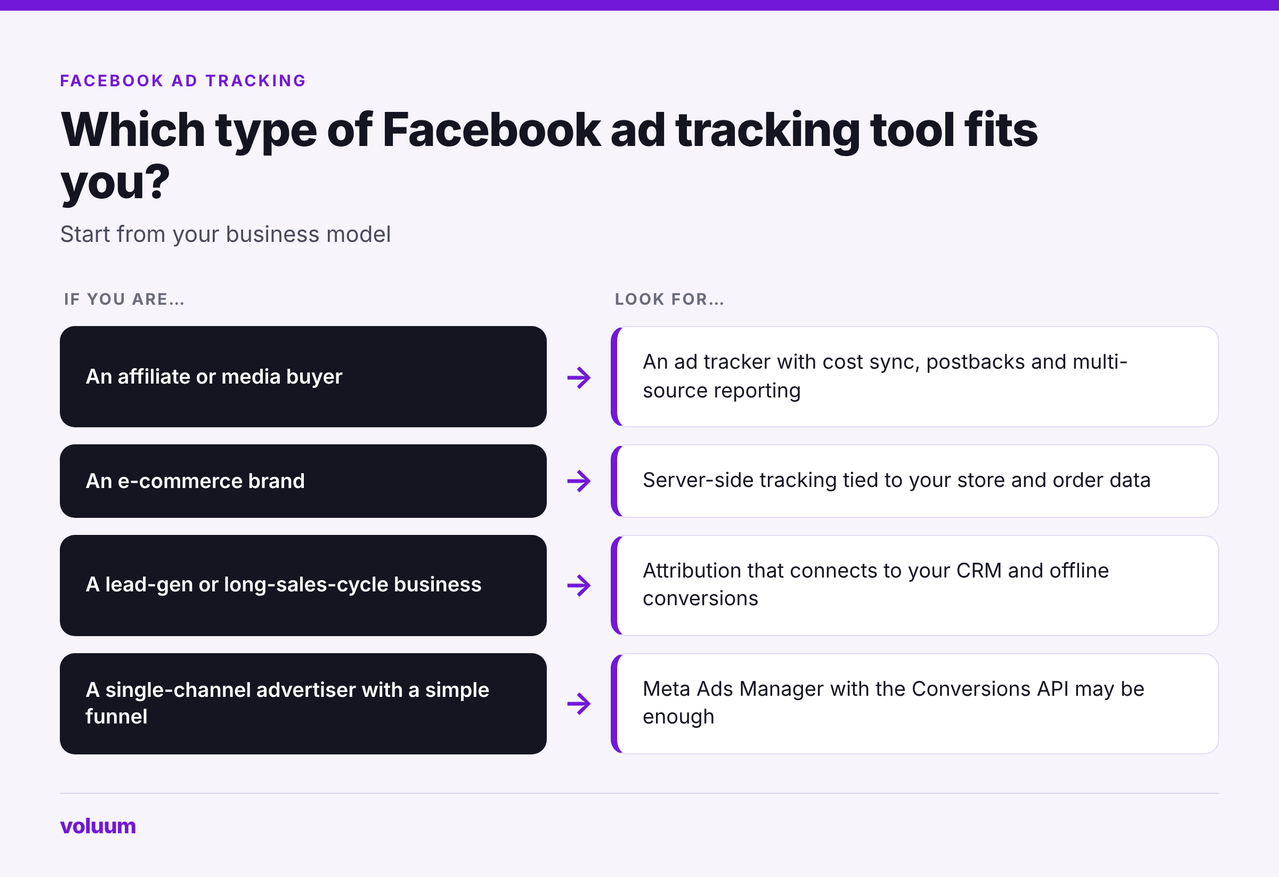
Affiliates and media buyers. You need a tracker that receives postbacks from networks, syncs cost and sends conversions back through CAPI. Voluum fits multi-source teams, while AnyTrack suits publishers sending traffic to their own sites.
E-commerce brands. If data quality is the main issue, start with Elevar or Stape. If you want attribution and store metrics together, Polar Analytics is the better match, and larger brands with big multi-channel budgets can look at Rockerbox.
Lead gen and B2B. Pick a tool that connects ad clicks to CRM outcomes. Ruler Analytics handles calls and forms well, SegMetrics suits funnel businesses, and Wicked Reports is strongest when LTV matters.
Agencies. Prioritize multi-client workspaces, multi-channel coverage and reporting you can share. Voluum and Ruler Analytics are worth testing, depending on whether your clients are performance-driven or lead-driven.
By Budget and Team Size
A solo media buyer should favor fast setup and predictable monthly pricing, and can start with native tracking until a second traffic source appears. Small teams benefit most from tools that combine tracking and reporting so no one has to maintain a custom stack. Agencies and enterprise teams can justify heavier onboarding in exchange for deeper measurement, custom integrations and dedicated support.
Questions to Ask Before You Commit
- What Event Match Quality does the tool typically achieve for Meta, and how does it improve it?
- Who owns the tracking data, and can you export it if you leave?
- Is the contract monthly or annual, and what happens if you exceed your event or order limits?
- What support is included, and how quickly do they respond when tracking breaks mid-campaign?
- How much work is migration from your current setup, and can you run both in parallel during testing?
- Does it support every traffic source and conversion type you plan to use in the next 12 months?
Frequently Asked Questions
What is the best Facebook ad tracking software in 2026?
It depends on your business model. Affiliates and media buyers running several traffic sources often choose Voluum or AnyTrack. Shopify stores tend to use Elevar or Polar Analytics. Lead gen and B2B teams usually look at Ruler Analytics, SegMetrics or Wicked Reports. Match the tool to where your conversions actually happen.
Do I need third-party tracking software for Facebook ads?
Not always. If Meta is your only paid channel and customers convert on your own site, the Meta Pixel plus Conversions API can cover the basics. A third-party tool becomes worth it when you add other traffic sources, promote affiliate offers, use external checkouts or close sales in a CRM.
What is the difference between the Meta Pixel and the Conversions API?
The Meta Pixel sends events from the visitor’s browser, so ad blockers and privacy settings can stop it. The Conversions API sends events from a server, which is more reliable and can include off-site conversions. Meta recommends using both together, with deduplication so each conversion is counted once.
Why do Facebook Ads Manager numbers not match my analytics?
Each system counts differently. Meta uses its own attribution windows, models some conversions it cannot observe directly, and may report them days after the click. Your analytics tool or affiliate network uses different windows and sees only what it tracks. Cross-device journeys and consent choices widen the gap further.
How much does Facebook ad tracking software cost?
Prices range from free native tools to custom enterprise contracts. Most dedicated trackers use monthly tiers based on events, orders, revenue or contacts. Server-side infrastructure tools often charge by request volume. Check each vendor’s live pricing page, since plans and limits change often.
Is there free Facebook ad tracking software?
Yes. Meta Ads Manager with the Pixel and Conversions API is free, and some vendors, such as AnyTrack and Stape, offer free entry options. Free setups work for testing or single-channel campaigns, but they usually limit volume, integrations or reporting depth once you scale.
Can I track Facebook ads for affiliate offers without access to the checkout page?
Yes. Affiliate trackers receive a server-to-server postback from the affiliate network when a conversion happens, then match it to the original Meta click. The tracker can forward that conversion to Meta through the Conversions API, so you never need to place a pixel on the offer page.
How does Voluum track Facebook ad conversions?
Voluum records each Meta click, receives conversions from your site, checkout or affiliate network via postback or pixel, and attributes them to the right campaign, ad set and ad. It syncs ad spend automatically and can send conversions back to Meta through the Conversions API.
Track Facebook Ads with Voluum
If you run Meta alongside other traffic sources, Voluum gives you one place to see what each campaign really earns. The Meta integration pulls in ad spend automatically, so profit and ROI reflect actual cost instead of estimates. Conversions from your site, checkout or affiliate networks flow back to Meta through the Conversions API, giving the algorithm cleaner data to optimize on. And with Automizer rules, you can set conditions that pause or adjust campaigns for you, so budget stops leaking while you focus on testing new angles.
See how the Voluum Facebook integration works



 Facebook
 Telegram