
Best Affiliate Tracking Software for Media Buyers and CPA Affiliates (2026)

Search for “affiliate tracking software” and half the results are tools for running an affiliate program: dashboards where a brand recruits partners, sets commissions and pays out. Useful software, wrong side of the deal.
This guide is for the other side. You buy traffic on Meta, TikTok, native, push or pop, send it to CPA offers, and get paid when a network fires a postback. Your tracker has to tell you, per source, zone and creative, whether yesterday’s spend made money.
The best affiliate tracking software for media buyers in 2026 is the one that pulls costs from the sources you actually buy. Voluum and RedTrack cover the widest mix of social, native and push sources through API, ClickFlare is strongest on social, native and search arbitrage, and Binom and Keitaro suit self-hosting buyers who want a flat license. BeMob is the low-cost way to start.
Disclosure: Voluum is our product. Every tool here, Voluum included, was checked against the same criteria and its own public documentation in November 2026.
Affiliate-Side vs Program-Side Tracking
Program-side tools (Tapfiliate, Post Affiliate Pro, Everflow and similar) are built for the company that owns the offer. They track partners, calculate commissions and handle payouts. If that’s you, this list isn’t.
Affiliate-side trackers sit between your traffic source and the offer. Every click gets a click ID, landers and offers rotate inside campaigns, the network’s S2S postback brings the conversion back, and costs come in from the traffic source. The result is profit by source, campaign, zone, creative, lander, offer and GEO, which is the view a media buyer needs every morning. The six tools below all work this way.
How We Compared Affiliate Tracking Software
We judged every tracker on the five things that decide whether a media buyer can trust the numbers and act on them fast. We used each vendor’s own documentation and pricing pages, checked in November 2026, and didn’t accept claims from comparison pages, including competitors’ claims about each other.
1. Cost import from your traffic sources. Revenue arrives by postback; cost is the hard half. On many CPC push and pop sources, cost arrives in the click URL through a cost token, so any tracker can read it. Platforms such as Meta and Google don’t pass cost in the URL at all, so without an API integration you’re typing spend in by hand. Ad-level API sync is what makes same-day ROI real.
2. Postbacks and conversion handling. Clean S2S postbacks with click ID, payout and status, support for multiple conversion types, and sending conversions back to traffic sources and ad platforms. Our guide to postbacks and dynamic parameters covers the mechanics.
3. Automation that acts on the source. Reports tell you a zone is losing money; rules pause it, cut its bid or add it to a blacklist while you sleep. There’s a big difference between rules that act inside the traffic source via API and rotation rules that only act inside the tracker.
4. Traffic distribution and split testing. Weighted lander and offer rotation, rule-based paths by GEO, device or ISP, and ideally automatic shifting of traffic toward the winner.
5. Hosting, speed and pricing model. Cloud trackers charge by events and run the servers for you. Self-hosted trackers charge a flat license, but you pay for and maintain the server. Neither is better in the abstract; what matters is your volume and how much ops work you want to own.
Traffic-Source Coverage: Who Imports Costs From Where
We didn’t find a comparison like this in the current search results, so we built one. For 12 sources media buyers commonly run, we checked whether each tracker documents an API integration that imports cost. A check mark means the vendor’s own docs or pricing page list it in November 2026. A dash means we couldn’t find it documented; on push and pop sources that pass a cost token, you can often still get cost into the tracker that way.
| Source | Voluum | RedTrack | ClickFlare | Binom | Keitaro | BeMob |
|---|---|---|---|---|---|---|
| Meta | ✓ | ✓ | ✓ | ✓ | ✓ | – |
| Google Ads | ✓ | ✓ | ✓ | ✓ | ✓ | – |
| TikTok | ✓ | ✓ | ✓ | – | ✓ | – |
| Snapchat | – | ✓ | ✓ | – | – | – |
| Taboola | ✓ | ✓ | ✓ | – | – | – |
| Outbrain | ✓ | ✓ | ✓ | – | – | – |
| MGID | ✓ | ✓ | ✓ | – | – | ✓ |
| RevContent | ✓ | ✓ | ✓ | – | – | ✓ |
| Zeropark | ✓ | ✓ | – | – | – | – |
| PropellerAds | ✓ | – | – | – | – | ✓ |
| ExoClick | ✓ | ✓ | – | – | – | ✓ |
| TrafficJunky | ✓ | ✓ | – | – | – | ✓ |
Sources: Voluum full integrations, RedTrack pricing (ad-level cost updates), ClickFlare cost integrations, Binom docs for Facebook and Google Ads, Keitaro third-party integrations, and BeMob integration guides.
Two things stand out. The cloud trackers built for media buying cover far more sources by API than the self-hosted ones, which lean on cost tokens and Meta, Google and TikTok integrations. And coverage isn’t the same as control: some integrations only import cost, while others also let you pause campaigns, block zones or change bids from the tracker. That second layer is where automation lives.
The 6 Best Affiliate Tracking Tools for Media Buyers
Each entry is deliberately short and focused on the five criteria. For longer reviews, including tools aimed at e-commerce, see our ad tracking software comparison. Prices are on monthly billing unless stated and were checked on the vendors’ sites in November 2026.
1. Voluum: Best for Multi-Source Media Buying With Automation
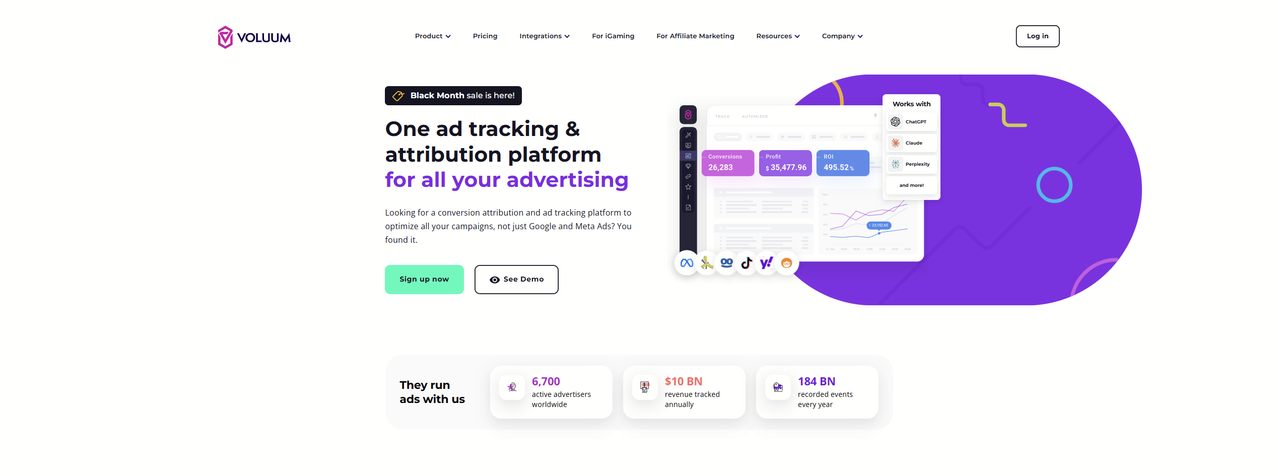
Voluum is a cloud tracker built around the affiliate media buyer: campaigns, flows of landers and offers, S2S postbacks and real-time reports down to zone and creative.
How it scores: cost import is its strongest point, with API integrations through Automizer for Meta, Google, TikTok, the big native networks and many push and pop sources, including Zeropark, PropellerAds, ExoClick, EvaDav and TrafficJunky. On most of those, the same integration lets rules pause campaigns, block zones or change bids in the source. Traffic Distribution AI shifts traffic toward the best-performing landers and offers, the Anti-Fraud Kit flags suspicious clicks (see our bot traffic guide), and Voluum MCP connects your AI assistant to your data.
Limitations: Automizer is free up to $1,000 of monthly ad spend and paid above that, the Anti-Fraud Kit starts on the Scale plan, and Conversion API postbacks to the major ad platforms are an add-on on Agency and included on Enterprise. Snapchat is supported by template, not API.
Pricing: Profit $149 per month, Scale $349, Start-up $599, Agency $999 and Enterprise $1,999, with event limits and overage (Voluum pricing).
2. RedTrack: Best for Social-Heavy Buyers Who Want CAPI on Every Plan
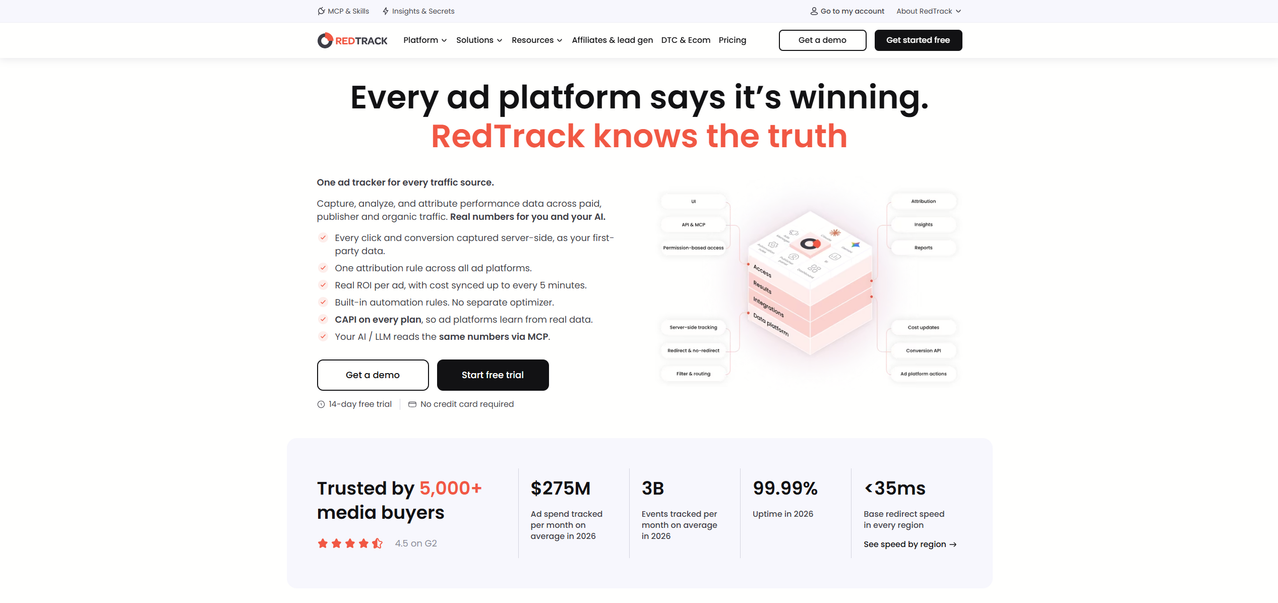
RedTrack is a cloud tracker with separate plans for affiliates and for e-commerce brands. The affiliate plans cover redirect and direct tracking, S2S postbacks, smart links and MCP access.
How it scores: broad API cost coverage across social and native, plus Zeropark, ExoClick and TrafficJunky. Conversion API to eight ad platforms and Stop Rules are on every plan, which matters if most of your budget is on Meta or TikTok. Traffic distribution, filters and day parting are included.
Limitations: ad spend syncs every 60 minutes on Solo and every 30 on Team; faster sync is an add-on priced by your ad spend. Scale Rules and editing bids or budgets from its Ads Manager are add-ons below the Enterprise plan. The Solo plan allows one user and five ad accounts per platform.
Pricing: Solo $169 per month (5 million events), Team $399 and Enterprise $999, with a 14-day free trial (RedTrack pricing).
3. ClickFlare: Best for Search Arbitrage and Native
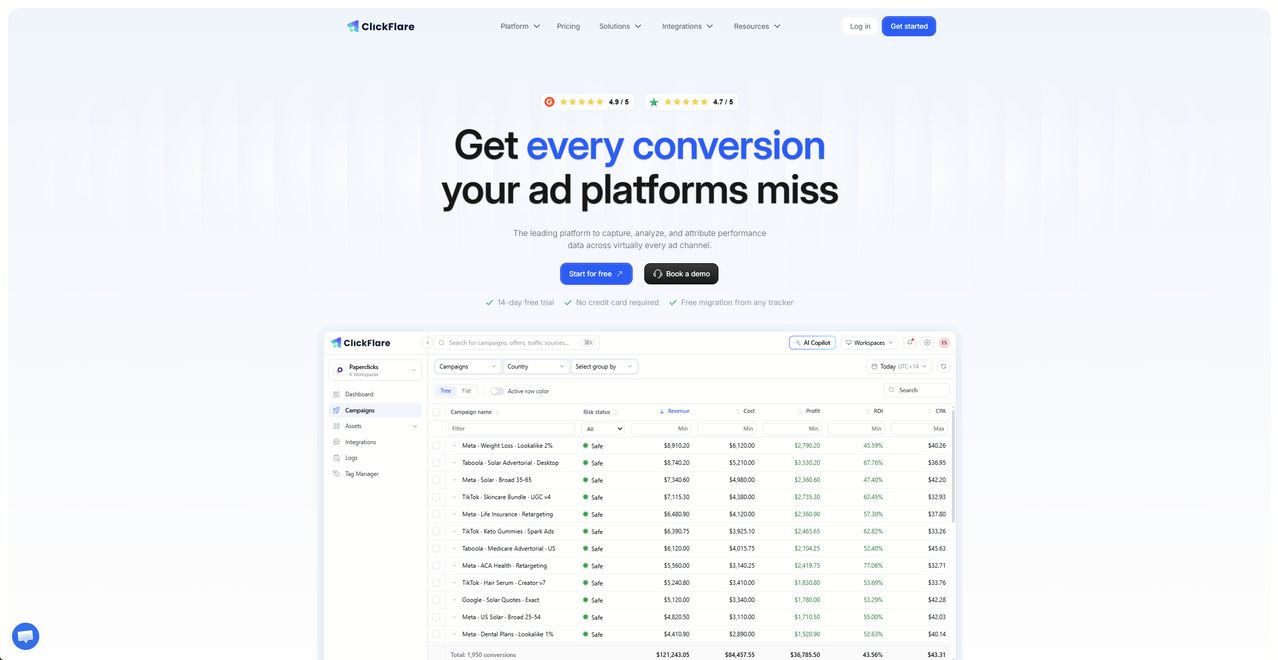
ClickFlare is a cloud tracker popular with search arbitrage and native buyers, with revenue feed integrations for RSOC and parked-domain providers such as Tonic and System1.
How it scores: API cost import from Meta, Google, TikTok, Snapchat, Reddit and the main native networks (Taboola, Outbrain, MGID, RevContent, NewsBreak, SmartNews and MediaGo). Conversion API, AI traffic routing and automatic cost sync are on every plan, and its Ads Manager lets you pause and scale ads from inside the tracker.
Limitations: push and pop sources such as PropellerAds rely on cost tokens rather than API, according to ClickFlare’s own guide. Cost refreshes hourly on Starter and Pro, with 30-minute updates from the Master plan. Rule-based automation is the focus of TheOptimizer, a separate product from the same company.
Pricing: Starter $89 per month (1 million events), Pro $219 and Master $429, with 20% off on yearly billing and a 14-day free trial without a card (ClickFlare pricing).
4. Binom: Best for High-Volume Pop and Push on Your Own Server
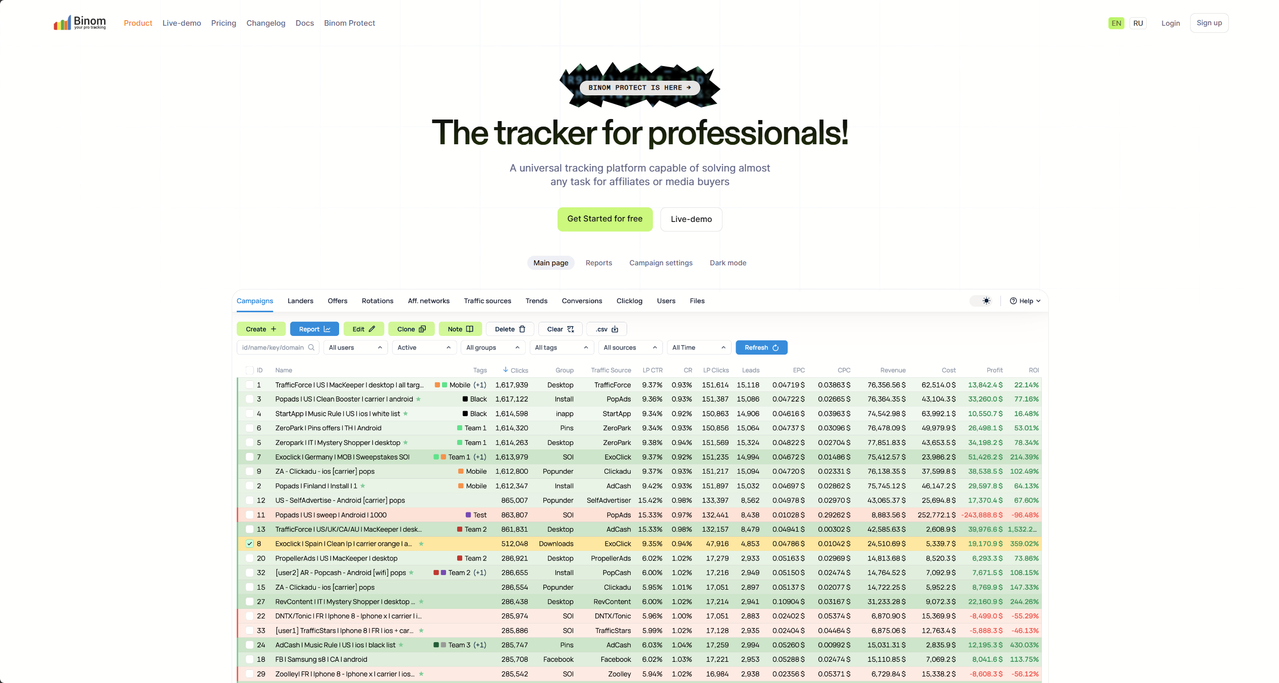
Binom is a self-hosted tracker known for fast redirects and a flat license: no event charges, unlimited users and domains, and lifetime data retention.
How it scores: at very high volume on CPC push and pop traffic, where cost comes in through the URL token, the flat license is hard to beat. Binom documents API cost sync for Facebook and Google Ads, and integrated sources can be paused or resumed from the Binom interface. Routing rules and split testing are mature.
Limitations: on the self-hosted version, the server, its uptime and its security are yours to manage, and the server bill comes on top of the license. Documented API cost import is limited to Facebook and Google, so native buyers will do more manual work. Bot protection is a separate product, Binom Protect.
Pricing: Binom v2 $149 per month ($104 on yearly billing) plus your server, Binom Cloud $299 per month, and Binom Protect $99 per month (Binom pricing).
5. Keitaro: Best for Routing Flexibility on a Budget
Keitaro is a self-hosted tracker with deep flow and filter logic, a built-in landing page editor, Click API and an Admin API, popular with technical social buyers.
How it scores: cost integrations for Facebook, Google Ads and TikTok, plus Facebook Conversions API. Routing by flows and filters is among the most flexible on this list, which suits buyers who build complex funnels by GEO or device.
Limitations: you need your own server and the skills to run it. The Facebook cost integration starts on the Advanced plan, according to Keitaro’s docs, and native, push and pop sources don’t have documented API cost imports.
Pricing: Starter €40, Advanced €72 and Expert €104 per month on yearly billing, plus your server (Keitaro pricing).
6. BeMob: Best Low-Cost Starting Point
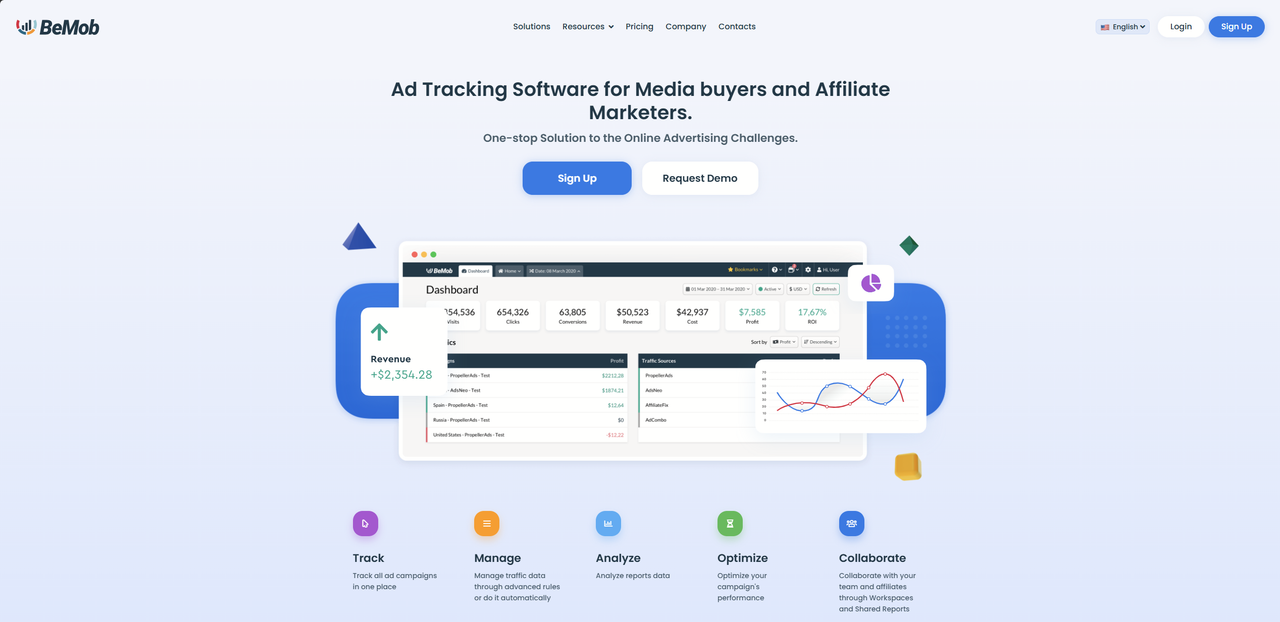
BeMob is a cloud tracker with a free plan, aimed at buyers testing their first campaigns or running modest volume on push, pop and native.
How it scores: API cost collection for PropellerAds, ExoClick, MGID, RevContent and TrafficJunky, bought as add-on integrations, and a Facebook Conversions API integration for $19 per month. Templates cover the common sources, and postback setup is straightforward.
Limitations: integrations cost extra on top of the plan, Facebook cost can’t be imported automatically according to BeMob’s docs, and automation is thinner than in the leading cloud trackers.
Pricing: a free plan, then paid plans with event limits and overage (BeMob).
Which Tracker Fits Your Setup
Coverage tables help, but most buyers decide by their traffic mix. Here’s how we’d match common setups to the tools above.
| If you… | Start with | Why |
|---|---|---|
| Run push, pop and native across several sources and want rules acting in the source | Voluum | Widest API coverage across push, pop and native, with rules that pause, block and bid in the source |
| Spend mostly on Meta, TikTok and Google and want CAPI on a solo budget | RedTrack | Conversion API to eight platforms and Stop Rules from the entry plan |
| Do search arbitrage or native with RSOC feeds | ClickFlare | Native and social cost sync plus revenue feeds from Tonic, System1 and others |
| Push millions of CPC pop or push clicks a day and can run a server | Binom | Flat license with no event charges, cost from URL tokens |
| Build complex social funnels and want deep routing for little money | Keitaro | Flexible flows and filters, Meta, Google and TikTok cost integrations |
| Are testing your first campaigns | BeMob | Free plan, simple setup, paid integrations only when you need them |
Our Take
If you buy from one or two sources, almost any tracker on this list will do; pick on price and whichever interface you’ll actually open every morning. The gap opens when you scale across sources. Then the question stops being “can it track?” and becomes “how much of my morning goes into reconciling cost and pausing losers by hand?”
That’s where API cost coverage and source-side automation pay for themselves. Self-hosted trackers win on cost per click at very high volume, provided someone on the team is happy to be the sysadmin. Before you commit, run your real traffic through two trial accounts for a week and compare yesterday’s profit in each against your network and traffic source dashboards. The one that matches with the least manual work is your tracker. Our list of affiliate marketing KPIs shows which numbers to compare.
See Voluum on Your Own Traffic
If you buy across push, pop, native and social and want cost, postbacks and automation in one place, see how Voluum works as affiliate tracking software, then compare plans on the pricing page.
Frequently Asked Questions
What is the best affiliate tracking software?
For media buyers, the best affiliate tracking software is the one that imports costs from your traffic sources and handles postbacks from your networks with the least manual work. Voluum and RedTrack cover the widest source mix by API, ClickFlare suits search arbitrage and native, Binom and Keitaro suit self-hosting buyers, and BeMob is the low-cost start.
What’s the difference between affiliate tracking software and affiliate management software?
Affiliate management software is built for the brand or network that runs a program: recruiting partners, setting commissions and paying out. Affiliate tracking software for media buyers sits on the affiliate’s side, tracking clicks from traffic sources to offers and combining cost with postback revenue to show profit by source, zone and creative.
Do I need a tracker if my CPA network has stats?
Usually, yes. Your network sees conversions but not your costs, landers or traffic-source zones, and it only shows its own offers. A tracker joins cost and revenue in one report, rotates landers and offers, and lets you cut losing placements, which network stats can’t do.
Should I choose a cloud or self-hosted tracker?
Cloud trackers like Voluum, RedTrack, ClickFlare and BeMob run the infrastructure for you and charge by events. Self-hosted trackers like Binom and Keitaro charge a flat license, but you pay for and maintain the server. Self-hosting tends to pay off at very high click volume if someone can manage the server.
Is there free affiliate tracking software?
Yes, with limits. BeMob has a free plan with a monthly event cap, and most paid trackers, including Voluum, RedTrack, ClickFlare and Binom, offer free trials or previews. Free tiers are fine for testing, but scaling usually needs paid features like API cost import and automation.



 Facebook
 Telegram


