
Types of Attribution Models Explained: First-Click, Last-Click, Linear, Time-Decay & Data-Driven

Picture a relay race. Four runners, one baton, one gold medal. Now imagine the organizers have to engrave a single name on that medal. Do they pick the runner who started, the one who crossed the line, or do they cut the medal into four pieces?
Sounds absurd. Yet it’s exactly what happens to every sale that follows more than one ad.
Attribution models are the rules that decide who gets that medal. They tell your reports which ad, channel or touchpoint earned the credit for a conversion, and there are six you’ll run into: first-click, last-click, linear, time-decay, position-based and data-driven. The first five follow a fixed formula. Data-driven attribution learns its own rules from your conversion data.
Pick the wrong one, and you’ll confidently cut the campaign that was feeding all the others.
Meet the Buyer Who Clicked Three Ads
To see how attribution models work in practice, let’s follow one buyer. We’ll call her Ana.
On Monday, Ana scrolls past your TikTok ad, taps it and browses the offer for a minute. Not ready. On Wednesday, a Taboola placement on a news site reminds her you exist. On Saturday, she types your brand name into Google, clicks the search ad and buys. You earn a $100 payout.
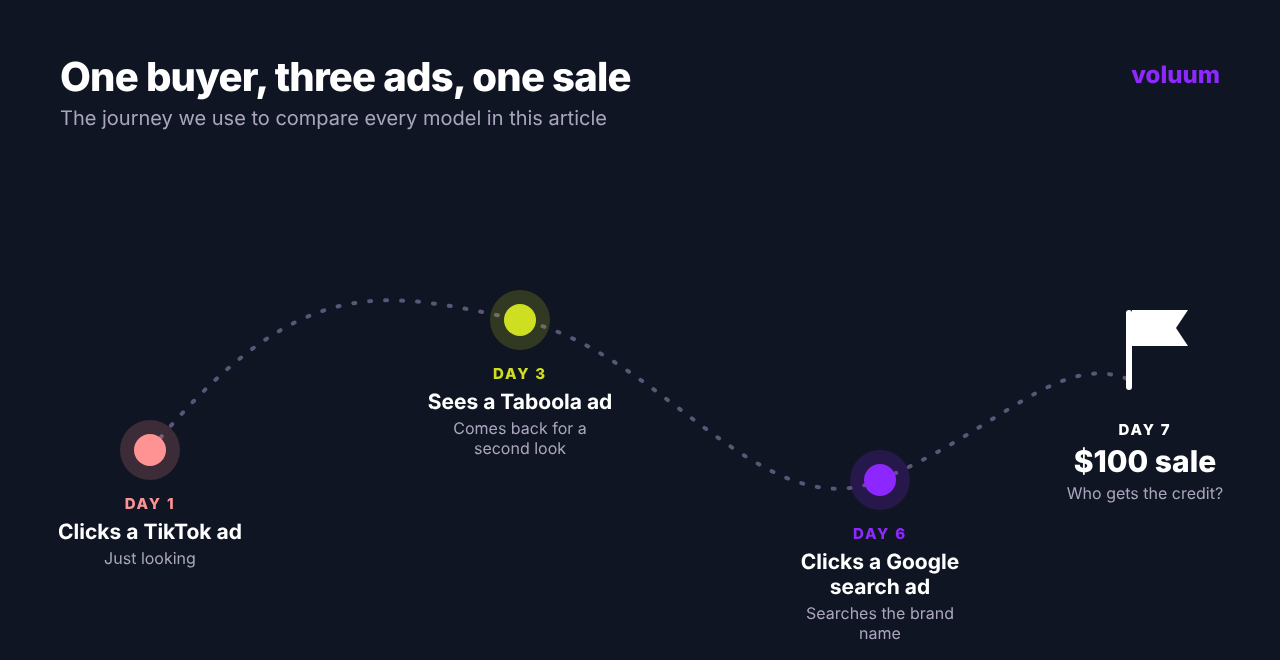
Three ad platforms touched that sale. Ask each of them, and each will happily take the credit. Your job, and the job of your attribution model, is to decide who actually deserves it.
One thing before we start: a model can only split credit between touchpoints that fall inside your attribution window. If Ana’s TikTok click had happened a month earlier, many setups wouldn’t see it at all.
Six Ways to Split One Sale
First-Click: The Matchmaker Takes the Wedding Photo
First-click gives all the credit to the touchpoint that started the journey. TikTok gets the full $100. Taboola and Google get nothing.
It’s the model that asks, “Who introduced us?” That makes it handy for judging prospecting campaigns and new GEOs, where finding fresh buyers is the whole point. For daily optimization, though, it’s almost useless. It never tells you what closed the deal.
Last-Click: The Striker Who Taps It In
Last-click attribution hands 100% of the credit to the final touchpoint. Google search takes the $100, like a striker tapping in a ball that ten teammates moved up the pitch.
Is that unfair? Sometimes. But for a lot of affiliate traffic, it’s simply accurate. When a push or pop click sends someone straight to an offer and they convert, there’s only one touchpoint to credit. The trouble starts in longer journeys, where last-click keeps rewarding channels that catch demand, like branded search, and starves the ones that create it.
Linear: Splitting the Bill Evenly
Linear divides the credit equally. TikTok, Taboola and Google get about $33 each.
You know the dinner where the bill gets split evenly, even though one friend only had water? That’s linear. It keeps every channel visible, which is a decent starting point when you have no idea which step matters most. It just assumes a passing glance is worth as much as a deciding click.
Time-Decay: Credit for Carrying the Couch Up the Last Flight
Time-decay gives more weight to touchpoints closer to the sale. With a common 7-day half-life, Ana’s journey splits roughly $26 to TikTok, $32 to Taboola and $42 to Google.
This model fits short, promotion-heavy journeys, such as a Black Friday push, where the last few days do most of the work. The downside is predictable: the channel that got Ana interested in the first place ends up with the smallest slice.
Position-Based: The Opening Act and the Headliner
Position-based, or U-shaped, usually gives 40% to the first and last touchpoints and splits the remaining 20% across the middle. TikTok and Google get $40 each, and Taboola gets $20.
It rewards the introduction and the close, which feels right for many longer journeys. Just remember that 40/20/40 is a convention somebody picked, not a number your account measured.
Data-Driven: The Referee Who Won’t Show His Notes
Data-driven attribution compares thousands of paths that converted with paths that didn’t, then gives credit based on what seems to tip people over. How would it split Ana’s $100? Nobody can say in advance. It depends on the history in that specific account.
With enough conversions, it can spot patterns no fixed rule would catch. The catch is trust. You can’t recalculate its numbers, and the platform running the model is the same one selling you the clicks.
Who Gets the $100?
Put the five rule-based attribution models side by side, and the same sale tells five different stories:
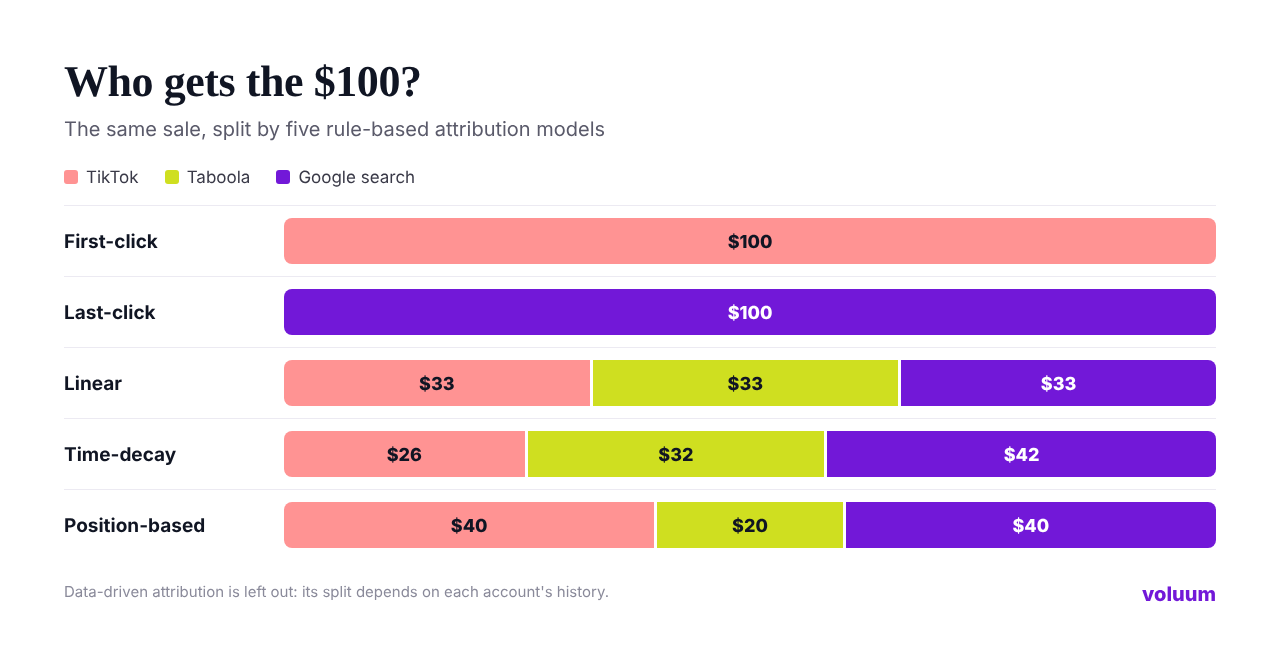
Under first-click, TikTok is your hero channel. Under last-click, it doesn’t exist. Run your monthly budget review on either report, and you’ll reach opposite conclusions with equal confidence.
That’s the real danger. Not that one model is wrong, but that switching between them quietly rewrites which campaigns look like winners.
Why Can’t the Ad Platforms Agree?
Because each one is grading its own homework, with only its own pages in front of it.
The big platforms have mostly moved to algorithmic attribution models. In 2023, Google retired first-click, linear, time-decay and position-based attribution in Google Ads and Google Analytics 4, leaving data-driven attribution as the default and last-click as the alternative. Meta, alongside its standard attribution setting, now offers an incremental attribution option that tries to estimate whether an ad caused a conversion rather than just preceded it.
None of that is bad. But Google’s data-driven model can’t see Ana’s TikTok click, and Meta’s can’t see her Taboola visit. Each platform runs a smart model on a partial picture, and each picture happens to put its own ads in the frame.
If you buy traffic from more than one source, you need a referee that isn’t on either team.
Which Attribution Model Should You Use?
It depends less on which model is “best” and more on what your funnel looks like. Here’s a practical starting point:
| If your funnel looks like this | Start with | Because |
|---|---|---|
| One click straight to an offer, typical for push, pop and many native traffic sources | Last-click | There’s only one touchpoint, so last-click is the true picture |
| Paid social or search to your own site, short sales cycle | Last-click for decisions, data-driven for platform bidding | Easy to act on, while the platform’s algorithm gets the signal it expects |
| Several channels over days or weeks, like lead gen, high-ticket offers or iGaming acquisition | Position-based or data-driven | Credits both the channel that introduced the user and the one that closed |
| Prospecting or a new GEO test | First-click | Shows which channels bring in new people |
| A short seasonal promotion | Time-decay | Rewards the touchpoints that pushed buyers over the line |
Whichever of these attribution models you choose, write it down and stick with it when you compare periods. A model that changes every quarter is like a scale that recalibrates itself between weigh-ins.
For iGaming, the model is only half the picture anyway. A first deposit is rarely a player’s full value, so pair attribution with long-term player value tracking before you decide which channel is really paying off.
How Voluum Decides Who Gets the Credit
Voluum takes a different route from the platforms. Instead of splitting credit with a formula like the attribution models above, it matches each conversion to the exact visit that produced it.
Every click gets a unique click ID. That ID travels to the offer, and when Ana converts, it comes back to Voluum in an S2S postback or a conversion pixel. If the IDs match, the visit gets the credit, along with its traffic source, campaign, lander, offer and GEO. Not sure which of the two delivery methods to use? Our comparison of the tracking pixel and postback URL walks through the trade-offs.
Which click ID comes back depends on the offer side, and most networks return the one from the visit that led to the sale. So in a typical affiliate funnel, Voluum’s view lines up with last-click across every source you track, and the same rule applies to all of them. That’s what makes side-by-side comparisons between TikTok, Google, native and push fair.
You don’t have to choose between that view and the platforms’ algorithms, either. Voluum can pass the conversions it records back through the Conversion API, including conversions tied to GCLID data for Google, so each platform’s bidding learns from more complete data. For app campaigns, Voluum also connects with measurement partners like AppsFlyer, as covered in our guide to mobile attribution. And if Meta is your main channel, our comparison of Facebook ad tracking software shows how other tools handle the same problem.
Give Every Channel a Fair Hearing
Ad platforms will keep disagreeing about Ana, because none of them sees her whole journey. Voluum gives you one click-level record of what converted across every source you buy from, so budget follows what actually paid. See what else Voluum tracks and reports.
Frequently Asked Questions
What are the main types of attribution models?
The six main types of attribution models are first-click, last-click, linear, time-decay, position-based and data-driven. The first five are rule-based and split credit with a fixed formula. Data-driven attribution uses machine learning to assign credit based on the conversion paths in your own account.
What is last click attribution?
Last click attribution gives 100% of the credit for a conversion to the final touchpoint before it. It’s simple and accurate for single-click funnels, which is why many affiliates rely on it. In longer journeys, it overvalues channels that close sales, like branded search, and undervalues the ones that created the demand.
What is data driven attribution?
Data driven attribution compares the paths of users who converted with those who didn’t and assigns credit based on which touchpoints seem to make a difference. It’s the default model in Google Ads and Google Analytics 4. It works best with steady conversion volume, and its results can’t be recalculated by hand.
Which attribution model is best for affiliate marketing?
For most affiliate funnels, last-click is the practical choice, because a single ad click usually leads straight to the offer and the conversion comes back by postback with that click’s ID. When campaigns run across several channels with longer journeys, add a position-based or data-driven view to avoid underrating the channels that introduce users.
Why did Google remove first-click and linear attribution?
In 2023, Google retired first-click, linear, time-decay and position-based models in Google Ads and Google Analytics 4, citing low adoption. Google said fewer than 3% of web conversions used them. Conversion actions that relied on them were switched to data-driven attribution, with last-click available as the alternative.



 Facebook
 Telegram


