

On September 25, 2026, Brazil went from licensed iGaming market to closed market in a single day. A provisional measure signed that day stopped new deposits at once and gave betting sites and apps until October 6 to go offline. Every campaign built on a Brazilian license lost its legal footing in less than two weeks.
The traffic sources didn’t change that week. The license did.
Short answer: your iGaming license decides which countries you can legally target, and the target country decides which traffic sources will take your money. Google, Meta and TikTok accept gambling ads only from operators licensed in the country being targeted. Push, pop and native networks set their own rules, and official Telegram Ads accepts none at all.
This guide is for iGaming affiliates and agencies deciding which operator offers to run where. It maps the three license situations you’ll meet most often against the sources you buy, then shows how to build the license into your tracking, so one regulator’s decision costs you a few edits instead of a month of revenue.
Method note: platform rules were checked against each platform’s own policy pages, and regulator rules against regulators or established industry press, in November 2026. Policies in this vertical change often. This article is not legal advice, so check with counsel before you enter a market.
Why Your iGaming License Doesn’t Travel With Your Ads
A license tells you where an operator may take bets. It means nothing to an ad platform until it matches the country in your targeting settings. Many affiliates learn that from a disapproval email.
The big platforms spell it out. Google’s Gambling and games policy requires a valid local license for every region you target, and an affiliate site may link only to operators licensed in that region. Meta asks for written permission plus evidence that the gambling is licensed or lawful in the territories you want to reach. TikTok’s certification asks for documents proving your licenses and legal compliance in the target market.
So before you pick a source, run each offer through three checks, in this order:
- Is online gambling legal in the GEO, for this vertical? Casino, sports betting and lotteries are often licensed separately.
- Is the operator licensed for that GEO? Licensed there, not just licensed somewhere.
- Does the traffic source accept that license in that GEO? This is the platform’s call, and it’s often stricter than the law.
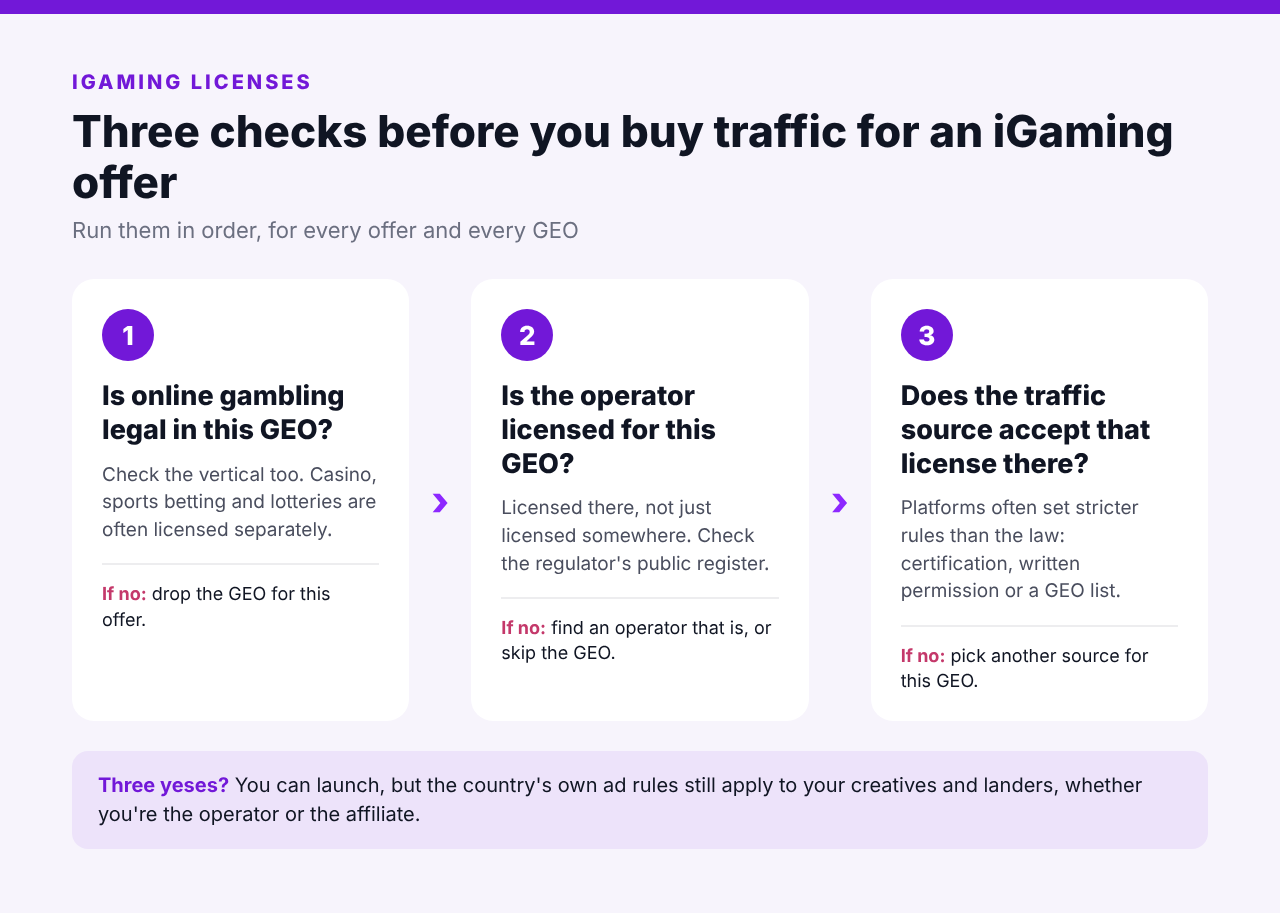
A no at any step ends the conversation for that offer in that GEO. Three yeses still leave the country’s own advertising rules, which bind affiliates as well as operators.
The Three License Situations You’ll Run Into
Every offer in your network dashboard has an iGaming license behind it, and it’s usually one of three kinds. Each opens a different set of doors.
A Local License for the Target Country (UKGC and Similar)
Great Britain is the reference case. To advertise online casino, bingo, sports betting or lotteries there on Google, the operator must be registered with the Gambling Commission and hold a valid operating license number. Other regulated markets follow the same pattern with their own regulator, from Spelinspektionen in Sweden to the Kansspelautoriteit in the Netherlands.
A local license opens the most sources and comes with the strictest creative rules. British affiliates don’t hold a license, but they must follow the CAP and BCAP advertising codes, and the ASA holds the operator primarily responsible for what its affiliates publish. On social media, people under 25 must not feature in gambling ads. Expect operators to check your creatives before they check your volumes.
An MGA License Without a Local One
The Malta Gaming Authority’s B2C license used to work like a passport across Europe. That changed as France, Belgium, Italy and others introduced their own national licenses from 2010 onward. Today an MGA license covers Malta and markets without their own regime, and its ads must show the licensee’s name, license number, minimum age and responsible gaming information, social media included.
For paid platforms, the gap is sharper than most people expect. Malta isn’t on Google’s list of countries open to online gambling ads (checked November 2026), so an MGA license on its own doesn’t unlock Google Ads anywhere. For the large EU markets, see our guide to iGaming regulation in the European Union.
A Curaçao License
Curaçao has rebuilt its regime. Under the National Ordinance on Games of Chance (LOK), the Curaçao Gaming Authority now licenses operators directly instead of through master license holders, and supplier licensing becomes fully enforceable on December 24, 2026, when the two-year transition ends.
The rules are tightening, but a Curaçao license still isn’t a local license in any regulated market. No country on Google’s list accepts it, and Meta and TikTok want proof that the activity is licensed or lawful where you target, which a Curaçao license can’t give you in a regulated market. In practice, Curaçao offers live on push, pop, some native networks and Telegram channel buys, aimed at GEOs without their own licensing system. That’s where its traffic map ends.
And More: Anjouan, Provincial Licenses and Markets That Close
Anjouan has emerged as a newer offshore alternative to Curaçao, with a similar position: it doesn’t open regulated markets. At the other end, some licenses are narrower than a country. In Canada, Google accepts sports betting and online casino ads only from operators licensed by a province, targeting only that province.
And sometimes the license itself disappears, as Brazilian operators found in September. More on that below.
The Matrix: Which Traffic Sources Each License Opens
Find your traffic source in the first column, then the column that matches the offer’s license in the GEO you want to target. “Gated” means possible only after the platform’s own approval. Checked in November 2026.
| Traffic source | Local license in the target GEO (e.g., UKGC) | MGA license, no local license | Curaçao license |
|---|---|---|---|
| SEO and affiliate sites | Allowed; local ad codes apply to your pages | Allowed in GEOs that accept the license | Allowed only in GEOs without their own regime; block or risk the rest |
| Google Ads | Gated: certification per country and per domain | Not available (Malta isn’t on Google’s country list) | Not available |
| Meta (Facebook, Instagram) | Gated: written permission plus local license proof | Possible only where you can show the activity is lawful in that GEO | Rare; regulated GEOs need a local license |
| TikTok | Gated: certification, only in markets TikTok opens | Only if TikTok accepts it for that market | Not allowed for unlicensed services |
| Native networks | Network-dependent; large networks require a license in the target region | Network-dependent | Rarely, and not in regulated GEOs |
| Push and pop networks | Network-dependent | Network-dependent | Common, within the network’s GEO list |
| Official Telegram Ads | Not allowed | Not allowed | Not allowed |
| Telegram channel buys and Mini App networks | Channel- or network-dependent; local ad law applies | Same | Same |
| Streamers (Twitch, YouTube, Kick) | Allowed within platform rules | Twitch: only if it counts the regulator as protective enough; YouTube: only if Google-certified | Blocked on Twitch and YouTube; Kick allows only licensed, ID-verified sites |
The pattern is easy to see once it’s laid out: the more mainstream the source, the more local the license it wants.
Search: SEO and Google Ads
SEO has no platform gatekeeper, which is why so many affiliates with offshore offers lean on it. The law of the reader’s country still applies, though. In Britain, the CAP Code covers affiliate review sites the same way it covers banners. Some markets also block unlicensed domains at the ISP level, which can quietly zero out a page’s traffic from that GEO. For measuring organic players, see our guide to iGaming SEO tracking.
Google Ads is the strictest door. You need certification for each country, a domain that matches the certificate, and a clean policy history. From November 19, 2026, new online gambling applications move from the Help Center into the Google Ads account. Affiliates may run only if they link exclusively to operators licensed in the targeted region and say so in the site footer. Our breakdown of Google’s 2026 gambling ad rules covers the policy-health checks and the manager account risk for agencies.
What this means for tracking: Google ties a certificate to a specific website, and ads pointing elsewhere get disapproved with “URL does not match gambling certificate”. Keep the certified domain as the final URL and check how your click tracking appears in it before launch.
Social: Meta and TikTok
Meta has required prior written permission for online gambling ads for years, along with license evidence for each territory and no targeting of people under 18. Affiliate and aggregator landing pages need permission too. Since 2025, Meta’s policy lists only the markets where gambling ads can’t run at all, instead of the ones where they can. That doesn’t make the rest open by default: every country has to be named in your application, and adding one later means asking Meta to extend the permission. An MGA or Curaçao license only helps where you can show the activity is lawful in that country.
TikTok is often described as a flat ban, but its own policy says otherwise. Gambling ads are allowed only in specified markets where gambling is legal, after certification through TikTok’s Industry Pilot Program, and ads promoting unlicensed services aren’t allowed anywhere. TikTok doesn’t publish the full market list outside its help center and sales team, and it has opened markets one at a time since a 2022 pilot with a licensed Australian sportsbook. Treat TikTok as a market-by-market conversation with your account manager, and only for offers licensed in that market.
Both platforms measure conversions on their own terms, so send results back server-side: Meta through the Conversions API and TikTok through the Events API with the ttclid. Our pillar on tracking in walled gardens compares the setups side by side.
Push, Pop and Native: Where the Network Decides
Outside the walled gardens, each network writes its own rulebook. The biggest native platforms behave like the social ones: Taboola, for example, prohibits gambling ads in regions where the client isn’t licensed. Push and pop networks are usually more flexible and publish GEO lists for gambling offers, which is why so many Curaçao offers run there.
Here’s the catch. A network accepting your campaign doesn’t make the GEO legal for that offer. If a market’s regulator says only local licensees may advertise, a push network’s approval won’t help you or the operator when the regulator comes asking. Treat the network’s GEO list as a ceiling, not a permission slip.
The better networks say as much themselves. PropellerAds, for instance, treats iGaming offers as a regulated vertical with its own checks and GEO restrictions, and expects licensed, transparent offers. Ask each network for its current gambling GEO list before you plan a launch, and compare it with the operator’s licenses, not the other way around.
Tracking on these sources is the most complete of all: an S2S postback carries the click ID back from the operator, and cost comes in through the source integration. Our list of traffic sources for iGaming covers where to buy this traffic.
Telegram: Official Ads vs. Everything Else
Official Telegram Ads is simple: section 5.6 of its ad rules prohibits real-money gambling advertising, with no exception for licensed operators or individual countries. The rest of Telegram is a different market. Direct channel buys and Mini App ad networks set their own rules, and the advertising law of the reader’s country still applies to what you publish there.
If your funnel ends in a casino bot, the bot’s start parameter can carry the click ID. Our guide to tracking Telegram Ads, Mini App ads and bot traffic walks through the setup.
Streamers: Twitch, YouTube and Kick
Since October 2022, Twitch has banned streaming of slots, roulette and dice sites that aren’t licensed in the US or another jurisdiction with sufficient consumer protection. Sports betting, fantasy sports and poker streams are still allowed, and Twitch hasn’t published a full list of the regulators it accepts. On YouTube, since March 19, 2025, creators may not direct viewers to gambling sites that aren’t certified by Google, whether by link, logo or verbal mention, and online casino content is age-restricted.
Kick, founded in October 2022 with backing from Stake’s co-founders, is the most permissive of the three, but it has rules too. Since February 1, 2025, streamers may only broadcast gambling from sites that verify users with ID, and its guidelines allow sponsored gambling only for platforms licensed in the relevant jurisdiction, with affiliate links clearly disclosed. Kick has also hidden its Slots and Casino category in nine countries, including France, the Netherlands and Australia, as of September 2026. If an offer only works on Kick, ask why before you scale it.
Streamer deals live or die on attribution. Give each creator a unique tracking link and promo code, and pass the creator, stream and placement as custom variables, so you can compare creators on registrations and first-time deposits (FTDs), not views.
Build the License Into Your Tracking Setup
A tracker can’t replace an iGaming license check, but it can make sure every click lands where it’s allowed to land, and tell you within hours when that changes. Here’s how that works in Voluum.
- Route by country. Voluum detects each visitor’s country on its own, with no parameter from the traffic source. Rule-based paths with a country of origin condition then send visitors from each country to the offer licensed there, while the default path catches everyone else with a destination that’s safe wherever you buy.
- Reuse the routing. Save the setup as a flow: a saved path, with its landers and offers, that you can reuse across campaigns. Changes to a flow apply to every campaign that uses it, so when a market closes you edit the routing once, not campaign by campaign. You can also give a flow a country label to keep GEO-specific setups apart.
- Track the events operators pay for. Custom conversions record registration, KYC approval and FTD as separate conversion types on the same click. Keep personal data out of postbacks, as our KYC and AML guide explains.
- Watch and react. On integrated sources, Automizer rules can stop a campaign or send an alert when conditions are met. Our guide to automated rules for iGaming traffic has ready-made examples.
Keep one campaign per GEO and license where volumes allow it. Reports stay clean, and a single regulator’s decision touches one campaign, not your whole account. More on the iGaming side of Voluum is on our iGaming tracking page.
When the Map Changes Overnight
Brazil is the extreme case, but not the only one. After the September ban, the Supreme Federal Court froze every lower-court challenge until it rules on the measure’s constitutionality, and Congress extended the measure on November 11, giving lawmakers into early 2027 to vote on it. As of November 18, 2026, the market stays closed, and that’s the safest assumption until a final decision.
Smaller shifts happen every few weeks. Google stopped certifying gambling-promoting content for Croatia on October 7, 2026, which cut affiliates off while licensed operators kept advertising. A few habits keep these changes from becoming emergencies:
- Follow the regulator in every GEO you buy, plus Google’s gambling policy page and its change log.
- Recheck platform approvals and each operator’s license status every quarter, not only at launch.
- Keep a fallback path ready for every GEO, so a closed market means one routing change.
- Ask operators how they’ll settle commissions if a market closes mid-month, before it happens.
Keep Every GEO on the Right Side of Its License
Voluum shows where each click came from, which licensed offer it reached and what it earned, across every source you buy, so you can route traffic by GEO and change course in minutes when the rules move. See how Voluum tracks iGaming campaigns.
Frequently Asked Questions
What is an iGaming license?
An iGaming license is a regulator’s authorization for an operator to offer online casino, sports betting, poker or lottery products to players in a specific jurisdiction. Local licenses such as the UKGC’s cover one market. International licenses such as Malta’s or Curaçao’s are used in markets without their own regime. Ad platforms usually require a license valid in the country you target.
Can Curaçao-licensed casinos advertise on Google Ads?
No, in practice. Google allows online gambling ads only in listed countries and only from operators licensed by that country’s authority. As of November 2026, no country on Google’s list accepts a Curaçao license, so Curaçao-licensed offers usually run on push, pop or native networks or through SEO in markets without their own licensing system.
Does an MGA license let you advertise in the UK?
No. Advertising online gambling to people in Great Britain requires a license from the Gambling Commission, and Google certifies UK gambling ads only for operators registered with it. An MGA license covers Malta and markets without their own regime. Operators targeting Britain hold a separate UKGC license alongside or instead of the Maltese one.
Which traffic sources accept Curaçao gambling offers?
Mostly push, pop and some native networks, along with Telegram channel buys and Mini App networks, each within its own GEO list. Google, Meta and TikTok want a license valid in the targeted country, and official Telegram Ads bans gambling. A network’s approval doesn’t make a GEO legal, so check the target country’s law as well.
Do iGaming affiliates need their own license?
It depends on the market. British affiliates don’t need a Gambling Commission license but must follow the CAP Code, and operators are responsible for their conduct. Some markets go further: Google’s policy notes that Greece and Ukraine require advertising agencies to be authorized, and Romania requires aggregators to hold a Class 2 license.


 Facebook
 Telegram


