
Affiliate Marketing KPIs: 15 Metrics to Track (EPC, CR, ROI, CPA, FTD)

Open any ad tracker and you’ll find more columns than a Greek temple. Visits, clicks, CTR, CV, CR, EPC, EPV, eCPA, ROI. Which ones actually deserve your attention at 9 a.m. with a coffee in hand?
Fewer than you’d think. A pilot doesn’t fly by staring at every dial in the cockpit at once. They know which three gauges say “we’re fine” and which one says “land now.” Affiliate marketing KPIs work the same way.
The quick version: the affiliate marketing KPIs that matter most are the ones that tell you whether traffic is worth buying (iCTR, CPV, lander CTR), whether the funnel converts (CR, CV, eCPA, average payout) and whether you’re making money (EPC, EPV, profit, ROI, ROAS). iGaming affiliates add three more: registration-to-FTD rate, cost per FTD and player lifetime value. Below are all 15, with formulas and a simple benchmark for each.
First, the Words That Trip Everyone Up
Before any formula, two definitions. Get these wrong and half your KPIs will quietly mean something else.
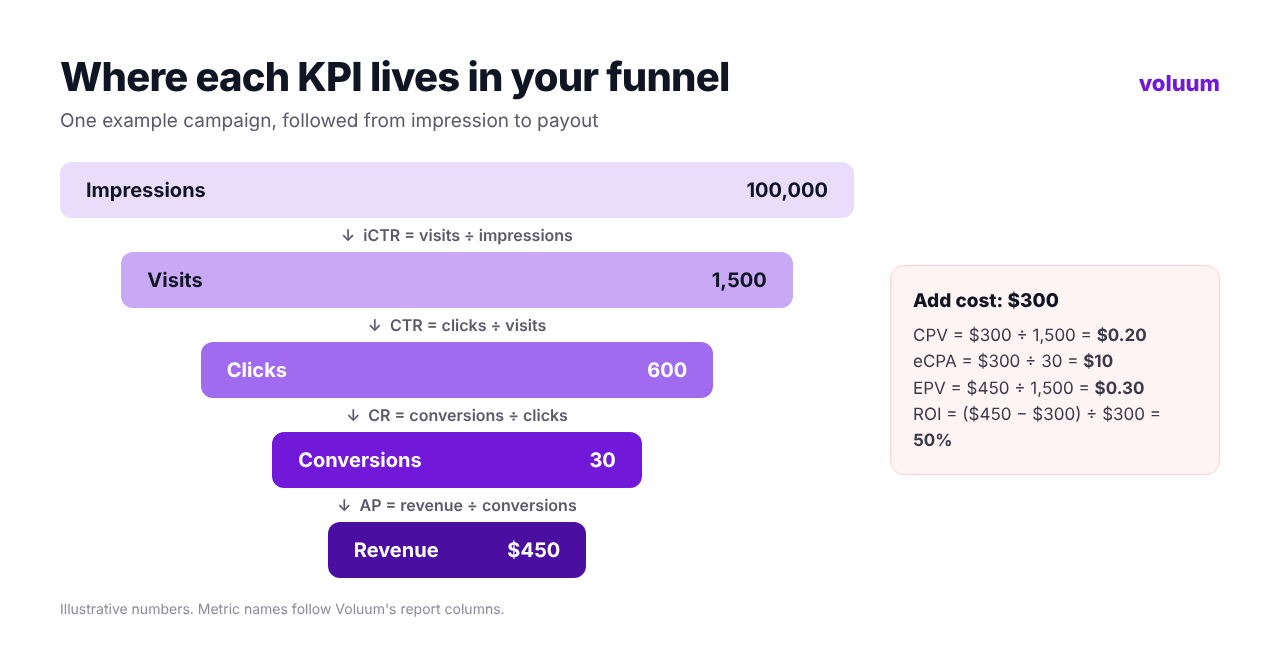
In Voluum, a visit is someone landing on your lander, or on the offer if you link directly. A click is someone moving from your lander to the offer. So a click isn’t the click on your ad. That one shows up as a visit.
This is why Voluum’s CTR column measures clicks divided by visits, which is your lander’s click-through rate, while the ad’s click-through rate lives in a separate iCTR column. Many traffic sources call the ad metric CTR. Compare the two without checking, and a 40% “CTR” in your tracker will look like a miracle next to a 1.5% CTR in your ad network. It’s not a miracle. It’s two different questions.
Is the Traffic Worth Buying?
These three affiliate marketing KPIs judge the ad and the audience before the offer gets a say.
1. iCTR (Impression Click-Through Rate)
iCTR = visits ÷ impressions × 100. It tells you whether the ad earns attention. A falling iCTR on a campaign that used to work usually means creative fatigue: the audience has seen your banner so often it has become wallpaper.
Benchmark: your own last 7 days for the same placement and GEO. Format matters too much for a universal number. A push notification and a search ad live on different planets.
2. CPV (Cost per Visit)
CPV = cost ÷ visits. On pop and push, it’s often the number you actually bid on, so it’s your price tag for a single shot at a conversion.
Benchmark: CPV has to stay below EPV. If a visit costs $0.06 and earns $0.05, every visit loses you a cent, and scaling only makes the hole deeper.
3. Lander CTR
Lander CTR = clicks ÷ visits × 100, the CTR column in Voluum. It measures how well your lander warms people up and sends them to the offer.
Is a low lander CTR always bad? Not quite. A lander that filters out tire-kickers might send fewer clicks but more buyers. Always read it next to CR.
Does the Funnel Convert?
Now the offer is on stage. These four affiliate KPIs show whether the people you paid for actually do something.
4. CR (Conversion Rate per Click)
CR = conversions ÷ clicks × 100. It isolates the offer: of everyone who reached it, how many converted? If CR drops while lander CTR holds steady, look at the offer page, the payout terms or a cap before you touch your traffic.
5. CV (Conversion Rate per Visit)
CV = conversions ÷ visits × 100. It’s the whole-funnel conversion rate, lander included, and the better number for comparing campaigns with different landers, or with no lander at all.
Benchmark: there isn’t a universal one, and anyone who gives you a single number is guessing. For context, search ads in WordStream’s latest Google Ads benchmarks average a conversion rate of 8.18%. A pop campaign converting at a tiny fraction of that can still be very profitable, because its visits cost a tiny fraction too. Judge CV together with CPV, never alone.
6. eCPA (Effective Cost per Acquisition)
eCPA = cost ÷ conversions. Think of it as the real price of one result, whatever cost model you bought the traffic on.
Benchmark: eCPA must stay below your average payout. That line is your break-even, and it’s the cleanest number to put in an automated stop-loss rule.
7. AP (Average Payout)
AP = revenue ÷ conversions. On fixed CPA offers, it barely moves. On RevShare, tiered or dynamic payouts, it moves a lot, and a sudden dip can mean your traffic got cheaper for a reason: lower-quality users who convert but don’t deposit or buy much.
Are You Actually Making Money?
Conversions are nice. Money is nicer. These five affiliate marketing KPIs connect the funnel to your bank account.
8. EPC (Earnings per Click)
EPC = revenue ÷ clicks. Affiliate networks love to show EPC on their offer pages, and it’s a handy way to compare offers. Just remember the network’s EPC comes from other affiliates’ traffic, not yours.
9. EPV (Earnings per Visit)
EPV = revenue ÷ visits. If you only keep one money metric for daily decisions, keep this one, because you can put it right next to CPV. EPV above CPV means each visit makes money. EPV below CPV means each visit costs money. It’s as simple as a lemonade stand.
10. Profit
Profit = revenue − cost. Obvious? Sure. But it’s the only KPI on this list your landlord accepts. A 300% ROI on $20 of spend is a great story and a terrible month.
11. ROI (Return on Investment)
ROI = (revenue − cost) ÷ cost × 100. It shows how hard each dollar works, which makes it the best metric for comparing campaigns of different sizes.
Benchmark: anything above 0% is profitable. Most media buyers set a target well above zero to leave room for payout delays, chargebacks and the days when a placement goes sideways.
12. ROAS (Return on Ad Spend)
ROAS = revenue ÷ cost. It’s ROI’s cousin, preferred by e-commerce teams and ad platforms. A ROAS of 1.5 equals an ROI of 50%. Use whichever your team speaks, but don’t mix them in the same report.
iGaming Extras: Is the Player Worth It?
In iGaming, a conversion is often a registration, and a registration doesn’t pay the bills. These three affiliate KPIs follow the player further.
13. Registration-to-FTD Rate
Reg-to-FTD = first deposits ÷ registrations × 100. A source that sends plenty of registrations but few first-time deposits is sending browsers, not players. To see this in Voluum, you’ll need registrations and FTDs as separate custom conversion types, which our guide to tracking first-time deposits with postbacks walks through.
14. Cost per FTD
Cost per FTD = cost ÷ first deposits. On CPA deals, compare it with the CPA you’re paid. On RevShare or hybrid deals, compare it with what a depositing player is worth, which brings us to the last KPI.
15. Player Lifetime Value (LTV)
LTV is the revenue a group of players generates over time, usually measured per player over 30, 60 or 90 days. It’s the KPI that turns a “loss-making” source into your best one, or the other way around. If you work on RevShare, read our piece on shifting your focus from FTDs to LTV and the guide to advanced player segmentation.
Which KPI Tells You What’s Broken?
Affiliate marketing KPIs earn their keep when something goes wrong. Here’s where to look first:
| What you see | Check first | Likely cause |
|---|---|---|
| Spend is up, conversions aren’t | iCTR and CPV | Creative fatigue or a bid war on your placements |
| Plenty of visits, few clicks to the offer | Lander CTR | Lander doesn’t match the ad’s promise, or loads slowly |
| Clicks are fine, conversions drop | CR | Offer issue: page change, cap reached or payout terms changed |
| Conversions look normal, profit falls | AP and eCPA | Lower payouts or rising costs eating the margin |
| Registrations up, revenue flat (iGaming) | Reg-to-FTD and LTV | The source sends sign-ups who never deposit |
| Tracker and network numbers disagree | Postback setup and attribution window | A broken postback or different counting rules |
That last row deserves its own warning. If your numbers don’t match your network’s, fix the tracking before you trust any KPI. Our guide to the most common tracking issues covers the usual suspects, and the article on attribution windows explains why two honest systems can still count differently.
Build Your KPI Dashboard in Voluum
You don’t need a spreadsheet for any of this. Voluum calculates all of these affiliate marketing KPIs already, so building an affiliate dashboard is mostly a matter of choosing what to show and in what order.
Voluum’s column templates let you save that choice and reuse it in any report:
- Open a report and click the Columns button.
- Select Custom order and tick the KPIs you want, for example Visits, CTR, CV, EPV, CPV, eCPA and ROI.
- Drag them into the order you read them in.
- Tick Save as template, give it a name like “KPI daily check” and save.
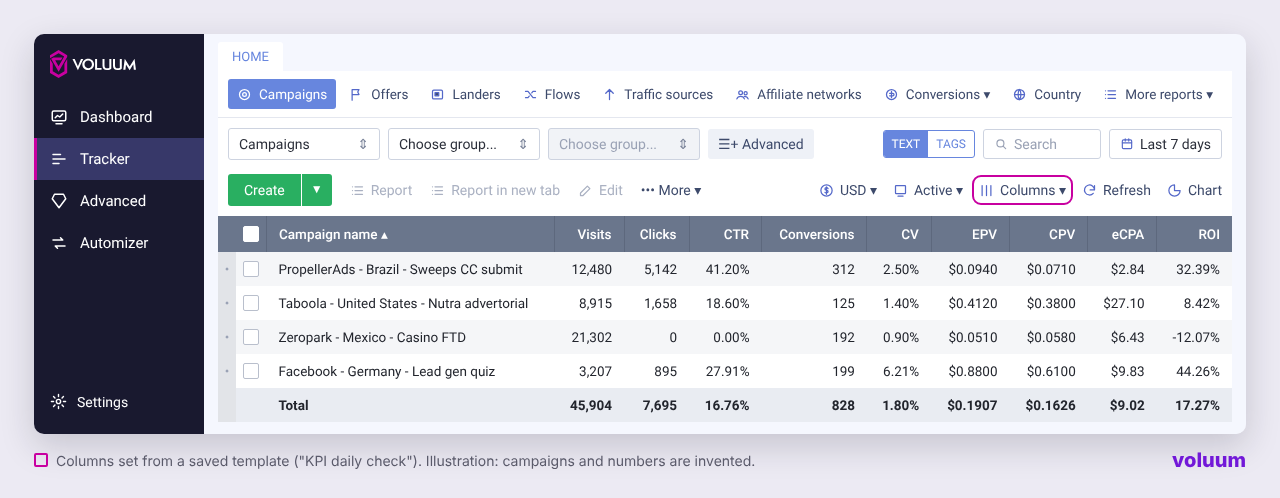
For metrics Voluum doesn’t calculate out of the box, such as registration-to-FTD rate, create a custom column from your custom conversion types and add it to the same template. Templates are saved per user, so everyone on your team can keep their own view.
Then let the dashboard come to you. Scheduled reports can email your KPI view every morning, and automated rules can pause a placement when eCPA climbs above your payout, before you’ve even opened your laptop. If you’d rather ask than click, Voluum MCP lets you ask an AI assistant which campaigns dropped below break-even yesterday.
Which attribution model sits behind these numbers matters too. If you’re unsure how Voluum credits each conversion, our explainer on attribution models covers it.
Track the KPIs That Pay the Bills
Fifteen affiliate marketing KPIs, one rule: every metric is only as good as the tracking behind it. Voluum calculates all of them from click-level data, puts every traffic source in one report and lets you act on the numbers automatically. Compare Voluum plans and start tracking.
Frequently Asked Questions
What are the most important affiliate marketing KPIs?
The most important affiliate marketing KPIs are EPV and CPV for daily decisions, conversion rate to judge the funnel, eCPA against your payout for break-even, and ROI and profit for the overall result. iGaming affiliates should add registration-to-FTD rate, cost per FTD and player lifetime value.
What is a good EPC in affiliate marketing?
A good EPC is one that’s higher than your cost per click, because that’s the point where each click becomes profitable. Network EPCs are useful for comparing offers, but they’re calculated from other affiliates’ traffic, so your own EPC on your own traffic is the number to trust.
What is the difference between EPC and EPV?
EPC divides revenue by clicks, and EPV divides revenue by visits. In Voluum, a visit is a landing on your lander or offer, and a click is a move from the lander to the offer. EPV is easier to compare with your cost per visit, which makes it the more practical metric for daily optimization.
How do you calculate ROI in affiliate marketing?
Subtract your cost from your revenue, divide the result by your cost and multiply by 100. For example, $450 in revenue on $300 of spend gives an ROI of 50%. Anything above 0% is profitable, though most media buyers aim higher to cover delays and chargebacks.
What should an affiliate dashboard include?
A useful affiliate dashboard shows visits, lander CTR, conversion rate, EPV, CPV, eCPA and ROI, broken down by traffic source, campaign and offer. Add profit for the big picture and iGaming metrics like FTDs where relevant. In Voluum, you can save this set as a column template and reuse it in every report.



 Facebook
 Telegram


