

The Challenge of Fragmented Data
When you buy pop and push traffic across 15+ networks, every source reports its own version of the truth. Before Voluum, Tamhold Media judged performance network by network, using each platform’s dashboard and a set of spreadsheets. There was no single view across sources.
That gap showed up where it hurt most. Conversions from different networks couldn’t be reconciled against operator data, and there was no reliable way to tell a registration from a first-time deposit. Finding which source, GEO, or OS was losing money took days of manual work, and blacklisting zones meant repeating the same changes by hand in every network. In a business where budget burns by the hour, that lag was expensive.
Why Voluum
Tamhold Media found Voluum through a business connection, and it became the team’s first dedicated tracker. The requirements were specific to how the agency operates.
It needed S2S postbacks that could handle multiple conversion goals, so registrations and deposits could be tracked separately. It needed unified reporting across many traffic sources, so performance could be compared in one place. And it needed a platform that holds up under high pop volume without slowing the team down. Voluum met all three, and moving from spreadsheets to a single real-time source of truth changed how quickly the team could make decisions.
What Changed in Practice
The clearest shift was speed. Optimization that used to take days of reconciliation now happens the same day. With 15+ sources running at once, live reporting lets the team cut losing sources and scale winning ones before the budget is gone.
Multi-goal postbacks changed what the team optimizes for. Tamhold Media tracks registrations, FTDs, and qualified FTDs as separate goals, so budget follows revenue events rather than signups. The same setup let them meet a traffic partner’s requirement to run a managed buy on a qualified-FTD basis.
A qualified FTD is a first-time deposit that meets conditions agreed with the operator, typically a minimum deposit amount and sometimes a level of betting activity. Not every first deposit comes from a player who sticks around, and the qualification filters out the smallest, lowest-value ones. That makes qualified FTDs a closer signal of real player value, and in many CPA deals they are the event that actually gets paid. Tracking them as their own goal shows Tamhold Media which sources bring players who deposit meaningfully, not just players who deposit once.
Drill-downs also exposed leaks the team had missed. A full portfolio breakdown surfaced a traffic source spending with no return, and a GEO where the operator’s payment rails were failing, so users could register but not deposit. Both were cut within a day. Device and OS data showed which platforms converted best, so campaigns were split by device and budget moved accordingly. At the zone level, the team exports data and applies visits-per-signup thresholds to build blacklists and whitelists for every network from one source of truth. Workspaces give partners access to what they need without exposing the whole account.
The World Cup campaign
The real test came with the 2026 World Cup. Tamhold Media treated the first three weeks as a testing phase, running pop-under traffic in a core LATAM market to find which sources delivered depositing players. Using live reports and FTD-level postbacks, the team cut non-converting sources and zones daily and moved budget to proven ones. By late June the structure was in place, and the team scaled through the knockout rounds into the final on 19 July.
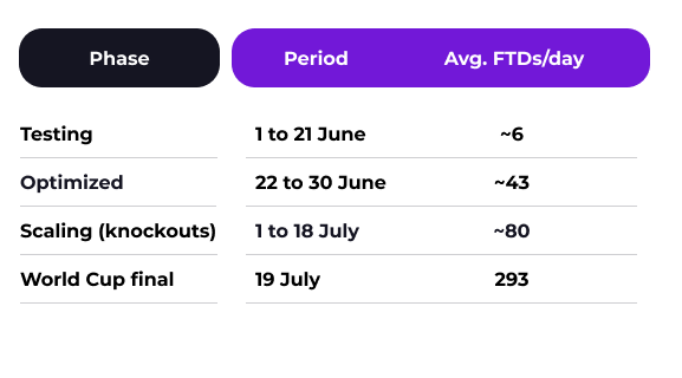
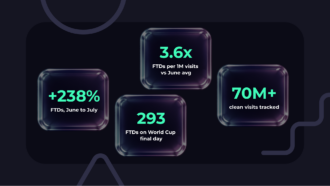
Final day was the campaign’s peak. It delivered 293 FTDs, more than half of the entire June total, along with 3,804 signups from 2.48M visits. FTDs per million visits reached 118, 3.6x the June average, and signup-to-FTD held at 7.7%. Peak traffic converted better, not worse.
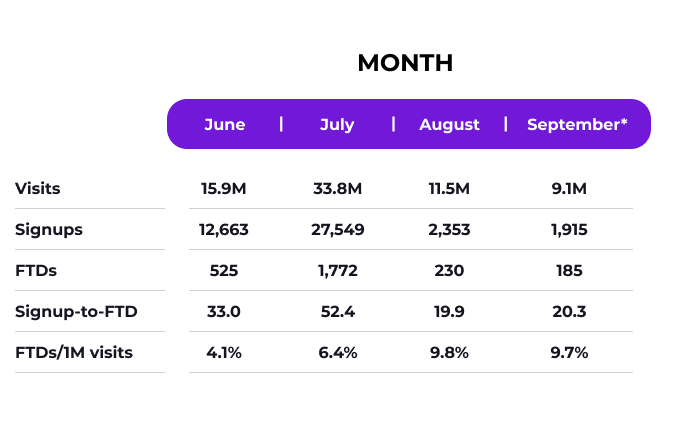
Across the campaign, FTDs grew 238% month over month, from 525 in June to 1,772 in July. Visits more than doubled (+113%) while FTDs per million visits rose 59%, so efficiency improved as volume grew. After the final, the team cut volume to its strongest sources, and signup-to-FTD settled at around 9.7% in August and September, more than double the June baseline. Over 70M+ tracked visits, every month passed Voluum’s anti-fraud checks as clean.



 Facebook
 Telegram


